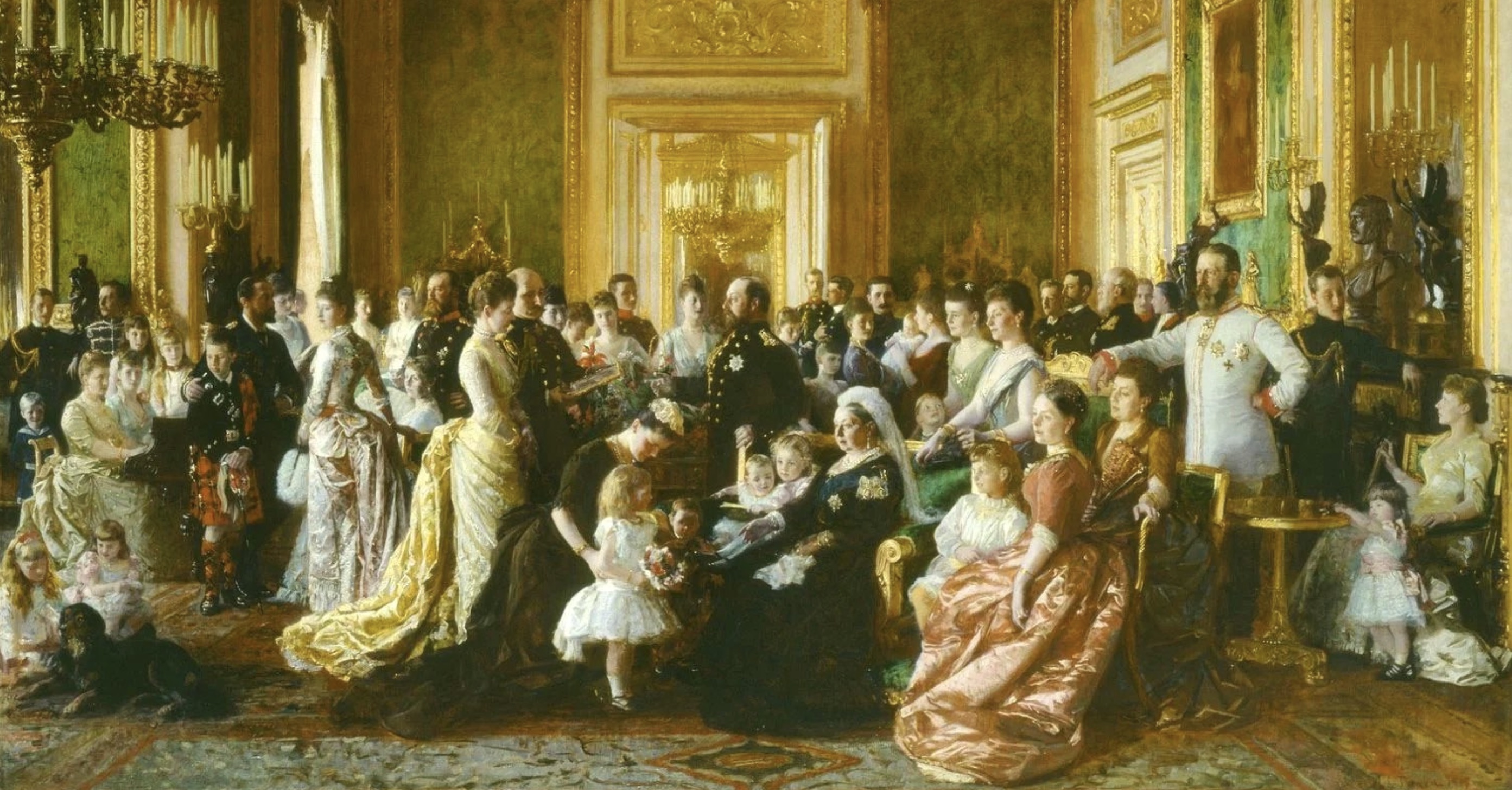
Hemophilia is as old as the humanity, but it has never had a direct influence on the affairs of a nation. This was until the disease mysteriously appeared in descendants of Queen Victoria, “the grandmother of Europe”, successively touching the heirs to the throne of Russia and Spain. In particular Alix of Hesse and Victoria Eugenie of Battenberg, granddaughters of the English queen (and also second cousins through German kinship), who had to face not only a personal and human drama, but a dynastic tragedy with various reflections, especially for the first, in the vicissitudes policies of their adoptive countries.
Thank You to Antonio Orefice for sharing this article with us!

On April 7, 1853, the Queen gave birth to her eighth child and a notable innovation in the field of obstetrics made royal birth exceptionally interesting: a famous Edinburgh anesthetist was called to administer chloroform to Her Majesty. The bitter battle between those who believed blindly in the new sedative and those who opposed the use of it suddenly subsided thanks to the intervention of the Queen. After having painfully given birth to seven children,Victoria never tires of praising “this blessed chloroform”. It is a great gift given by the sovereign to her people: “the refusal to accept the pains of childbirth as a destiny of women willed by God”. Unfortunately, the baby born into the world on this auspicious occasion is suffering from a very serious and incurable disease: haemophilia.

Hemophilia is a blood coagulation disorder, transmitted via females according to Mendel’s law of recessive characteristics linked to sex, which causes abnormal bleeding due to the absence of a coagulation factor whose synthesis is encoded precisely on the X chromosome. The woman is the healthy carrier of defective genes, she is almost never affected by the disease which, with rare exceptions, affects only males, without however necessarily affecting all males of the same family.

At the time of her wedding to her first cousin Prince Albert of Saxe-Coburg-Gotha, Queen Victoria certainly did not know that she was a healthy carrier. The discovery of Prince Leopold’s illness , upsets her: “in our family there has never been this disease”, she says on several occasions, and in fact, no case of hemophilia can be traced in the family tree of the British royal house. On the other hand, however, the documents may be inaccurate, or those who had been affected by this disease may have died while dying in childhood, as often happened among children at the time. Another explanation of the phenomenon is that the defective genes could have remained latent for same generations, but according to scholars the most probable source of the disease is to be found in a spontaneous mutation that took place in the genetic heritage of the Queen or in the X chromosome passed on to her by her father. A fact that is not entirely rare, and current research has also confirmed that at least 30% of hemophiliacs owe their condition to a spontaneous mutation (due to environmental factors, radiation, medicines) in the parents’ genetic heritage. Recently some researchers have also hypothesized the illegitimate birth of Queen Victoria, who would have received the defective gene from a father who was not the Duke of Kent.

In addition to the sick son, two of her five daughters were certainly healthy carriers: Princess Alice, wife of the Grand Duke Ludwig IV of Hesse, and Princess Beatrice, wife of Prince Heinrich of Battenberg. According to some sources, even the eldest daughter of the Queen, Victoria “Vicky”, the Princess Royal, wife of the future Emperor Friedrich III of Germany and mother of Kaiser Wilhelm II, may have been a healthy carrier, but there is little information on the matter, especially because at the time, the tendency was to keep quiet about the health of members of the royal house. The only certainty is that two of Vicky’s sons: Sigismund and Waldemar, died, the first at two, the second at eleven, for unspecified reasons (haemophilia, again according to Lady Longford) and that none of her daughters (Sophia, wife of King Constantine I of Greece, will be grandmother, among others, of Queen Sofía of Spain, of King Michael of Romania and of Prince Amedeo of Savoy, Duke of Aosta, while Margaret, wife of the Landgrave of Hesse-Kassel, will be the mother-in-law of Princess Mafalda of Savoy) transmits the disease to their offspring. Queen Victoria’s third daughter, Princess Helena, married to Prince Christian of Schleswig-Holstein has two healthy sons and two childless daughters, while the Queen’s fourth daughter, Princess Louise, marries the Duke of Argyll and has no heirs.

Prince Leopold’s hemophilia was evident from early childhood: he developed bruises and swelling around his joints. Despite his illness, the Queen tried to give her youngest son a normal life, but it wasn’t always possible. At the age of ten, Leopold was entrusted with the task of watching over his German nephew Wilhelm, the future Kaiser, during the wedding of his brother, the Prince of Wales, to Princess Alexandra of Denmark. Restless and short-tempered, the boy bit his uncle on the leg. There were no consequences, but the Queen was deeply concerned. Leopold, crippled partly by his illness, which had permanently damaged his knee, and partly by the Queen, who always wanted to keep him out of harm’s way, had only one thing in mind: trying to rebel against her august mother’s authority. The prince refused a vacation at Balmoral, disappeared for two weeks in Paris, and insists on getting married at all costs. Victoria does her utmost, but in the end, she herself suggests the name of a possible bride, Princess Helena of Waldeck and Pyrmont, convinced that her son deserves a normal life in any case. Moreover, neither she nor the doctors treating the prince consider the hereditary nature of the disease. Yet Leopold’s sister, Alice, had already given birth to a hemophiliac son, Frederick, who died at the age of three from internal bleeding caused by a fall. The gene for the disease is present on the X chromosome, and this is sufficient to know that Leopold will make all his future daughters carriers, but will only give birth to healthy sons. Indeed, his only daughter, Alice, later Countess of Athlone, would have hemophiliac children, while his son Charles Edward, born in perfect health shortly after his father’s death, would inherit the Duchy of Saxe-Coburg-Gotha from his uncle Alfred. He would lose the throne in 1918, become a fervent supporter of Nazism, and, before dying at nearly seventy in 1954, become the maternal grandfather of the heir to the throne of Sweden, now King Carl XVI Gustaf. Leopold, Duke of Albany, died at the age of 31 while on holiday in Cannes: a simple fall caused an unstoppable cerebral hemorrhage. The Queen was devastated, but her reaction was typical of her pragmatic nature:
“We could not mourn dear Leopold; he was so greedy for everything he could not have, a desire that seemed to increase rather than diminish with the years.”

Prince Leopold was the uncle of the Tsarina of Russia (née Princess Alix of Hesse) and the Queen of Spain (née Princess Victoria Eugenie of Battenberg). The Tsarina is the sister of little Frederick (who died at the age of 3). Their sister Irene (wife of their cousin Prince Heinrich of Prussia, son of their aunt Vicky), gives birth to two haemophiliac children out of a total of three: the youngest (also named Heinrich after his father) dies in four years, a few months before the birth of his cousin the Tsarevich, while his brother Waldemar, despite the extreme frailty due to illness, reaches the age of 56, marries, but has no children. But if in England and Germany the illness of the royal princes has no direct consequences on the succession to the throne, the same cannot be said for Russia, where the hemophilia of the heir to the throne has a decisive influence on the fate of the imperial family and of the nation.

“The Tsarevich’s illness cast its shadow over the entire last period of the reign of Nicholas II and is the only explanation for it. It was without seeming it, one of the primary causes of his downfall, as it allowed the Rasputin phenomenon and led to the fatal isolation of the rulers, who ended up living in a world apart, enclosed in a tragic anguish which moreover they had to hide from the eyes of all. Without Rasputin there would have been no Lenin”

Orphaned at the age of six, Alix was raised by her older sister Victoria (future grandmother of Prince Philip, Duke of Edinburgh), under the supervision of her English grandmother who often welcomed them to Windsor, Osborne and Balmoral. Beautiful, tall, with magnificent tawny hair and blue eyes, Alix is very sensitive, but also cold, shy and tends to isolate herself from the world. The German princess meets Nicholas (her second cousin), heir to the throne of Russia, when she, still a girl, attends the wedding of her sister Elizabeth with the Grand Duke Sergei, brother of Tsar Alexander III and uncle of Nicholas. The fantasy of this sad and introverted girl lights up and from that moment she will dream (reciprocated) of marrying the then Tsarevich. Born into the Lutheran religion, Alix embraces the Orthodox faith (becoming Alexandra Feodorovna) at the time of wedding, and for her this is the only reason for doubt and perplexity, she certainly does not think of the “dowry” that is carried in her blood. In 1894, the year of her engagement and , the princess had already lost a brother, a sister and an uncle to her haemophilia, furthermore her sister Irene had already given birth to two haemophiliac children. But no one raises doubts about the matter; Tsar Alexander III and Tsarina Maria Feodorovna are strongly against this union, but only for political (a German princess would not be well regarded in Russia) and character reasons. To fully understand the reasons for this “unconsciousness” it is necessary to explain that Queen Victoria herself never seemed to fully understand the hereditary nature of the evil to which she herself had given so much diffusion; hemophilia was considered one of the many risks of marriage and procreation. At the time, all royal families had many children and that one of two died at an early age was considered, if not normal, at least natural. At the time of the marriage of the future Tsarina of Russia, the Queen of England raises political and character objections, certainly not medical and genetic ones. Alix is judged by her grandmother to be emotionally too fragile and unprepared for a difficult country like Russia.

Shy enough to become cold and unfriendly, after the birth of Alexei, the Tsarina isolated herself more and more. Disliked by the brilliant Russian aristocracy, who reproached her for exaggerated moralism, distant from the imperial family with which she has bad relations, in open antagonism with her mother-in-law, the brilliant and lively Maria Feodorovna (née Princess Dagmar of Denmark), isolated from the people and from reality of a country she fails to understand, Alix lives in her own world. The Tsarina soon withdrew into herself to pour all attention and affection on her husband and children. In the first eight years of marriage Alix gives birth to four beautiful girls: Olga, Tatiana, Maria and Anastasia, one disappointment after another because Tsar Paul I, out of hatred for his mother Empress Catherine, reinstated the Salic law , which excludes women from the throne. Alexei, born in 1904, is for the empress the culmination of ten years of marriage, it is God’s blessing on the Tsar and on Russia, it is concrete proof that her fervent prayers have been heard and her vows fulfilled. Alix is the happiest and proudest of mothers, the baby is beautiful and lively, but a hemorrhage from the navel, when the baby is only six weeks old, puts the Tsar and Tsarina in front of a much sadder and more painful reality: the Tsarevich is haemophiliac. The tragedy, completely unexpected, annihilates the Empress, until then delirious with joy. But is it possible that Alix, surrounded everywere by hemophilia, hadn’t thought about the possibility of having a sick child? Why does the discovery of her son’s illness hit her with such violence? Alix has sick relatives everywhere and the suspicion of her should have touched her, but no, the Tsarina blames her fate, but begins to macerate in guilt, vaguely aware that she is responsible for the transmission of the disease.

Did Nicholas know about the illness afflicting her family? Was he aware that the uncle, brother, and nephews of the woman he loved and married were hemophiliacs? Perhaps so, but his diaries and letters reveal nothing of this, and he likely didn’t give the matter much importance, unlike the other husbands of Queen Victoria’s daughters and granddaughtes, that is almost all the sovereigns of Europe. Alix had been asked to marry her cousin Eddy (the Duke of Clarence and Avondale, heir to the British throne), and no one in the family had opposed it. However, the Tsar accepted the reality with a resigned but not desperate fatalism: Alexei would be raised as an heir, and only his closest relatives would bear the burden of this anguish and this secret. The Empress began her painful journey at her sick son’s side. A son who, in times of crisis, cries out in pain she can in no way alleviate. The strain on Alix is tremendous; the nights spent watching over her son exhaust her, and her only comfort is the religion. At the age of three and a half, Alexei receives a blow to the face, and the swelling is so severe that both eyes remain closed. Hemophilia causes the child excruciating pain, and if the bleeding occurs in a joint, it prevents him from moving for a long time. Once the blood enters the joint, it has a corrosive effect on bone, cartilage, and tissue. Furthermore, hemophilia is a deceptive disease: Alexei is fine for weeks, months, then suddenly attacks. In 1912, the Tsarevich was eight years old, and while boarding a small boat, he took a nasty fall, suffering a hematoma in his groin that resolved within a few days. Unfortunately, it’s a false recovery: it’s only the beginning of a nightmare that lasts several weeks and a crisis that brings the heir to the throne of all Russia to the brink of death. The child screams in despair, but neither the doctors nor his mother can do anything. After days and days spent beside her son, without food or sleep, the Tsarina asks a seer monk to pray for the child’s salvation. The following day, the bleeding stops. For Alix, it’s a miracle: God has had mercy on her and her son, because a saint has prayed for them, that saint is Grigori Rasputin. In reality, it’s just a coincidence: the monk fired the doctors treating the Tsarevich and prescribed him acetylsalicylic acid (aspirin), which is a painkiller and also a blood thinner.

For the imperial family it is the beginning of the end. The Empress of All Russia, whose mind is dominated only by her son’s illness, becomes blind and deaf to everything that is happening around her. Only one man has her unconditional trust, the one who manages to appease his son’s suffering: Rasputin. An attitude Alix’s was viewed with fear and apprehension even within her closest family. Her nephew Lord Louis Mountbatten (war hero, last viceroy of the Indies, uncle of Prince Philip, Duke of Edinburgh, assassinated by the IRA in 1979) remembers that his mother Victoria often said: “that crazy lunatic Alix will start a revolution”, but despite the close bond between them and her frequent visits to Russia, she is unable to do anything. The conversation between the Tsarina and her sister Elizabeth (the widow of Grand Duke Sergei, who after the murder of her husband, had founded a monastic order) is of no use, if not to definitively freeze already tense relationships.

Alexei is not a hemophiliac like everyone else, he is first of all the heir to an empire that extends from Poland to the Pacific Ocean, he is the symbol of the dynastic continuity of a family that has dominated an immense territory for three centuries. Uncertainty for the future is added to the drama of the disease: a Tsarevich continually threatened with death and unable to live a normal life, is of no help to an autocratic monarchy like the Russia. But for Alix the possibility that her son could being discarded from the succession does not exist: Alexei is the heir by God’s will and she will do everything so that in due course he can access the throne, despite haemophilia. For this reason the Tsar and Tsarina choose the path of silence and secrecy. Very few are aware of the child’s real health conditions and the seriousness of his illness. Only intimates know that Alexei will never heal. But that wall of secrecy only makes things worse, exposes the family to all kinds of malicious rumors, undermines the respect of the nation and the Empress. The Russians totally unaware of the Tsarevich’s illness, never understood the nature of Rasputin’s power and unaware of Alix’s drama, they attributed his detachment to an antipathy towards Russia and her people. The silence on the Tsarevich’s illness involved a large number of people, but it was acquitted and impenetrable and not knowing the Tsarina’s pain and desperation, no one was willing to forgive her coldness, her lack of availability towards others and her bond with Rasputin. With the outbreak of war ,increased by her German birth, the hatred could only increase dramatically. It would be simplistic and simplistic to say that Alexei’s hemophilia was the cause of the October revolution, but it is certainly true that the Tsar, already weak and uncertain by nature, becomes, over the years, more and more dominated by a wife devastated by the disease of a son and from feelings of guilt for having passed it on to him. Alix sometimes does not listen to anyone, not even the most enlightened members of the imperial family. For her there is only Rasputin, to whom she asks for her first to save her son and then to help her keep intact all the power of the Tsar. Thus Rasputin, an unlikely miracle worker for an incurable disease, becomes the moral and political guide of a woman who is unreasoned by pain and of a man who is too weak to oppose and react.

By a strange twist of fate, a few years after the fall of the tsarist empire, another kingdom is also wiped off the map of Europe. And also in Spain the disease arrives through Queen Victoria. Princess Victoria Eugenie of Battenberg, daughter of Beatrice of the United Kingdom, has two haemophiliac brothers (Leopold and Maurice) and in 1906, at the time of her wedding with the King of Spain, the haemophiliac children of her cousins Irene and Alix were already born. However, this does not prevent the madly in love Alfonso XIII, whose genetic heritage is already burdened by the damage of many marriages between blood relatives, from asking for her hand in marriage.

No one has ever been able to explain why Alfonso XIII is so determined to find himself an English and Protestant wife. The sovereign visits England for the first time in 1905 and is fascinated by the country, by his King ,the brilliant Edward VII, and by the many granddaughters of the recently deceased Queen Victoria. With Princess Patricia, daughter of Prince Arthur, Duke of Connaught, he has no success, but when he meets her cousin, Princess Victoria Eugenie of Battenberg, called Ena, it is love at first sight. The beautiful young princess has a german name, but she is English as well as in appearance also in manners, education and habits. Unfortunately the history, culture and traditions of Spanish royal family (as well as the strong oppositions of the Queen mother Maria Cristina, more inclined to look towards her native Austria) are already a huge obstacle to this wedding project. Not to mention the foreign powers, Germany in the lead, who fear a rapprochement between Spain and England. But Alfonso, to the enormous satisfaction of King Edward VII, who is in fact trying to favor an Anglo-Iberian alliance, is very much in love and above all is used to getting immediately everything he wants.

To favor the nascent idyll and to allow the two young people to get to know each other a little better, outside the constraints of the court, it was decided to send Princess Victoria Eugenie and her mother to Biarritz, a French city, which however being a few kilometers from the Spanish border, she could be reached by Alfonso XIII often and in “secret”. After a month of courtship, the Spanish king finally asks for Ena’s hand and is joyfully accepted. Edward VII would have tried to warn the Spanish sovereign about the possibility that Victoria Eugenie was a healthy carrier, but Alfonso, madly in love with her, does not listen to anyone. On the other hand, England talks as little as possible about hemophilia and perhaps only a very small circle of people are aware of the disease. In 1922, when the Duchess of Albany, widow of Prince Leopold, Queen Victoria’s haemophiliac son (and Ena’s aunt), died, the Times wrote recalling the husband of the deceased:
“The Duke of Albany, who had always been in good health delicate, died suddenly in Cannes…”.

After almost 40 years (Leopol died in 1884) a veil of secrecy still shrouded the disease. Unfortunately, the fears prove to be well founded, Victoria Eugenie is, like her cousin the Empress of Russia, a healthy bearer of evil which does not take long to arrive on her descendants. The haemophilia of Don Alfonso, Prince of Asturias, born in 1907, came to light after his birth, when the doctors proceeded with the traditional circumcision. The sovereign is shocked by this blow of fate, but the tragedies for the royal family are not over: a year later Jaime is born and she soon discovers that he is deaf-mute. Haemophilia also affects two other children of the couple: a stillborn child and the youngest, Infante Don Gonzalo. The only son spared from the “disease of kings” is the Infante Don Juan (the grandfather of the current King of Spain, Felipe VI) and the two females, Infanta Beatrice and Infanta Maria Cristina, are apparently healthy.

The two cousins, the Empress of Russia, and the Queen of Spain, react differently to the tragedy of their children’s illness and Victoria Eugenie’s attitude is perhaps more similar to that of her English grandmother, from whom she inherited considerable strength character. It must be said, however, that unlike her cousin the Tsarina, mother of four girls and only one boy, the Queen of Spain gave birth to two haemophiliac children and a deaf-mute (not considering the one who died in swaddling clothes). Queen Victoria’s steadfastness towards her sick son (Leopold) will never fail her, and it’s possible that it will benefit him. Victoria first of all holds him responsible for his ills, for his constant refusal to listen to the doctor. She will deny him permission to make long journeys, but in return she will assign him precise responsibilities even before the others, and she will undeniably infuse him with courage and energy. She is certainly not a woman who would have bowed to a Rasputin: the British queen has the makings of a Roman matron. There is no Rasputin at Don Alfonso’s bedside, but unlike what happens in Russia, rather than uniting the disease separates his parents. The hemophilia of the heir to the spanish throne and consequently the problem of dynastic succession, put the relationship of the sovereigns in great crisis, and in exile, they will live de facto separated. While Alix withdraws into herself for hide the drama of her son’s illness, the fragility of the heir to the throne, sinking into mysticism, Victoria Eugenie is a determined and pragmatic woman and retains her fortitude. The same fortitude that she had made her keep calm on her wedding day, when bombs had been thrown on the royal procession that had caused several deaths. She, the new Queen of Spain, doesn’t bat an eyelid and shows up at the reception with a white dress stained with blood. Unfortunately Ena lacks decisive and fundamental support, that of her husband. And from that point of view the contribution of Tsar Nicholas II was truly remarkable. Never was there a more tender and compassionate man with his wife, never before had a tsar dedicated so much time to a sick son.
“However one judges him as a ruler, the last Tsar of Russia shines a splendid light on his conduct as a husband and father,”

There is very little information on the illness, life and education of the Prince of Asturias, it seems that he never had to suffer from the devastating crises of Tsarevich Alexei. However, Alfonso is placed under continuous surveillance because his general state of health makes any effort impossible. The prince lives between Madrid and a country residence where he can devote himself to raising chickens and pigs. A “hameau de la reine” for use by a bloodless infant. Among the populace there is a rumor that in order to survive the child must drink a glass of fresh blood every morning. But what must be underlined is that in Spain as in Russia the eldest son, even if haemophiliac and very fragile, will always be considered the heir and raised as such. Spain hadn’t been a monarchy for two years now when Don Alfonso met a Cuban woman in Switzerland, Edelmira Sampedro, whom he married in 1933, automatically renouncing his rights to the throne. This marriage, which did not comply with the strict dynastic laws issued by his ancestor Charles III, resolved, so to speak, the thorny problem of succession, certainly not to a throne that no longer exists at the moment, but to dynastic leaders and the duties of head of the family. Probably aware of his limitations and of his difficulties, the Prince of Asturias anticipates his father’s decision and abandons (as his deaf-mute brother Jaime will do shortly after) the weight of the crown on the shoulders of the young, robust and very healthy younger brother Juan. Alfonso assumes the title of Count of Covadogna, dies in 1938 in Miami, USA; his car violently collides with a telephone booth and the internal bleeding that occurs is unstoppable and fatal. The Infante Don Gonzalo, the last son of Alfonso XIII is haemophiliac, but it seems to be less serious than his older brother. Born in 1914, he studied engineering at the University of Louvain and died in 1934 in Austria of internal bleeding caused in his case by an automobile accident.

With the death of the former Prince of the Asturias, hemophilia disappears from the genealogical trees of European royal families, but not from the much larger one of Queen Victoria’s descendants. Leopold’s daughter Alice, born 1883, died 1981 (as Queen Victoria’s last surviving granddaughter), wife of Prince Alexander of Teck, later Earl of Athlone (brother of Queen Mary, wife of Alice’s cousin, King George V) having inherited the diseased X chromosome she is obviously a healthy carrier and gives birth to three children, two of which are diseased males. The first Rupert, Viscount Trematon, was born in 1907 and died in 1928 in France after fifteen days of agony due to internal bleeding caused again by a minor road accident, the second son Maurice was born and died in 1910, probably haemophiliac. The only daughter, May was born in 1906 and married Sir Henry Abel Smith in 1931 with whom she had two girls and a boy, which in turn make Princess Alice seven times great-grandmother. Lady May may have inherited the diseased gene from her mother, but her son Richard is not haemophiliac, while his sisters Anne and Elizabeth may be carriers, but on the state of health of these descendants of Queen Victoria there is no news. As for the descendants of Queen Victoria Eugenie of Spain, the two hemophiliac sons who died without heirs, uncertainty remains as to what concerns the two daughters Beatrice (her grandson Paul Alexandre Weiller, son of her daughter Olimpia Torlonia, died in 1975 at 5 years for a “blood problem”) and Maria Cristina.
Thank You to Antonio Orefice for sharing this article with us!