Nine Kings, Five Queens and an Emperor led over Sixty Royals and Heads of State at the Shah of Iran and Empress Farah’s magnificent Celebrations marking the 2500th Anniversary of the Persian Empire in Persepolis, the ancient capital of the Persian Empire, on this day in 1971, 55 years ago, which had a feast of spectacular Tiaras!


Shah Mohammad Reza Pahlavi of Iran and Empress Farah held a spectacular Banquet in a splendid Hall set in the midst of a specially constructed tent city in Persepolis, with an illustrious guest list that made it one of the grandest royal events of the last century regarded the most expensive party ever held in modern history.
On 14 October, a grand gala dinner took place in the Banqueting Hall in celebration of the birthday of the Shahbanu. Sixty members of royal families and heads of state were assembled at the single large serpentine table in the Banqueting Hall.


They dined off a special dinner service of 10,000 plates commissioned from the English china manufacturer Spode, each plate decorated in turquoise and gold, with the Shah’s coat of arms. The official toast was raised with a Dom Perignon Rosé 1959. Six hundred guests dined over five and a half hours, thus making for the longest and most lavish official banquet in modern history as recorded in successive editions of the Guinness Book of World Records.


A son et lumière show, the Polytope of Persepolis designed by Iannis Xenakis and accompanied by the specially-commissioned electronic music piece Persepolis,concluded the evening.


Nine Kings, Five Queens and an Emperor led the over Sixty Royal Guests at the Celebrations:
- Emperor Haile Selassie of Ethiopia
- King Frederik IX and Queen Ingrid of Denmark
- King Olav V of Norway
- King Mahendra and Queen Ratna of Nepal
- King Baudouin and Queen Fabiola of Belgium
- The King and Queen of Malaysia
- King Constantine II, Queen Anne-Marie and Prince Michael of Greece
- King Hussein, Princess Muna, and Princess Basma bint Talal of Jordan
- Sultan Qaboos bin Said Al Said of Oman
- King Moshoeshoe II of Lesotho
- Grand Duke Jean and Grand Duchess Joséphine Charlotte of Luxembourg
- Prince Rainier III and Princess Grace of Monaco
- Prince Franz Joseph and Princess Gina of Liechtenstein
- The Duke of Edinburgh and the Princess Anne
- Crown Prince Carl Gustav of Sweden
- Prince Bernhard of the Netherlands
- Prince Juan Carlos and Princess Sofia of Spain
- The Prince and Princess of Naples
- Prince Shāh Karim al-Husayni, the Aga Khan IV and Begum Om Habibeh Aga Khan
- Prince and Princess Mikasa of Japan
- Prince Moulay Abdallah and Princess Lamia of Morocco
- Prince Bhanubandhu Yugala of Thailand
- Princess Bilqis Begum of Afghanistan
- Sheikh Isa bin Salman Al Khalifa of Bahrain
- Sheikh Ahmad bin Ali Al Thani of Qatar
- Sheikh Sabah III Al-Salim Al-Sabah of Kuwait
- Sheikh of Zayed bin Sultan Al Nahyan of Abu Dhabi
- Prince Makhosini Dlamini of Swaziland


Prince Michael of Greece said:
We were discussing the jewels that the Queens were bringing to Persepolis. Queen Anne Marie said she was brining the Emeralds, which are huge Romanov Emeralds, everyone was bringing their best.”
“But I said, listen compared to what Empress Farah is going to show, they are peanuts, because she has the most important jewels on Earth”


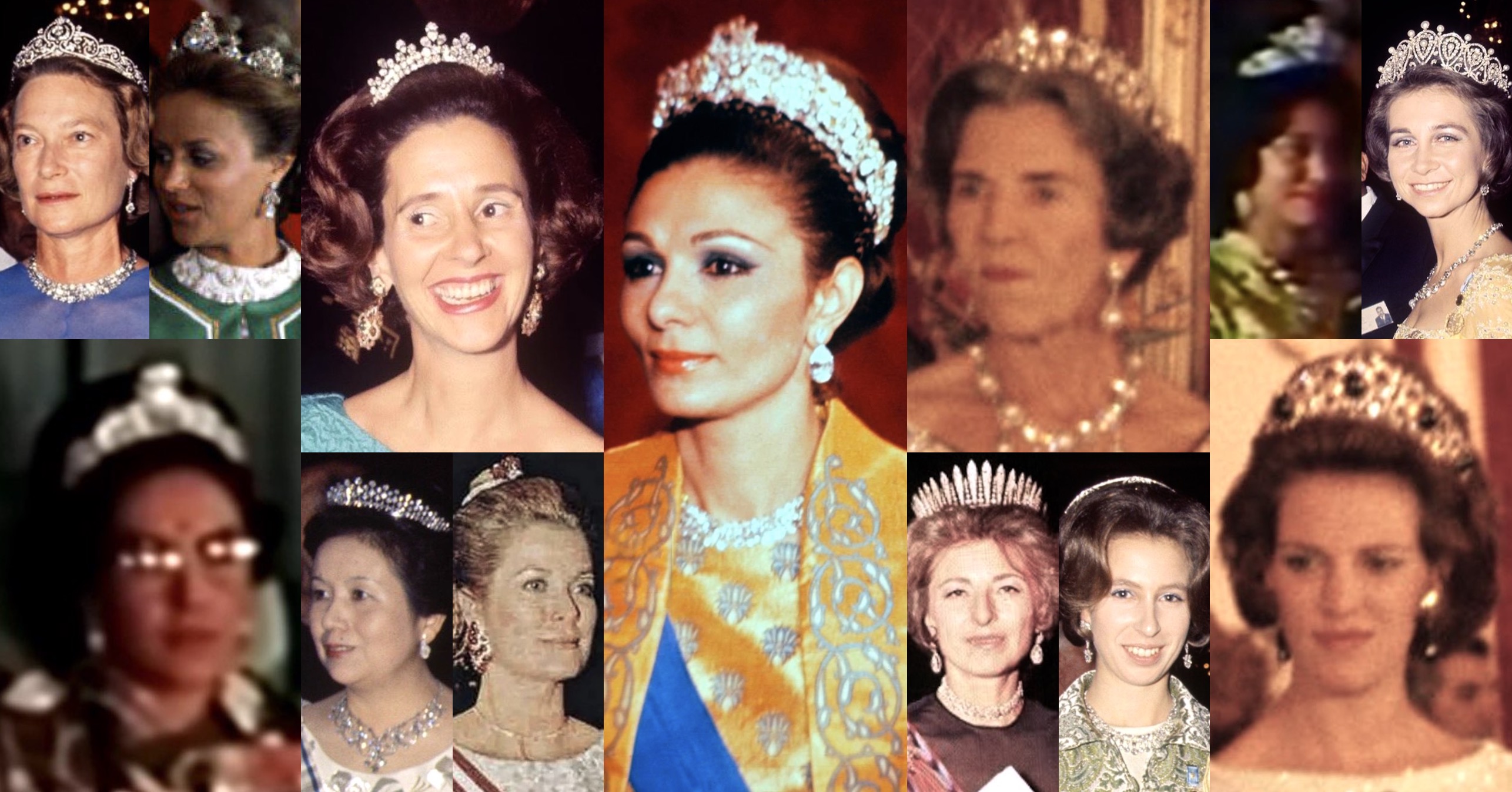
Empress Farah of Iran was wearing the Noor-ul-Ain Tiara


Queen Ingrid of Denmark wore the Danish Pearl Poiré Tiara and Parure


Queen Anne-Marie of Greece wore the Greek Emerald Tiara and Parure

Queen Ratna of Nepal was wearing the Nepalese Emerald Tiara


Queen Fabiola of Belgium wore the Wolfers Necklace Tiara

The Queen of Malaysia was in the Gandik Diraja Tiara

Grand Duchess Joséphine Charlotte of Luxembourg wore the Belgian Scroll Tiara


Princess Grace of Monaco was in a mystery Ruby Tiara


Princess Gina of Liechtenstein wore the Habsburg Fringe Tiara and her Diamond Choker

Princess Muna Al-Hussein of Jordan was wearing her Diamond Scroll Tiara


Princess Sofia of Spain wore Queen Maria Cristina’s Loop Tiara

Princess Mikasa of Japan wore Princess Itsuko Nashimoto’s Diamond Fringe Tiara and Diamond Necklace


Princess Anne was wearing Princess Andrew’s Meander Tiara and her Diamond Necklace

Princess Sara Gizaw of Ethiopia, Duchess of Harar wore her Art Deco Tiara

Princess Basma bint Talal of Jordan was in Princess Muna’s Diamond Loop Tiara


Spectacular Tiaras were also worn by the Iranian Royal Ladies.


The following day, there was a massive Parade before the Shah of Iran and Empress Farah hosted a traditional Persian Dinner in the Banquet Hall of the Tent City at Persepolis.
The next day saw a huge military parade of armies of different Iranian empires covering two and half millennia by 1,724 soldiers of the Iranian armed forces, all in period costume, followed by representatives of the Imperial Armed Forces, with a large military band, composed of military musicians and providing the music for the parade, split into two—the modern band playing in Western instruments and a traditional band wearing uniforms from different eras of Iranian history. In the evening, a less formal “traditional Persian party” was held in the Banqueting Hall as the concluding event at Persepolis.


The Shah Mohammad Reza Pahlavi of Iran and Empress Farah were joined by Foreign Royal Guests as they attended the unveiling of the new Shahyad Tower in Tehran before the Royal Guests departed.
On the final day, the Shah inaugurated the Shahyad Tower (later renamed the Azadi Tower after the Iranian Revolution) in Tehran to commemorate the event. The tower was also home to the Museum of Persian History. In it was displayed the Cyrus Cylinder, which the Shah promoted as “the first human rights charter in history”. The cylinder was also the official symbol of the celebrations, and the Shah’s first speech at Cyrus’ tomb praised the freedom that it had proclaimed, two and a half millennia previously. The festivities were concluded with the Shah paying homage to his father, Reza Shah Pahlavi, at his mausoleum.


For the duration of the festivities, the Royal Guests had stayed in a specially constructed Tent City consisting of fifty tents arranged in a star pattern around a central fountain, that allowed the royals to freely interact with each other.
The Tent City (also called Golden City) was planned by the Parisian interior-design firm of Maison Jansen on 160 acres (0.65 km2). They referred to the meeting between Francis I of France and Henry VIII of England at the Field of the Cloth of Gold in 1520. Fifty ‘tents’ (prefabricated luxury apartments with traditional Persian tent-cloth surrounds) were arranged in a star pattern around a central fountain. Numerous trees were planted around them in the desert, to recreate how ancient Persepolis would have looked. Each tent was provided with direct telephone and telex connections for attendees to their respective countries. The entire celebration was televised to the world by way of a satellite connection from the site.

Empress Farah’s Seven Emerald Tiara
Empress Farah’s Turquoise Tiara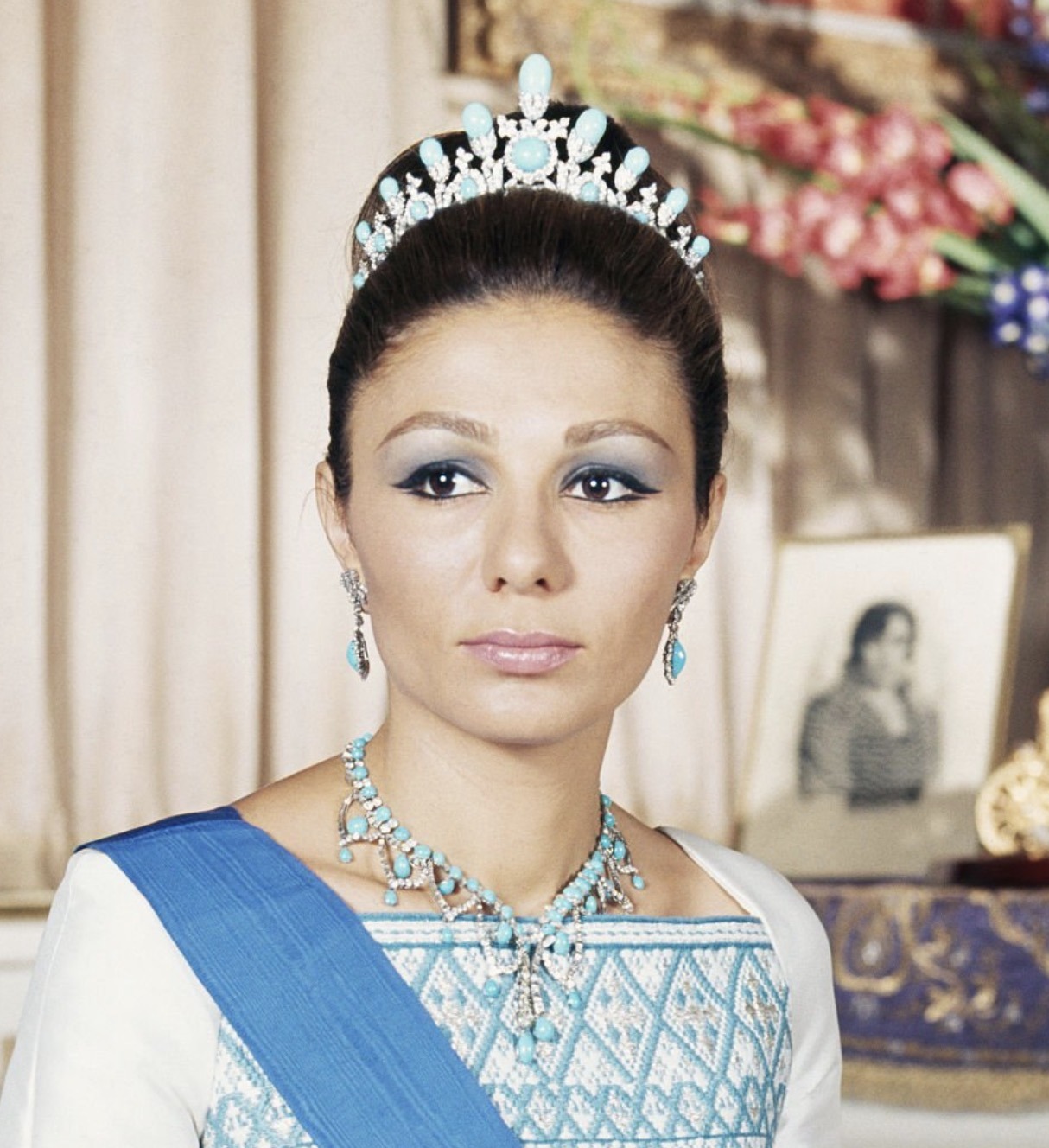
Princess Soraya’s Emerald Tiara

Empress Farah’s Art Deco Diamond Tiara


