Today marks the 135th Anniversary of the Birth of Mir Osman Ali Khan, Asaf Jah VII, the Nizam of Hyderabad, who was born on this day in 1886! The wealthiest and highest ranking of the rulers in Princely India who reigned over a territory larger than France, the Nizam is the fourth wealthiest individual of all time, today were are featuring a splendid jewel that he gifted to the Queen: the Nizam of Hyderabad Tiara!
Embed from Getty Images
But first, lets learn about the Nizam of Hyderabad! The son of the 6th Nizam of Hyderabad, Mir Osman Ali Khan was educated privately by British tutors before studying at Mayo College. He succeeded his father as the 7th Nizam of Hyderabad in 1911, at the age of 25, reigning as the semi-autonomous ruler, under the watch of a British Resident, over the largest of the over 500 states of Princely India, with a population of 16 million and an area of 223,000 km, making him the highest-ranking Prince in India, one of only five princes entitled to a 21-gun salute, and being uniquely titled ‘His Exalted Highness’ and ‘Faithful Ally of the British Crown’. The massive wealth of the Nizams of Hyderabad came from the famous Golconda mines, the world’s only supplier of diamonds for centuries, as well as over £100m in gold and silver bullion, and a further £400m of jewels. Known as the ‘Architect of modern Hyderabad’, the Nizam is credited with establishing many public institutions, including the Osmania University, Osmania General Hospital, State Bank of Hyderabad, Begumpet Airport (India’s first airport), and the Hyderabad High Court, as well as two reservoirs, Osman Sagar and Himayat Sagar. Having multiple wives, the Nizam had 34 official children, as well possibly 150 illegitimate offspring, from his 49 concubines, which caused a massive inheritance dispute among his more than 400 descendants after his death. Two of the Nizam’s sons married Ottoman Princesses, to give Hyderabad the status of the most prominent Muslim nation and inheritors of the Islamic caliphate. At the time of Indian Independence from British Rule in 1947, the Nizam refused to accede the state of Hyderabad to India or Pakistan, wanting to form an independent nation, but in 1948, the Indian Army invaded and annexed Hyderabad State, forcing him to surrender. Allowed to keep his titles and privy purse, the Nizam was appointed the Rajpramukh (Royal Governor and the Constitutional Head of the State) of the new Hyderabad State between 1950 and 1956, and still continued his charity work and social welfare projects. When the Nizam passed away in 1967, over one million people came out for his funeral procession, making it the biggest non-religious, non-political meeting of people in the history of India till that date.

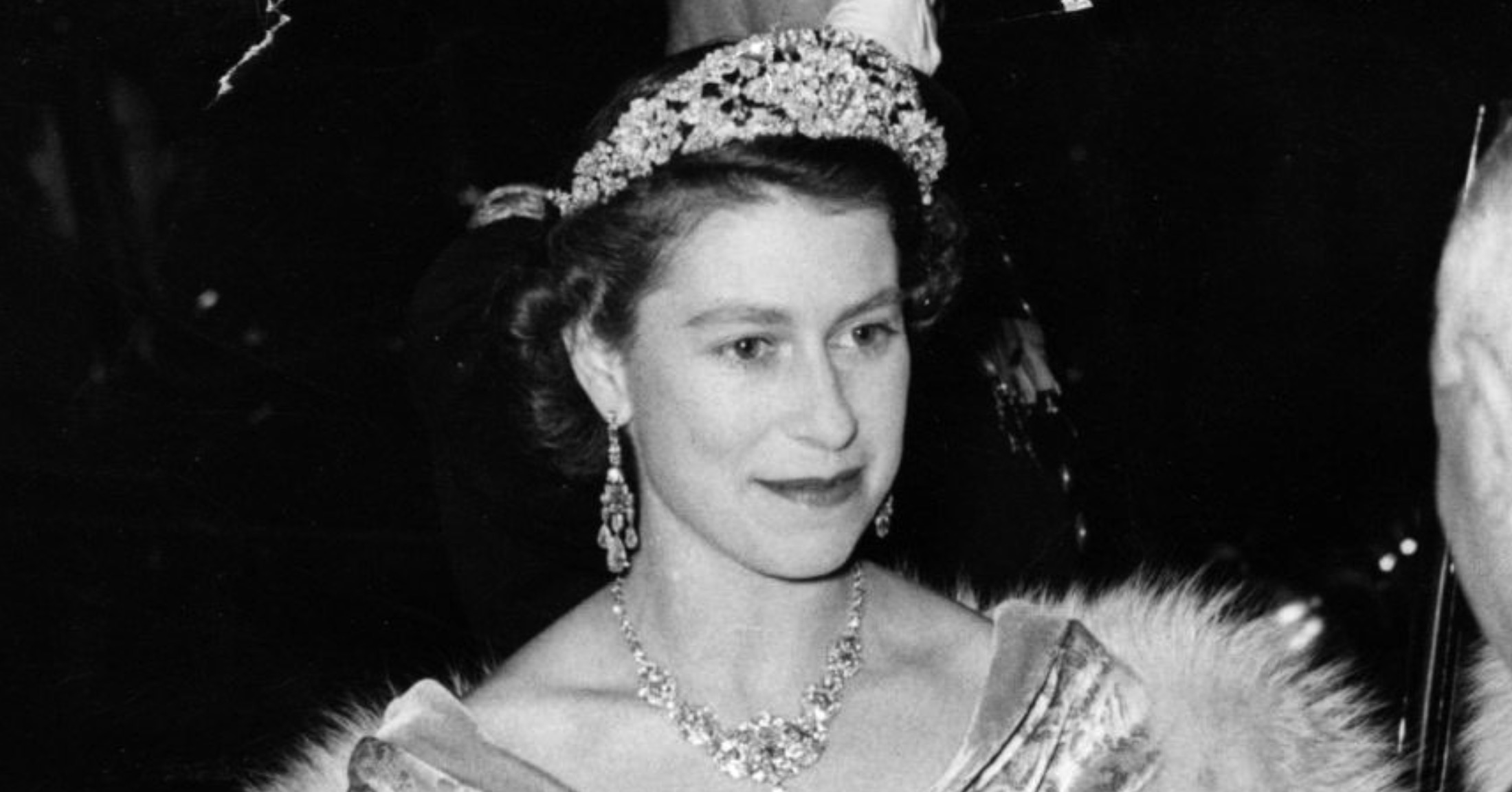
Consisting of three detachable english roses, one large and two smaller, set en tremblant in a foliate frame of leaves composed of diamonds set in platinum, this tiara was made by Cartier between 1939-1947, and the three roses could be removed, to be worn as brooches.

Ahead of the wedding of Princess Elizabeth to Prince Philip of Greece and Denmark in 1947, the Nizam of Hyderabad gave instructions to Cartier in London to allow the Princess to choose whatever she wanted as a wedding gift. In addition to this Tiara, the Princess also chose a Cartier Diamond Necklace, both of which were displayed with the Official Gifts at St. James’ Palace.


Princess Elizabeth publicly debuted the Cartier Tiara given by Nizam, paired with the Nizam of Hyderabad Necklace, and Queen Mary’s Diamond Stomacher, for a Gala Performance at the Opéra Garnier in Paris in May 1948, on her first Official Visit abroad after their Wedding.


Princess Elizabeth often wore the Nizam of Hyderabad’s Cartier Tiara in the early years of her marriage, alternating with the Girls of Great Britain & Ireland Tiara, with appearances including the State Banquet for the French State Visit to Britain in 1950 and the Return Banquet during the Dutch State Visit in 1950.


The Nizam of Hyderabad Tiara was also worn by Princess Elizabeth for the Danish State Visit in May 1951 as well as for a Dinner during the Norwegian State Visit the following month.


A few months later, Princess Elizabeth wore the Nizam of Hyderabad’s Cartier Tiara on several occasions on an extensive tour of Canada in the fall of 1951, which included the Banquet held by Governor General Lord Alexander at Rideau Hall in Ottawa, the Dinner hosted by the Ontario Government at the Royal York Hotel in Toronto, and also the Dinner hosted by the Premier and Government of Nova Scotia at the Nova Scotian Hotel in Halifax.


Following her Accession to the Throne in 1952, the new Queen wore the Nizam of Hyderabad Tiara with the Greville Diamond Chandelier Earrings as well as the Nizam of Hyderabad Necklace for the first Royal Variety Performance of her Reign, which was the last public appearance of the Tiara.


It is not known why the Queen stopped using the Nizam of Hyderabad Cartier Tiara, but she had gotten access to important tiaras that were heirlooms of the Crown and had also inherited much of the substantial collection of jewels from Queen Mary the following year. While the Queen continued to use the three diamond brooches over the following decades, in the 1970s, the Queen had the rest of the tiara dismantled to get diamonds to create her Burmese Ruby Tiara, which was confirmed by Hugh Roberts in ‘The Queen’s Diamonds’ in 2012.


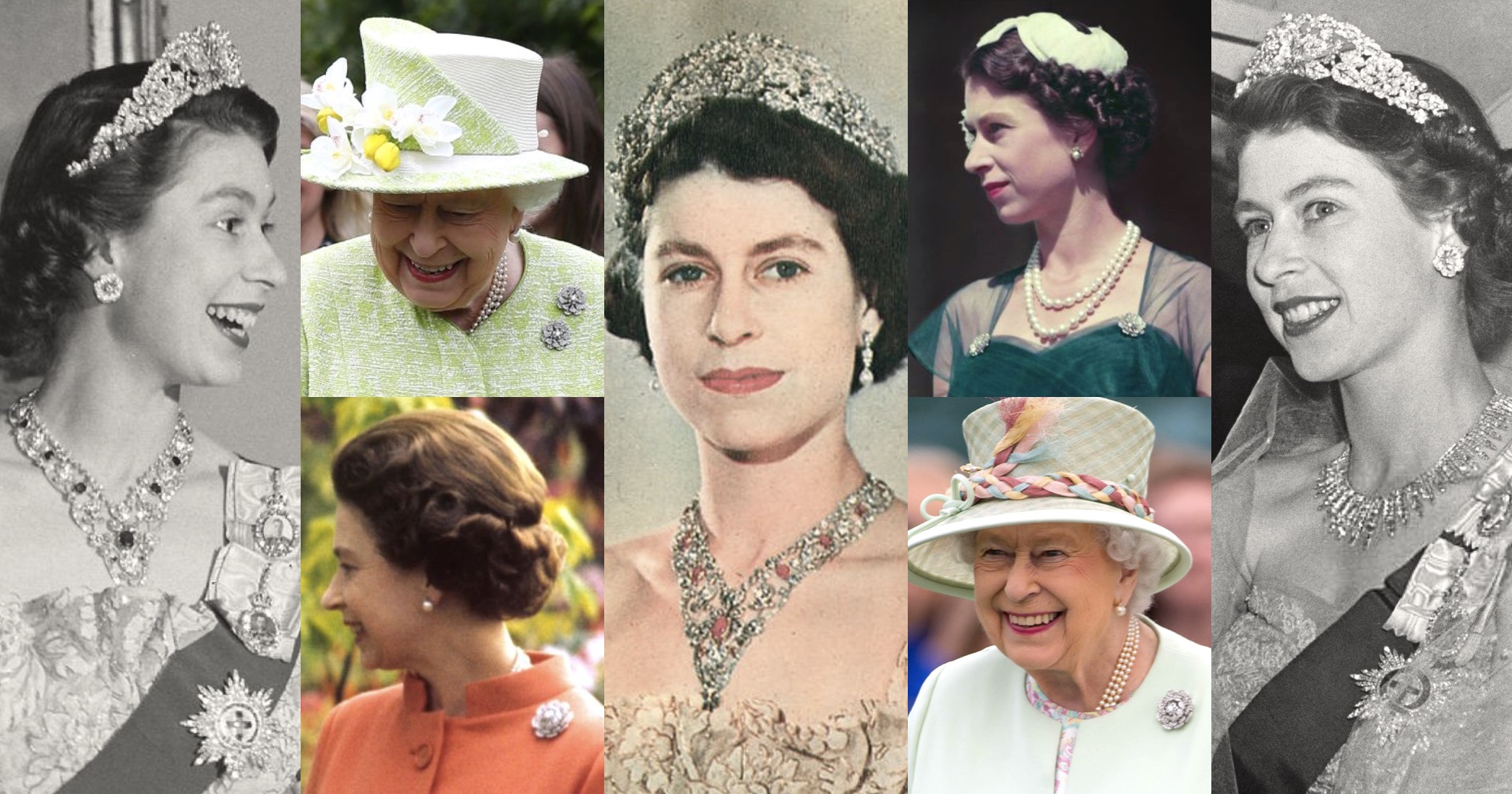
The three Diamond Rose Brooches were often worn through the decades, starting from multiple appearances during the famous Commonwealth Tour in 1953-54, up until 2021. The larger brooch was worn most often, with a couple of public appearances every year, while the two smaller brooches, always worn in a pair, were seen more rarely. Lets hope we see these Brooches worn again sometime soon!
Girls of Great Britain and Ireland Tiara
Vladimir Tiara

Queen Alexandra’s Kokoshnik Tiara
Belgian Sapphire Tiara
Burmese Ruby Tiara
Brazilian Aquamarine Tiara
Queen Mary’s Fringe Tiara
Queen Mary’s Lover’s Knot Tiara
Queen Victoria’s Oriental Circlet Tiara
Nizam of Hyderabad Tiara
Plunket Tiara
Five Aquamarine Tiara
Imperial State Crown
George IV State Diadem
Coronation Necklace and Earrings
The Cambridge Emerald Parure
Queen Victoria’s Golden Jubilee Necklace
King George VI Sapphire Suite
Queen’s Three-Strand Pearl Necklace
King George VI Festoon Necklace
Queen’s South African Diamonds
Queen’s City of London Fringe Necklace
Nizam of Hyderabad Necklace
Greville Ruby Necklace
Queen’s Japanese Pearl Choker
Kent Amethyst Parure
Queen’s Emerald Tassel Suite
Empress Maria Feodorovna’s Sapphire Choker
Greville Emerald Necklace
Queen’s Dubai Sapphire Suite
King Khalid Diamond Necklace
Pakistani Turquoise Necklace
Queen’s Jordanian Turquoise Suite
Andamooka Opal Necklace
The Queen’s Sapphires
Earrings
Greville Diamond Chandelier Earrings
Duchess of Gloucester’s Pendant Earrings
Queen Victoria’s Pearl Earrings
Queen’s Bahrain Pearl Earrings
Antique Diamond Earrings
Queen’s Pear-Drop Diamond Earrings
Queen’s Silver Jubilee Earrings
Brooches
The Cullinan Diamond
Queen Victoria’s Bow Brooches
Queen’s Williamson Pink Diamond Brooch
Duchess of Cambridge’s Pearl Pendant Brooch
Queen Mary’s Diamond Stomacher
Prince Albert’s Sapphire Brooch
Queen Victoria’s 11 Pearl Brooch
Queen Adelaide’s Diamond Brooch
Queen Mary’s Diamond Thistle Brooch
Queen Victoria’s Fringe Brooch
Queen Mary’s Russian Sapphire Cluster Brooch
Queen Victoria’s Wheat Ear Brooches
Queen Mary’s Celtic Knot Brooch
Teck Flower Brooch
Queen Victoria’s Diamond Jubilee Brooch
Maple Leaf Brooch
Queen Victoria’s Crown Ruby Brooch
Queen’s Welsh Guards Leek Brooch
Queen’s Brigade of Guards Brooch
Queen’s Cartier Gold and Sapphire Flower Brooches
Sapphire Jubilee Snowflake Brooch
Queen Victoria’s Diamond Bar Brooches
Bracelets
Queen’s Engagement Ring
Queen’s Wedding Gift Bracelet
Queen Victoria’s Diamond Bracelet
Queen Mother’s Cartier Bracelets
Regalia and Honours
Imperial State Crown
George IV State Diadem
The Coronation Regalia
Honours of Scotland
British Royal Orders
The Commonwealth Royal Orders
Royal Family Order of Queen Elizabeth II
The British Royal Tiaras
Tiaras | Necklaces | Earrings | Brooches | Bracelets | Regalia and Honours


Girls of Great Britain and Ireland Tiara
Queen Alexandra’s Kokoshnik Tiara
Burmese Ruby Tiara
The Belgian Sapphire Tiara
Greville Tiara
Delhi Durbar Tiara
Cubitt-Shand Tiara
Queen’s Five Aquamarine Tiara
George IV State Diadem
Queen Mary’s Crown
Queen Mary’s Lover’s Knot Tiara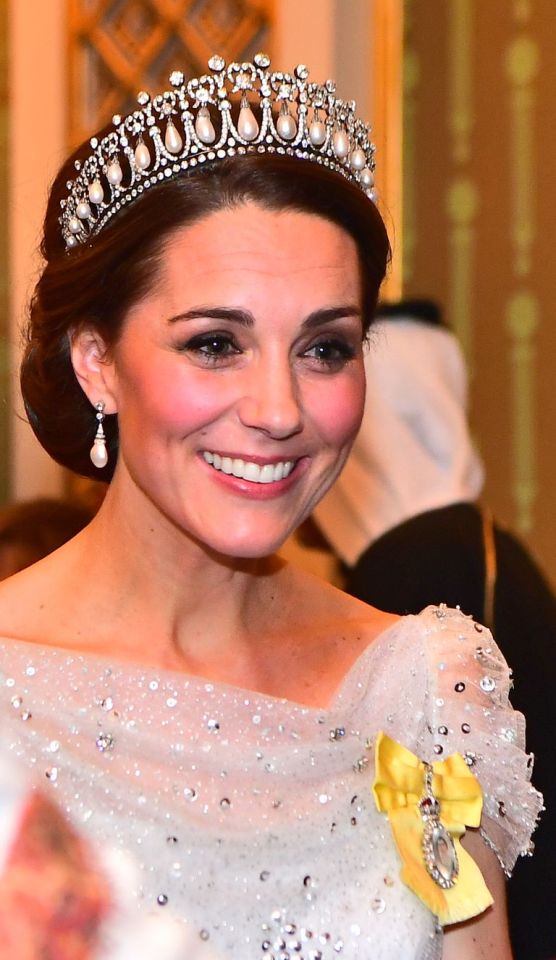


King George VI Festoon Necklace
Greville Festoon Necklace
Coronation Necklace
King George VI Sapphire Suite
Modern Diamond Suite
Diamond Serpent Necklace
Turquoise Suite
Click HERE to see the full version of this article!
The Nizam of Hyderabad Tiara: https://t.co/gExZUmYmue pic.twitter.com/XQXHUJsLzz
— The Royal Watcher (@saadsalman719) April 6, 2021

The Nizam of Hyderabad Tiara: https://t.co/gExZUmYmue pic.twitter.com/XQXHUJsLzz
— The Royal Watcher (@saadsalman719) April 6, 2021Consisting of three detachable english roses, one large and two smaller, set en tremblant in a foliate frame of leaves composed of diamonds set in platinum, this tiara was made by Cartier, and the three roses could be removed, to be worn as brooches. Ahead of the wedding of Princess Elizabeth to Prince Philip of Greece, the Nizam gave instructions to Cartier in London to allow the Princess to choose whatever she wanted as a wedding gift. In addition to this tiara, she also chose a Cartier necklace, and both were displayed with the Official Gifts at St. James’ Palace.
Embed from Getty Images Embed from Getty ImagesEmbed from Getty Images
The Nizam of Hyderabad Rose Brooches: https://t.co/gExZUnfXlM pic.twitter.com/WvXZAvRhjR
— The Royal Watcher (@saadsalman719) April 6, 2021
Embed from Getty ImagesEmbed from Getty Images
The Nizam of Hyderabad Rose Brooches: https://t.co/gExZUnfXlM pic.twitter.com/WvXZAvRhjR
— The Royal Watcher (@saadsalman719) April 6, 2021Princess Elizabeth often wore the Nizam of Hyderabad’s Cartier Tiara in the early years of her marriage, when she only had the Girls of Great Britain & Ireland Tiara as her other tiara option, though she also had the Halo Scroll Tiara and Princess Andrew’s Meander Tiara but they were never publicly worn. Notable appearences include the Return Banquet of the Dutch State Visit in 1950, a Dinner during the Norwegian State Visit in 1951, multiple appearences on an extensive tour of Canada in the fall of 1951, as well as the Royal Variety Performance in 1952, which was the last public appearance of the tiara, just a few months after she succeeded to the throne.
Embed from Getty Images
Around the time of her accession, the Queen had not only gotten access to important tiaras that were heirlooms of the Crown, but had also inherited a lot more substantial collection of jewels from Queen Mary the following year, thus it was possible for her to retire the Nizam of Hyderabad’s Cartier Tiara. While she continues to use the three brooches to this day, in the 1970s, the Queen had the rest of the tiara dismantled to get diamonds to create her Burmese Ruby Tiara, which was only confirmed by Hugh Roberts in ‘The Queen’s Diamonds’ in 2012.
The Nizam of Hyderabad Rose Brooches: https://t.co/gExZUnfXlM pic.twitter.com/WvXZAvRhjR
— The Royal Watcher (@saadsalman719) April 6, 2021
The Nizam of Hyderabad Rose Brooches: https://t.co/gExZUnfXlM pic.twitter.com/WvXZAvRhjR
— The Royal Watcher (@saadsalman719) April 6, 2021Embed from Getty ImagesEmbed from Getty ImagesEmbed from Getty ImagesEmbed from Getty ImagesEmbed from Getty Images
While the Tiara was not publicly worn after 1952, the three brooches have often been worn through the years, starting from multiple appearences during the famous Commonwealth Tour in 1953-54, up until last year. The large brooch is worn most often, getting a couple of public appearences every year, while the two smaller brooches, always worn in a pair, as seen more rarely.
Embed from Getty ImagesEmbed from Getty Images
https://www.instagram.com/p/ByxlrRxnCL3/
Embed from Getty ImagesEmbed from Getty ImagesEmbed from Getty Images
The Necklace which also came from the Nizam of Hyderabad’s wedding gift was an older stock piece at Cartier, that used to belong to the Countess of Warwick. It soon became a favourite of Princess and later Queen Elizabeth in the 1950s, and was often paired with the Girls of Great Britain & Ireland Tiara, as well as the George IV State Diadem for an iconic Official Portrait. After remaining in her jewellery box for decades, the necklace reappeared on the Queen in the 2000s, when it was worn for a variety of events and portraits. More recently, the Nizam of Hyderabad Necklace has been loaned to the Duchess of Cambridge, most prominently at the Diplomatic Reception at Buckingham Palace in 2019. (We will cover the necklace, in detail, around the time of the Duchess of Cambridge’s Birthday next January)
I don’t hate the Burmese Ruby as much as many do, but I do think dismantling this tiara was a shame. Perhaps more suitable for a princess, but so beautiful!
Agreed!
Beautiful Collection of Captures.