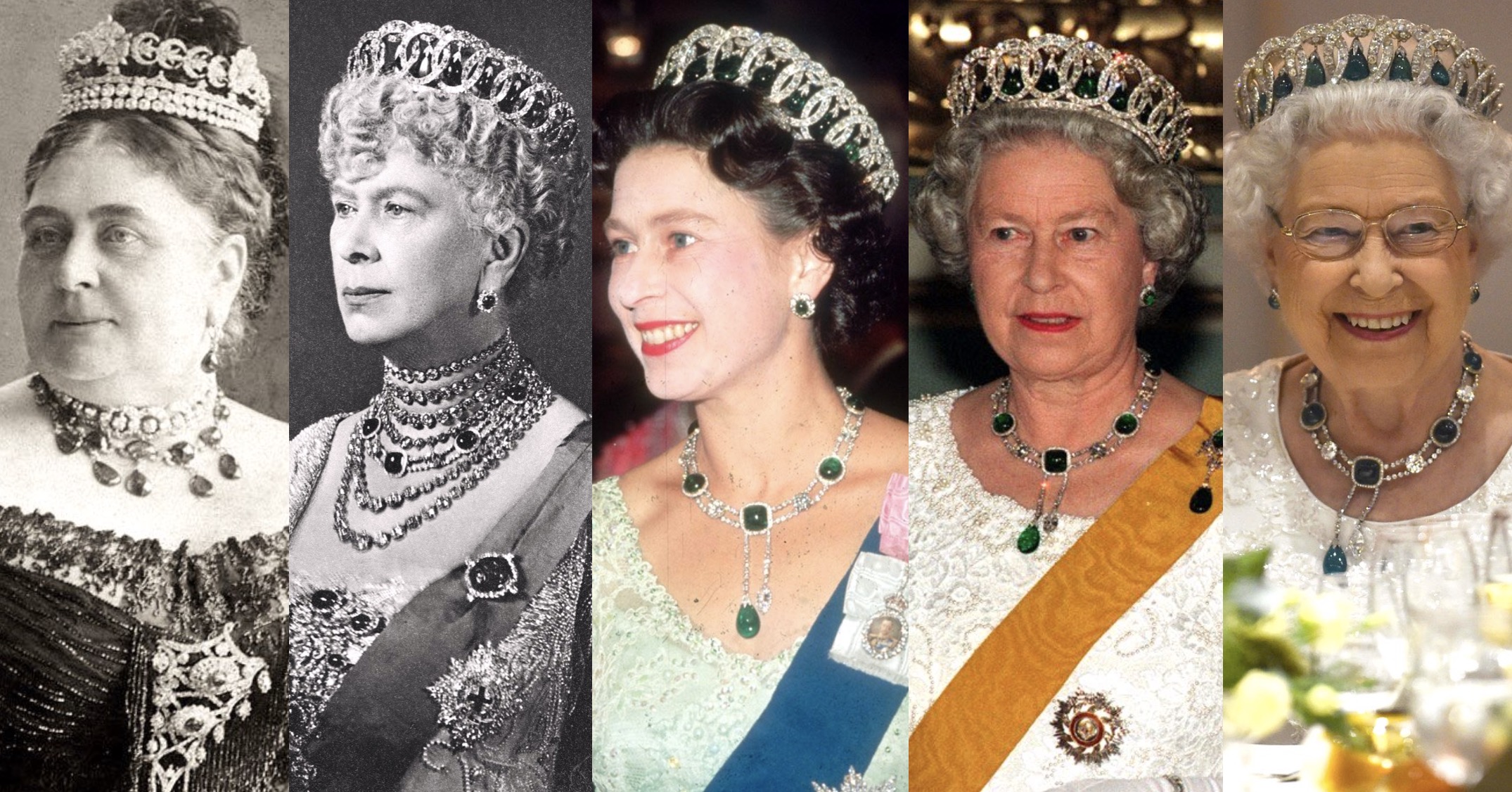
Today marks the Anniversary of the Birth of Queen Mary, the Queen’s grandmother, who was born on this day in 1867. Compiling a magnificent jewellery collection, a lot of her jewels are frequently seen on the Queen these days, and to mark the anniversary today, we are featuring some of her most iconic jewels, the Cambridge Emerald Parure.
Girls of Great Britain and Ireland Tiara | Vladimir Tiara | Queen Alexandra’s Kokoshnik Tiara | Belgian Sapphire Tiara | Burmese Ruby Tiara | Brazilian Aquamarine Tiara | Queen Mary’s Fringe Tiara | Cambridge Emerald Parure | Coronation Necklace | Delhi Durbar Necklace | George VI Festoon Necklace | Three-Strand Pearl Necklace | The Jewels of Queen Elizabeth II

In the early part of the 19th century, Princess Augusta, Duchess of Cambridge bought raffle tickets for a charity lottery in Frankfurt, and subsequently won a box that contained around forty magnificent cabochon round and pear-shaped emeralds of various sizes.

Setting some of the emeralds into a necklace and earrings, the Cambridge Emeralds were inherited by her younger daughter, Princess Mary Adelaide, the Duchess of Teck, the mother of Queen Mary, who also sometimes put some of the emeralds in her Stomacher. She left them to her son Prince Francis of Teck, who in turn left them to his mistress, the Countess of Kilmorey, in 1910, which horrified his sister, who paid £10,000 to acquire the Cambridge Emeralds, leaving just one brooch with the Countess.


Queen Mary used the Cambridge Emeralds in a new Parure she had commissioned for the Delhi Durbar of 1911, consisting of a necklace, earrings, stomacher, brooches, and bracelet, also putting some of the pear-shaped Emeralds on top of her Delhi Durbar Tiara. The Delhi Durbar Necklace is composed of nine of the Cambridge Emeralds alongside the Cullinan VII Diamond, and six large diamonds.


Queen Mary wore the Cambridge Emerald Parure on numerous occasions and portraits, usually layering the Delhi Durbar Necklace with her Art Deco Emerald Choker.


A few years later, Queen Mary adapted the Vladimir Tiara to be worn with the Cambridge Emeralds, which she also later put on top of her Diamond Bandeau, and was often pictured wearing the full Delhi Durbar parure on numerous occasions throughout the 1920s and 1930s.


After Queen Mary’s death in 1953, the Cambridge Emeralds were inherited by the Queen, and whenever she wore the emerald-version of the Vladimir Tiara, it was almost always paired with the Delhi Durbar Necklace. After being debuted on the Commonwealth Tour in 1954, the Queen wore the Delhi Durbar Necklace on countless occasions over the next few decades.


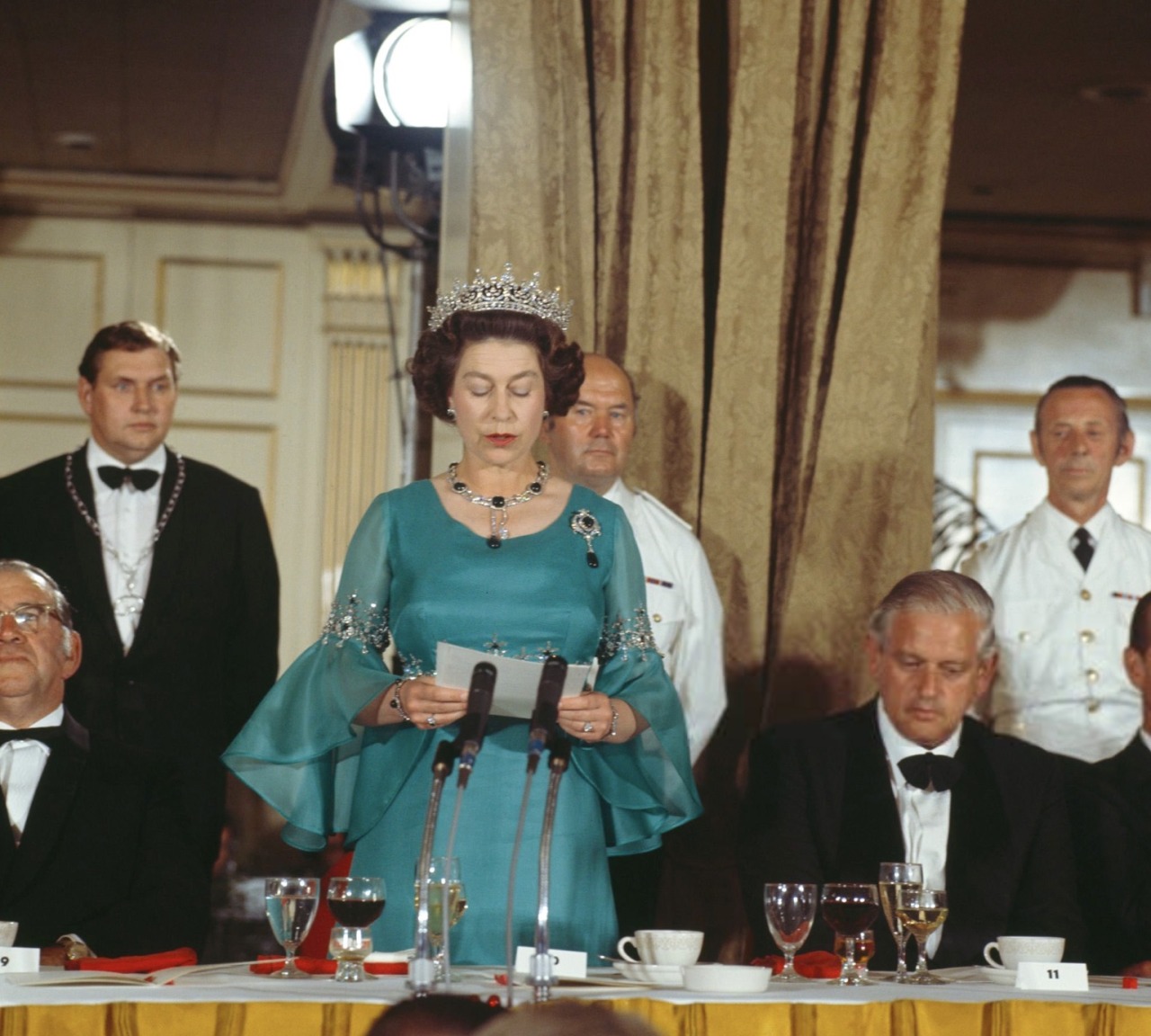


The Queen continued to wear the striking Delhi Durbar Necklace with the emerald-version of the Vladimir Tiara and also sometimes with the Girls of Great Britain and Ireland Tiara through the 1970s and 1980s.


The Delhi Durbar Necklace continued to be worn by the late Queen Ito the final years of her reign, with some notably appearances during an Irish State Visit in 2014 and a Gala Dinner in Malta in 2015.


In recent years, the Delhi Durbar Necklace was often displayed during the summer exhibitions at Buckingham Palace, most recently at the ‘Platinum Jubilee: The Queen’s Accession’ Exhibit in 2022, where I saw the Jewels at Buckingham Palace on the day the Queen passed away, which was also the last day that the Necklace was publicly seen! Let’s hope it is worn again soon!
Girls of Great Britain and Ireland Tiara | Vladimir Tiara | Queen Alexandra’s Kokoshnik Tiara | Belgian Sapphire Tiara | Burmese Ruby Tiara | Brazilian Aquamarine Tiara | Queen Mary’s Fringe Tiara | Cambridge Emerald Parure | Coronation Necklace | Delhi Durbar Necklace | George VI Festoon Necklace | Three-Strand Pearl Necklace | The Jewels of Queen Elizabeth II

Girls of Great Britain and Ireland Tiara
Vladimir Tiara

Queen Alexandra’s Kokoshnik Tiara
Belgian Sapphire Tiara
Burmese Ruby Tiara
Brazilian Aquamarine Tiara
Queen Mary’s Fringe Tiara
Queen Mary’s Lover’s Knot Tiara
Queen Victoria’s Oriental Circlet Tiara
Nizam of Hyderabad Tiara
Plunket Tiara
Five Aquamarine Tiara
Imperial State Crown
George IV State Diadem
Necklaces
Coronation Necklace and Earrings
The Cambridge Emerald Parure
Queen Victoria’s Golden Jubilee Necklace
King George VI Sapphire Suite
Queen’s Three-Strand Pearl Necklace
King George VI Festoon Necklace
Queen’s South African Diamonds
Queen’s City of London Fringe Necklace
Nizam of Hyderabad Necklace
Greville Ruby Necklace
Queen’s Japanese Pearl Choker
Kent Amethyst Parure
Queen’s Emerald Tassel Suite
Empress Maria Feodorovna’s Sapphire Choker
Greville Emerald Necklace
Queen’s Dubai Sapphire Suite
King Khalid Diamond Necklace
Pakistani Turquoise Necklace
Queen’s Jordanian Turquoise Suite
Embed from Getty ImagesEmbed from Getty Images
In the early part of the 19th century, Princess Augusta, Duchess of Cambridge bought raffle tickets for a charity lottery in Frankfurt, and then won a box that contained around forty magnificent cabochon round and pear-shaped emeralds of various sizes.
Embed from Getty Images
Forming some of the emeralds into a necklace and earrings, the Cambridge Emeralds were inherited by her younger daughter, Princess Mary Adelaide, the Duchess of Teck, the mother of Queen Mary, who sometimes put some of the emeralds in her Stomacher. She left them to her son Prince Francis of Teck, who in turn left them to his mistress, the Countess of Kilmorey, in 1910, which horrified his sister, who paid £10,000 to acquire the Cambridge Emeralds, leaving just one brooch with the Countess.
Embed from Getty ImagesEmbed from Getty Images
Queen Mary used the Cambridge Emeralds in a new Parure she had commissioned for the Delhi Durbar of 1911, consisting of a necklace, earrings, stomacher, brooches, and bracelet, also putting some of the pear-shaped Emeralds on top of her Delhi Durbar Tiara, also commissioned for the occasion, along with her Art Deco Emerald Choker]. A few years later, Queen Mary adapted the Vladimir Tiara to be worn with the Emeralds, which she also later put on top of her Diamond Bandeau. The Parure was not too frequently picture, but often worn.
 Embed from Getty Images
https://www.instagram.com/p/-sWvxom211/
 Embed from Getty ImagesEmbed from Getty ImagesEmbed from Getty ImagesEmbed from Getty Images
Embed from Getty Images
After Queen Mary’s death in 1953, the Cambridge Emeralds were inherited by the Queen, along with the Vladimir Tiara, while the Delhi Durbar Tiara was given to the Queen Mother and the Diamond Bandeau was left to the Duchess of Kent. The Delhi Durbar Parure has been among the Queen’s most worn jewels throughout her reign, and she has often worn the brooches for daytime events as well. There is no doubt we will continue to see the Cambridge Emeralds for years to come.