There will be many striking antique Jewels coming up for Auction during the annual Jewellery Sales over the next few weeks, with the several exciting Royal and Noble Jewels recently revealed to be going on Auction at Sotheby’s and Phillips in Geneva next month, which we look forward to seeing in person in a few weeks!
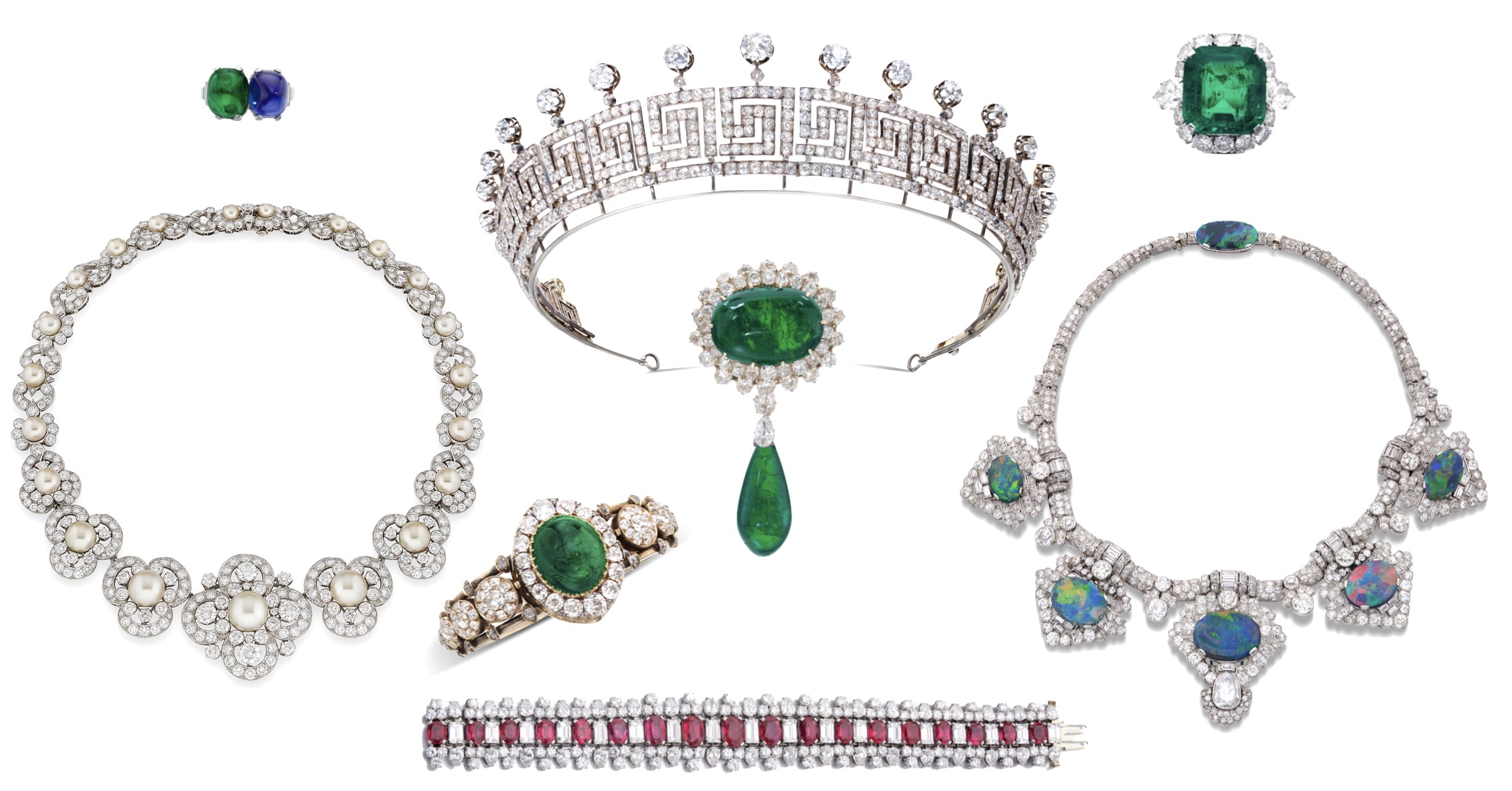
The Devonshire Cartier Opal Necklace Tiara, a Mellerio Orléans Tiara, a Pearl and Diamond Necklace from Queen Mary and the Duke and Duchess of Beaufort, and Queen Amelie of Portugal’s Emerald Brooch and Bangle will be among the Royal and Noble Jewels going on Auction at Sotheby’s and Phillips in Geneva next month, the lots of which are still being slowly revealed. We look forward to being in Geneva next month for the Auctions!
Devonshire Cartier Opal Necklace Tiara
Estimate: 780,000 – 1,100,000 CHF
Formerly in the collection of Mary Cavendish, Duchess Of Devonshire


A Cartier Art Deco Black Opal and Diamond Tiara/Necklace-Brooch Combination featuring five detachable brooches each centring an oval black opal, set throughout with old mine-, old European- and single-cut diamonds, accented by baguette diamonds, the front highlighted by a collet-set pear-shaped diamond, unsigned, tiara fitting, fitting to wear the three central brooches as a devant-de-corsage, one small diamond deficient, fitted case stamped Cartier; circa 1937.

Provenance
Mary Cavendish, Duchess of Devonshire (1895-1988)
Thence by descent
Exhibited
Cartier, Victoria & Albert Museum, London, 12 April – 16 November 2025


The Devonshire Opal Tiara/Necklace
The extraordinary, transformable opal and diamond tiara/necklace was created by Cartier in the late 1930s for Mary Cavendish (1895-1988), then Marchioness of Hartington and later Duchess of Devonshire. Most likely, the jewel was commissioned in the context of the 1937 coronation of King George VI, an occasion that give rise to a large number of spectacular commissions that allowed Cartier London to reach its creative pinnacle during the art deco period and experiment with numerous unusual high jewellery materials and shapes. In doing so, Cartier fused the splendour of the Edwardian-era British court with mid-20th century innovation and aesthetics. According to family tradition, the exquisite black opals set on the jewel were provided by the client. The Marquess and Marchioness of Harrington had undertaken an extensive government tour of Australia and New Zealand in 1936-1937, during which they were presented with these six exceptional opals, Australia’s signature gem that is deeply connected to the country’s national identity.

In 1953, the jewel featured prominently in another coronation, that of George VI’s daughter Queen Elizabeth II. Mary Cavendish, by this time Dowager Duchess of Devonshire, held the office of Mistress of the Robes to the young Queen. As such she had a prominent part to play in the glittering ceremony. The Duchess walked just behind the Queen and her train-bearers during the stately procession and assisted the Queen with the numerous quick-changes and rituals performed during the ceremony. This was the first coronation of a British monarch in history to be filmed in its entirety in colour and televised. As such viewers of the telecast and ensuing film release could follow along the complete ancient mass and admire the robes and jewels in every minute detail. The Dowager Duchess of Devonshire wore the opal and diamond necklace by Cartier together with the impressive and historical diamond-set Devonshire Palmette Tiara. As such, the necklace was one of the jewels most prominently featured during the ceremony, second only to those of the Queen herself.

On 5 February 2026, the opal and diamond necklace was worn by director Emerald Fennell at the London première of her film adaptation of the classic novel Wuthering Heights held at the Odeon Theatre on Leicester Square. The entire press tour for the film starring Margot Robbie featured exquisitely selected outfits inspired by the Gothic, historical romance tone of the film. Historical jewellery featured prominently on the press tour, as exemplified by the Taj Mahal diamond formerly in the collection of Elizabeth Taylor, worn by Margot Robbie at the Los Angeles première of the film. Emerald Fennell used jewellery throughout the movie both to reflect the evolution of Margot Robbie’s character Cathy and to establish the colourful worldbuilding. Therefore, it is fitting that a director so in tune to using the visual language of jewellery in her art, would choose to wear this exquisite jewel.

Mary Cavendish, Duchess of Devonshire (1895-1988)
From the 1930s onwards, Mary Cavendish frequently wore her opal and diamond Cartier jewel in all its many possible transformations, whether as a necklace, tiara, five clips or on its devant-de-corsage fitting. The position she held as Mistress of the Robes to Queen Elizabeth II between 1953 and 1967, furthermore gave her many occasions to enjoy wearing her spectacular piece.
Mary Alice Cavendish was born in 1895 as the daughter of fourth Marquess of Salisbury at Hatfield House, Hartfordshire. In 1917, she married Edward Cavendish (1895-1950), the eldest son of the 10th Duke of Devonshire. As heir to the Dukedom, he held the curtesy title of Marquess of Hartington. Lord Hartington had a distinguished career in the British military and government, notably serving on the British Peace delegation at the Treaty of Versailles. Between 1936 and 1940, Lord Hartington served as Under-Secretary of State for Dominion Affairs and this capacity he undertook the aforementioned tour of Australia and New Zealand. In 1938, he inherited the Dukedom from his father and became the 10th Duke of Devonshire. The estate of the Dukes of Devonshire encompassed the historical Derbyshire stately homes Chatsworth House and Hardwick Hall, masterpieces of baroque and Elizabethan architecture respectively.

The tenth Duke and Duchess sadly lost their oldest son and heir William in 1944, when he died in action during the Liberation of Belgium. William had been married to Kathleen Kennedy, the sister of John F. Kennedy, only four months before. Six years later, the 10th Duke lost his life under mysterious circumstances. As Dowager Duchess, Mary Cavendish dedicated herself to Royal service as Mistress of the Robes to Queen Elizabeth II accompanying the Monarch during many state visits and important functions. The Queen appointed the Dowager Duchess Dame Grand Cross of the Royal Victorian Order in 1955, an honour only bestowed by the monarch upon personal discretion. To everyone who knew her, Mary Cavendish is remembered as a refined and kindhearted aristocrat who tirelessly fulfilled the duties of her station with unwavering grace.
Mellerio dits Meller Diamond Tiara
Estimate: 300,000 – 500,000 CHF
Formerly in the Collection of Marie Isabelle of Orléans, Countess of Paris


A Mellerio dits Meller Diamond Tiara of meander design, set throughout with old mine-cut diamonds, accented by rose-cut diamonds, unsigned, detachable to be worn as a necklace; circa 1862 with later alterations.
Provenance
Wedding gift from Antoine d’Orléans, the Duke of Montpensier and Galliera (1824-1890) and Infanta Louise-Fernande, Duchess of Montpensier and Galliera (1832-1897)
Marie Isabelle of Orléans, Countess of Paris (1848-1919)
Thence by descent
Private collection

Marie Isabelle of Orléans (1848-1919)
In 1864, when Marie Isabelle of Orléans (1848-1919) married Philippe d’Orléans, the Count of Paris (1838-1894), her parents gifted her this diamond tiara by Mellerio dits Meller. The bride’s father Antoine d’Orléans, the Duke of Montpensier and Galliera (1824-1890), was the youngest child of King Louis Philippe and Queen Marie Amélie who ruled France under the July Monarchie from 1830 to 1848. In 1846, he married the Spanish Infanta Louise-Fernande (1832-1897), the sister of Queen Isabella II of Spain. When the couple married their oldest daughter Marie Isabelle to her first cousin the Count of Paris, it was a clear dynastic statement fortifying the Orléans dynasty which until the mid-1880s retained a sizeable political support for a possible return to the French throne. The Count and Countess of Paris had eight children: Amélie Queen of Portugal, Philippe Duke of Orléans, Hélène Duchess of Aosta, Isabelle Duchess of Guise, Louise Princess of Bourbon-Two Sicilies and Ferdinand Duke of Montpensier.


The Mellerio Orléans Tiara
The transformable diamond tiara was created by Mellerio dits Meller, the oldest jeweller on Place Vendôme, for the London International Exhibition of 1862. During the 19th century, the concept of a World Fair gained widespread popularity following the Great Exhibition of 1851 at the Crystal Palace. World Fairs became events held every few years to offer a showcase for the best each country had to offer in terms of industry and the arts. When Mellerio dits Meller exhibited at the 1862 World’s Fair, France was at the peak of the economic expansion and modernisation under the Second Empire of Napoleon III.

The selection of jewels presented by Mellerio at the World’s Fair, and in particular this highly important tiara, showed the influence of Ancient Greek and Roman art. This was a direct reflection of Napoleon III’s acquisition of the Campana collection for the Louvre in 1861. The Campana collection was assembled by Giampietro Campana (1809-1880) and encompassed many highly important archeological finds including notable ancient jewels. Acquiring part of this collection for the Louvre was an important prestige project for France to establish itself at the vanguard of world culture. Therefore, the timeless Greek key or meander design of the tiara, references both classical antiquity as well as the direct historical context in which it was made in order to showcase the glory and prestige of France.

Paradoxically, though the tiara is inspired by a prestige project of the Second French Empire, it would become part of the collection of the dynasty that represented the previous regime: the Orléans family. In 1864, Antoine d’Orléans, the Duke of Montpensier and Galliera (1824-1890), the youngest child of King Louis Philippe acquired the exquisite piece for his eldest daughter Marie Isabelle when she married Philippe d’Orléans (1838-1894), the Count of Paris, the pretender to the French throne.
Hennell Pearl and Diamond Necklace
Estimate: CHF 120,000–180,000
From Queen Mary and the Duke and Duchess of Beaufort

A magnificent Hennell Cultured Pearl and Diamond Necklace, from Queen Mary and the Duke and Duchess of Beaufort, is a recreation of Queen Victoria’s iconic Golden Jubilee Necklace supposedly created for Queen Mary’s niece, the Duchess of Beaufort.


Queen Victoria received the striking Pearl and Diamond Necklace from a contentious group of Aristocratic Ladies on her Golden Jubilee in 1887, which later became a lifelong favourite of the late Queen.


In the mid-1960s, Queen Victoria’s Golden Jubilee Necklace was replicated, without the Crown element, for Princess Alexandra of Kent, the Hon. Lady Ogilvy, whose Necklace can also be worn with turquoises.
Antique Emerald and Diamond Bangle
Estimate: 70,000 – 100,000 CHF
Formerly in the Collection of Amélie of Orléans, Queen of Portugal

An Antique Emerald and Diamond Bangle, the detachable centre featuring a cabochon emerald weighing 27.38 carats within an old mine-cut diamond border accented by rose-cut diamonds, scratched numbering, French warning import marks; 1880s.

Provenance
Amélie of Orléans, Queen of Portugal (1865-1951)
Princess Esperanza of Bourbon-Orléans (1914-2005)
Princess Maria da Gloria of Orléans-Braganza, Crown Princess of Yougouslavia
Sotheby’s New York, December 9-10, 1981, lot 428
Gabriele Murdock (1941-1985), Sotheby’s, New York, December 7, 1999, lot 623

Amélie of Orléans (1865-1951) was born as the eldest daughter of the Count and Countess of Paris. At the time her family, the former French ruling Orléans dynasty, lived in exile in Great Britain. When Amélie was six years old, her parents were allowed to return to France again after the fall of the Second French Empire. She and her siblings grew up in Paris at the Hôtel Matignon. In 1886, Amélie met the Portuguese Crown Prince Don Carlos (1863-1908) and the pair soon married. Their lavish engagement celebrations were ill-perceived by the French Republic as a sign of the Orléans’ dynastic ambition and contributed to the Orléans throne pretender being exiled from France once again. The bride’s wedding gifts included a highly important Emerald and Diamond Parure, likely mounted by the former French Crown jeweller Bapst, comprising a tiara, a necklace, a devant-de-corsageand a set of smaller shoulder brooches which were given by the bride’s parents and her paternal great-uncle, the Duke of Aumale.
When Amélie arrived in Portugal, legend has it she stepped of the train with her left foot first, a bad omen for things to come. The Portuguese monarchy was increasingly unpopular while the country’s economy was in dire straits. When Don Carlos succeeded his father in 1889 as King Carlos I, his popularity would be tarnished due to the British Ultimatum of 1890, which forced Portugal to relinquish important territorial claims in Africa to Great Britain. His lavish lifestyle and indiscrete extramarital affairs were further cause for consternation at a time when Portugal was declared bankrupt twice, once in 1892 and again in 1902. Amélie’s charitable nature, personable character and regal presence, standing an exceptionally tall 1.82m, won her the sympathy of her compatriots. She worked tirelessly supporting schools, hospitals and the Red Cross and also founded the Institute Dona Amelia to support workers’ rights as well as the National Association against Tuberculosis. The Queen’s personal popularity was, however, hampered by a public perception of her getting overly involved in state affairs and being spendthrift like her husband.
On 1 February 1908, anti-monarchist feelings came to a tragic boiling point in the so-called Lisbon Regicide. When Carlos I and Amélie were riding in an open carriage over Lisbon’s iconic Praça do Comércio together with their two sons, twenty-year-old Luís Filipe, Prince Royal, and eighteen-year-old Manuel, Duke of Beja, they were attacked by two shooters who killed the King and Crown Prince. The Queen, who remained unharmed, was reported to have hit the assailants on the head with her bouquet in an attempt to protect her youngest son. The Lisbon Regicide greatly incensed the international community, but the instability of the country was such that the young King Manuel II’s reign only lasted for less than two years, ending with the Republican Revolution of 5 October 1910.
King Manuel and his mother took up exile in Great Britain, where she remained until 1920. King Manuel married Princess Augusta Victoria of Hohenzollern in 1913. Though the marriage was harmonious, the couple remained childless. In 1920, Queen Amélie moved from Great Britain to France and acquired the château of Le Chesnay near Versailles where lived out the rest of her life. In 1932, Amélie suffered a third devastating loss when King Manuel unexpectedly succumbed to an acute oedema of the throat at the age of only 42. Prime Minister António de Oliveira Salazar, who then ruled over Portugal, allowed for the former King to be interred at the Pantheon of the House of Braganza in Lisbon with befitting ceremony, however, his widow and mother could not return to the country to attend. In the ensuing years, Queen Amélie and de Salazar would establish a cordial correspondence. During the occupation of France in World War II, he offered her asylum in Portugal, but she preferred to remain in her chosen country of exile, albeit under Portuguese diplomatic protection. After the war, Queen Amélie did make a return visit to Portugal where the population fondly received this gracious lady representing a long-vanished past.

As Queen Amélie’s children predeceased her, she left her extensive jewellery collection to several different relatives. The important Emerald Parure, attributed to Bapst, she willed to Henri, Count of Paris (1908-1999), the head of the House of Orléans, since these emeralds were wedding gifts of her parents and great-uncle and presumably had been in the Orléans family before their time. The Count of Paris sold the suite at auction in London in 1959, at that point the large central square emerald had already been removed from the necklace which now appeared as a graduated fringe of pear-shaped stones. To the branch of the Braganza now holding the claim to the Portuguese throne she gave the Diamond Tiara which had been a wedding gift of her father-in-law. Her cabochon emerald bangle and brooch as well as the emerald devant-de-corsage which she wore with her historical emerald set she bequeathed to her niece and goddaughter Princess Esperanza of Bourbon-Orléans (1914-2005), who in turn gave them as wedding presents to her daughter Princess Maria da Gloria of Orléans-Braganza when she married Crown Prince Alexander of Yugoslavia in 1972. The Princess parted with the three emerald pieces at Sotheby’s New York in 1981 where all three were acquired by Gabriele Murdoch.
Antique Emerald and Diamond Brooch
Estimate: 70,000 – 100,000 CHF
Formerly in the Collection of Amélie of Orléans, Queen of Portugal

An Antique Emerald and Diamond Brooch featuring a cabochon emerald within a double border of old mine-cut diamonds, suspending a detachable emerald drop surmounted by a pear-shaped diamond; late 19th century with later alterations.


Provenance
Amélie of Orléans, Queen of Portugal (1865-1951)
Princess Esperanza of Bourbon-Orléans (1914-2005)
Princess Maria da Gloria of Orléans-Braganza, Crown Princess of Yougouslavia
Sotheby’s New York, December 9-10, 1981, lot 428
Gabriele Murdock (1941-1985), Sotheby’s, New York, December 7, 1999, lot 623

Gabriele Murdock had a short but remarkable life. Born in Munich in 1941, she came to the United States as a young woman. In 1967, she married financier David Murdock and they had three sons. They entertained some of the world’s most influential people at their homes in Bel Air and Hidden Valley, California, and in New York City.
Mrs. Murdock was a woman of many talents and achievements. She had exquisite taste and she embraced interior design with the flair of a professional. She restored the Hay-Adams Hotel, a Washington landmark, to its former grandeur after it was purchased by her husband in 1983.
Gabriele Murdock is also remembered as a great patron of the arts. She was appointed to the President’s Committee on the Arts and Humanities by President Ronald Reagan in 1983. Two years prior she was named to the Board of Trustees of the Los Angeles County Museum of Art where she helped make important decisions regarding development, acquisitions and finance. She was also a member of many art organizations, both nationally and in the Los Angeles area, including councils of the National Gallery of Art in Washington, the School of American Ballet and the Joffrey Ballet.
Mrs Murdoch acquired three emerald jewels formerly in the collection of Queen Amélie of Portugal at Sotheby’s in 1981, including the emerald and diamond bangle and brooch. With characteristic flair, Mrs Murdoch had the brooch altered to become an interchangeable clasp to be worn from a cultured pearl necklace.
Sapphire, Emerald and Diamond Ring
Estimate: 350,000 – 500,000 CHF
Formerly in the Collection of Catherine, Lady Walston (1916-1978)

A Sapphire, Emerald and Diamond Ring of toi et moi design, set with a cabochon sapphire weighing 7.83 carats and a similarly shaped emerald weighing 6.77 carats, between baguette and square diamond shoulders, accented by single-cut diamond; mid-20th century.
Catherine Walston (1916-1978) will always be primarily remembered as the inspiration for the character Sarah Miles in Graham Greene’s classic 1951 novel ‘The End of the Affair’. Her literary alter-ego is the unfulfilled wife of a reliable, but indifferent civil servant who’s adulterous, war-time liaison with the protagonist, a writer modelled after the author himself, has ended two years before the start of the story. Her character eventually becomes the catalyst for the religious awakening of the protagonist who abandons his atheist beliefs. The novel is a nuanced and well-rounded study of love, obsession, jealousy, resignation and ultimately religion. But who was Catherine Walston herself?

Born in Rye, New York in 1916 as Catherine Crompton, she married the British-American landowner and politician Henry Walston (1912-1991) in 1935. In 1961, Walston was created a life-peer and became Baron Walston, making his wife from then onwards known as Lady Walston. Lord Walston had a distinguished political career lasting more than four decades between the 1940s and the 1980s, serving on numerous government bodies, the Council of Europe and the European Parliament. With her husband’s focus on his career, Catherine found herself looking for meaning in life and in doing so turned to religion. In the early 1940s, she converted to Catholicism while the author Graham Greene acted as her godfather.
All through Graham Greene’s work the role of religion and in particular his own Catholicism was a central motif. Several highly regarded English authors of the mid-20th century were fascinated by the role of the minority religion Catholicism within British society, including Evelyn Waugh and Muriel Spark. Next to novels with religious themes such as ‘The Heart of the Matter’ (1948) and ‘The Power and the Glory’ (1940), Greene also excelled at thrillers and espionage fiction as illustrated by the popular novels ‘The Confidential Agent’ (1939), ‘Our Man in Havana’ (1958) and ‘The Human Factor’ (1978). One of Greene’s most enduring contributions to pop culture was his screenplay for the legendary 1949 film noir ‘The Third Man’ starring Orson Welles, Alida Valli and Joseph Cotton.
Catherine Walston and Graham Green started their affair in 1946. His time with Catherine was a period of great creativity in Greene’s work. It lasted until about 1951 when ‘The End of the Affair’ was published. He dedicated the novel ‘to C.’, but to everyone who knew the pair it was clear who was hiding behind the initial. With the publication of the roman à clef, Henry Walston demanded that the adulterous relationship come to an end. Nevertheless, Graham and Catherine continued to remain in close communication until her death in 1978.
Adler | Bucherer Sapphire, Pearl and Diamond Necklace
Estimate: 320,000 – 480,000 CHF
Property from an Italian Noble Family

An Adler | Bucherer Sapphire, Cultured Pearl, Mother-of-Pearl and Diamond Necklace, centring a collet-set octagonal step-cut sapphire weighing 43.07 carats, the front accented by mother-of-pearl, decorated with cultured pearls, pavé-set throughout with brilliant-cut diamonds, the front signed Bucherer with maker’s mark for Bucherer, partially numbered, the clasp signed Adler, Italian assay mark for gold, one small cultured pearl deficient, case stamped Bucherer.
Bulgari Emerald and Diamond Ring
Estimate: 45,000 – 60,000 CHF
Property from an Italian Noble Family

A Bulgari Emerald and Diamond Ring set with a step-cut emerald weighing 7.89 carats, framed by brilliant-cut diamonds, the shoulders accented by pear-shaped diamonds, signed Bvlgari.
Bulgari Ruby and Diamond Bracelet
Estimate: 70,000 – 120,000 CHF
Property from an Italian Noble Family

A Bulgari Ruby and Diamond Bracelet featuring a graduated series of oval and cushion-shaped rubies alternating with step-cut diamonds and flanked by pear-shaped and brilliant-cut diamonds, signed Bvlgari; 1950s.