There are many striking antique Jewels coming up for Auction this month, with five historic Brooches from the Russian Crown Jewels and a Fabergé Necklace commissioned by the last Tsar and Tsarina as a wedding gift for the last Prussian Crown Princess are among the ‘Fabergé, Gold Boxes, Silver & Ceramics’ on Auction at Sotheby’s in New York tomorrow!
Fabergé, Gold Boxes, Silver & Ceramics | 17 June 2026


Thank You to Sarah of NYC Royal Watcher for their wonderful photos!
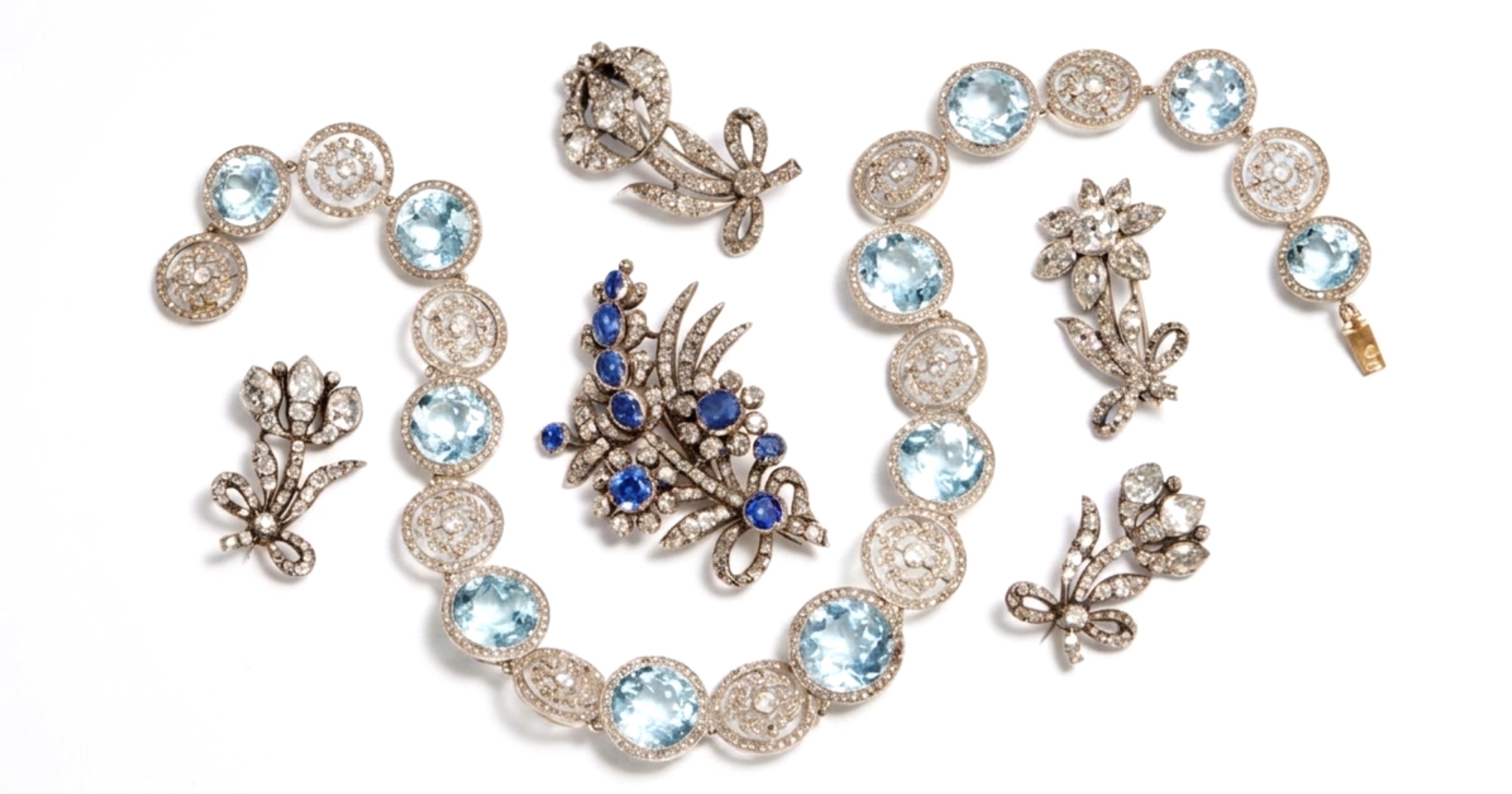
Silver, Sapphire and Diamond-Set Flower Dress Trimming from the Russian Crown Jewels
Estimate: 40,000 – 60,000 USD

Empress Elizabeth Petrovna: A Silver, Sapphire and Diamond-Set Flower Dress Trimming from the Russian Crown Jewels, attributed to Jérémie Pauzié and Louis David Duval, Circa 1740-1760, formed as a ribbon-tied spray of cornflowers and ears of wheat, the leaves and stem set with a variety of old-cut diamonds, the pistils set with sapphires mounted in gold foil, with later gold pin and clasp.

Empress Elizabeth Petrovna:
The Russian State Jewels;
Sold, either by private treaty or at Christie’s London, An Important Assemblage of Magnificent Jewellery, Mostly dating to the 18th Century, which formed part of the Russian State Jewels, 16 March 1927, possibly lot 10;

S.J. Phillips, London;
Acquired by the family of the present owner from the above in the 1960s;
Thence by descent
Two Silver and Diamond-Set Flower Dress Trimmings from the Russian Crown Jewels
Estimate: 60,000 – 80,000 USD
Collection of Erich & Inger Schliemann

Empress Catherine the Great: Two Silver and Diamond-Set Flower Dress Trimmings from the Russian Crown Jewels, attributed to Louis David Duval, circa 1780, formed as ribbon-tied flowers, set with a variety of old-cut diamonds, mounted in silver with a later gold pin and clasp.

Empress Catherine the Great;
The Russian State Jewels;
Sold, either by private treaty or at Christie’s London, An Important Assemblage of Magnificent Jewellery, Mostly dating to the 18th Century, which formed part of the Russian State Jewels, 16 March 1927, possibly lot 35;
S.J. Philips, London;
Acquired by the family of the present owner from the above in the 1960s;
Thence by descent
Silver and Diamond-Set Flower Dress Trimming from the Russian Crown Jewels
Estimate: 40,000 – 60,000 USD
Collection of Erich & Inger Schliemann

Empress Catherine the Great: A Silver and Diamond-Set Flower Dress Trimming from the Russian Crown Jewels, attributed to Louis David Duval, circa 1780, formed as a ribbon-tied flower in full-bloom set with a variety of old-cut diamonds with later pin and clasp.
Empress Catherine the Great:
The Russian State Jewels;
Sold, either by private treaty or at Christie’s London, An Important Assemblage of Magnificent Jewellery, Mostly dating to the 18th Century, which formed part of the Russian State Jewels, 16 March 1927, probably lot 37;
S.J. Phillips, London;
Acquired by the family of the present owner from the above in the 1960s;
Thence by descent
Silver and Diamond-Set Flower Dress Trimming from the Russian Crown Jewels
Estimate: 30,000 – 50,000 USD
Collection of Erich & Inger Schliemann

Empress Catherine the Great: A Silver and Diamond-Set Flower Dress Trimming from the Russian Crown Jewels, attributed to Louis David Duval, circa 1780, formed as a ribbon-tied closed flower, set with a variety of old-cut diamonds including one with a pink hue, with later gold pin.

Empress Catherine the Great;
The Russian State Jewels;
Sold, either by private treaty or at Christie’s London, An Important Assemblage of Magnificent Jewellery, Mostly dating to the 18th Century, which formed part of the Russian State Jewels, 16 March 1927, possibly lot 34;
with S.J. Philips, London;
Acquired by the family of the present owner from the above in the 1960s;
Thence by descent
Imperial Fabergé Diamond and Aquamarine Necklace
Estimate: 400,000 – 600,000 USD
Property of a Royal Family

A Rare and Magnificent Imperial Fabergé Diamond and Aquamarine Necklace, Workmaster Albert Holmström, St Petersburg, circa 1911, set with eleven graduated round-cut Siberian aquamarines framed by rose-cut diamonds, alternating with graduated openwork laurel motifs centred with elven old-cut diamond brilliants, set in platinized mounts, gold clasp, in original Fabergé fitted velvet and silk-lined holly-wood case stamped ‘Fabergé / St Petersburg / Moscow / London’.

Presented by the Imperial Cabinet in May 1911 to Empress Alexandra Feodorovna, with a cost of 2,650 rubles, as a suggested gift for the visit of their Highnesses the German Crown Prince Wilhelm and Crown Princess Cecilie to St Petersburg with their entourage;
The necklace was not selected and therefore returned to the Imperial Cabinet
“Naturally, if one compares firms such as Tiffany, Boucheron, and Cartier with my business, they probably possess more precious jewels than I do… One may find there a ready-made necklace worth 1,500,000 rubles… But they are merchants, not artist-jewelers. A thing interests me very little if its value lies only in the fact that many diamonds or pearls have been set into it.”
For Fabergé, a woman was exquisitely furnished with her own beauty; therefore if you dared to deck her out, it must be done with great discretion, and above all, there must be no material price upon her head. Thus he adorned her with delicate shades of meaning in stones of rare beauty but little worth, like tourmaline, aquamarine and moonstone…These stones, round, oval and square, surrounded quite simply with small diamonds, he set as brooches, pendants [and of course, as necklaces].”
The above quotes from Carl Fabergé and Henry Bainbridge encapsulate the essence of Fabergé’s approach to jewelry, which sought to enhance the beauty and lines of its wearers, not through use of the most extravagant and largest stones, but through subtle and thoughtful design. As Henry Bainbridge further elaborates, the intention was to ‘load the wearer in color and lights,’ thereby emphasizing their natural charm.
This necklace is an exceedingly rare and exciting example of Fabergé’s distinctive style of jewelry and characteristic use of stones from the Ural mountains. Echoing the words above, the focus of the necklace is on the luminous color of the aquamarines, a stone that became increasingly popular as fashions changed to a lighter, pastel palette circa 1900.(1)

The main aquamarine stones are further heightened by their simplicity in form and the added brilliance of their rose-cut diamond surrounds and diamond-set laurels, a popular Fabergé design motif. Even the setting has been carefully considered to enrich the luminosity of the stones. The deep gallery beneath the aquamarines, for instance, serves to lift the stones from the neck, allowing them to catch and reflect the light to maximum effect. It is also interesting to note the millegrain finish of the mounts, which enhance the sparkling effect of the jewel.
This technique was not usual for Fabergé jewelry and was reserved only for use on more important pieces, probably direct commissions.(2) It is the harmony of these thoughtfully conceived elements, down to the intentionality of the setting, that positions this necklace as the exemplar of Fabergé’s court jewelry of the period.
This necklace is an exciting discovery of an Imperial presentation necklace by Fabergé and its Imperial provenance further underscores its significance. This necklace was originally presented by the Imperial Cabinet in May 1911 to Empress Alexandra Feodorovna, with a cost of 2,650 rubles, as a proposed diplomatic gift for the visit of the Highnesses the German Crown Prince Wilhelm (1882 – 1951) and Crown Princess Cecilie of Mecklenburg-Schwerin (1886 – 1954) to St Petersburg with their entourage. It formed part of a group of jewels offered to Cecilie on this occasion, possibly recalling the aquamarine tiara made by Fabergé in 1904 for her sister-in-law.
The visit, which coincided with celebrations of Emperor Nicholas II’s 43rd birthday, included attendance at official court functions and a military parade at Tsarskoe Selo. Crown princess Cecilie had deep personal roots in the Russian Imperial court and this visit served as a high-profile diplomatic opportunity for the German Empire to strengthen political and family ties with the Romanovs, shortly before the German royals continued to represent their country at the coronation of King George V in London.

Incredibly, in the aftermath of the dissolution of Fabergé’s workshops during the Russian Revolution, two of the original design books collated by the St Petersburg workshops of Fabergé were discovered. The albums are both Albert Holmström’s and appear to record every jewel made from 6 March 1909 to 20 March 1915, including the present necklace.
The drawings contain a meticulous amount of detail about how each jewel was executed by the jeweller. On the right of each of the watercolour diagrams, a handwritten description of the materials, quantities of stones needed and exact weights is set out. The delicately rendered design for this necklace emanates from the largest central stone and details show that the design was to involve 11 round-cut aquamarines, 11 brilliants and 958 rose-cut diamonds.
Albert Holmström became Fabergé’s head jeweler after the death of his father August Holmström, and was responsible for making some of Fabergé’s most important commissions. Most notably, the Imperial Winter Egg of 1913, and Mosaic Egg of 1914, made in collaboration with his niece, Alma Pihl. Unrivalled in Russia, the Holmström workshop excelled not just as setters of stone, but as excellent goldsmiths, producing a wonderfully creative and diverse range of objects. Albert’s status as one of Fabergé’s foremost workmasters was reflected in his unique position as the only workmaster granted a large private office. At its height, his workshop employed over sixty workmen, including his niece Alma Pihl, and his sister Alina Holmström, who were responsible for designing much of the workshop’s production.(3)
Fabergé necklaces of this caliber, with their original fitted boxes, are exceedingly rare. The Revolution that brought about the firm’s demise also led to much of its precious jewelry being confiscated and subsequently broken up. It is therefore a rare occasion when a full necklace appears on the market. For two such examples, see a Fabergé diamond necklace, sold, Christie’s Geneva, 14 May 2025, lot 107, and a ruby and diamond necklace, sold, Christie’s New York, 25 April 2007, lot 169.

In comparison to this necklace, these works are less striking in design and, importantly, more interchangeable with those of other contemporary jewelers. Moreover, they are not Imperial. By contrast, the present necklace may more aptly be compared with the firm’s Imperial tiaras. Of particular note is the aquamarine and diamond tiara made for Grand Duchess Alexandra of Mecklenburg-Schwerin, sold, Christie’s Geneva, 15 May 2019, lot 267, which is similar in design to this necklace.
It is also interesting to note a diamond and aquamarine brooch of strikingly similar design and related scratched inventory number 909171, purchased by Dowager Empress Maria Feodorona from Fabergé on 3 January 1911 (see exhibition catalogue, Carl Fabergé and Masters of Stone Carving. Russian Gems, Moscow, The Kremlin Museum, 2011, p. 148, no.168).
With its exceptional beauty, exemplary of Fabergé’s refined jewelry production, together with its rarity and Imperial provenance, this necklace represents a remarkable rediscovery. Further enhanced by the completion of its presentation with its original design drawing and impressive original fitted case, it presents an extraordinary opportunity to acquire one of the most important Fabergé jewels to appear on the market in recent years.
Fabergé Two-Color Gold and Guilloché Enamel Desk Clock
Estimate: 80,000 – 120,000 USD

Empress Maria Feodorovna: A Fabergé Two-Color Gold and Guilloché Enamel Desk Clock, Workmaster Mikhail Perkhin, St Petersburg, circa 1898, triangular, the surface covered in translucent orange enamel over sunburst engine-turning, the circular aperture framed by chased gold laurel leaves and suspended from two yellow-gold ribbons, on two ball feet, ivorine reverse, silver-gilt strut and movement case, in original Fabergé silk-lined and holly-wood case stamped ‘Fabergé / St Petersburg / Moscow’

Purchased from the St Petersburg branch of Fabergé by Empress Maria Feodorovna, on the 9th of March 1898 for 275 rubles
With its unusual form, color of enamel and fine chased gold ribbon decoration, it is no surprise that this clock has Imperial provenance. It is recorded as a purchase by Dowager Empress Maria Feodorovna from Fabergé’s St Petersburg branch on the 9th of March 1898 for 275 rubles.
An impressive example of a Fabergé timepiece, the most striking aspect of this elegant clock is perhaps the deep orange guilloché enamel surface, an unusual color for the firm. Surprisingly, there are few color comparisons across Faberge’s vast production of guilloché enameled objects, although it is reminiscent of a white and orange enameled clock, sold, Christie’s London, 28 May 2012, lot 217, which was suggested to be a special commission.
The enameled surface also provides a wonderful backdrop to the fine green-gold and yellow gold chased ornamentation. The use of varicolored gold popularized by Parisian 18th century goldsmiths was developed to a surprising extent in the St Petersburg ateliers. A particularly wonderful aspect of the gold decoration on the present lot is that not only does it feature contrasting tones of gold, it also executes them in different finishes. For example, the sablé finish of the green-gold wreath which encircles the aperture is contrasted with the polished finish of the yellow-gold ribbons and ties.
Fabergé Gold and Guilloché Enamel Miniature Photograph Frame
Estimate: 15,000 – 25,000 USD

A Fabergé Varicolored Gold and Guilloché Enamel Miniature Photograph Frame, Workmaster Viktor Aarne, St Petersburg, 1899-1903, of arched shape, the photograph of Sophia of Prussia, Queen of Greece (1870 – 1932) and first cousin to Empress Alexandra Feodorovna, the surface of the frame of translucent sky-blue enamel over sunburst engine-turning, surmounted by a gold ribbon suspending varicolored gold garlands, on two bun feet, mother of pearl reverse, silver scroll strut.
Christie’s New York, 19 October 2004, lot 878
Antique Diamond and Sapphire-Set Gold and Silver ‘Button’ Bracelet
Estimate: 15,000 – 25,000 USD
Collection of Erich & Inger Schliemann

An Antique Diamond and Sapphire-Set Gold and Silver ‘Button’ Bracelet, set with eight ‘button’ diamond clusters, divided by step-cut sapphires flanked by collet-set diamonds at each end, with closed-back settings and gold link chain, in a fitted leather case.
Acquired in the 1960s from S. J. Phillips, London
Thence by descent
Antique Diamond-Set Gold and Silver Cross Pendant Necklace
Estimate: 5,000 – 10,000 USD

An Antique Diamond-Set Gold and Silver Cross Pendant Necklace in the form of a cross, composed of a variety of old-cut diamonds with closed-back settings, the diagonals decorated with gold rays, mounted in silver, gold suspension loop and chain.
Acquired in the 1960s from S. J. Phillips, London
Thence by descent