There are many striking antique Jewels coming up for Auction this month, with a Boucheron Tiara from the Harcourt Family, several Jewels from the Viscounts Sidmouth and Dame Nellie Melba’s Cartier Sautoir are among the Antique and Art Deco Jewels on Auction in the Bonhams ‘Exceptional Jewels’ Sale in London this week!
Bonhams Exceptional Jewels | 11 June 2026


While we were in London a few weeks ago, we were graciously invited by Bonhams to preview some of the spectacular Noble Jewels going on auction!
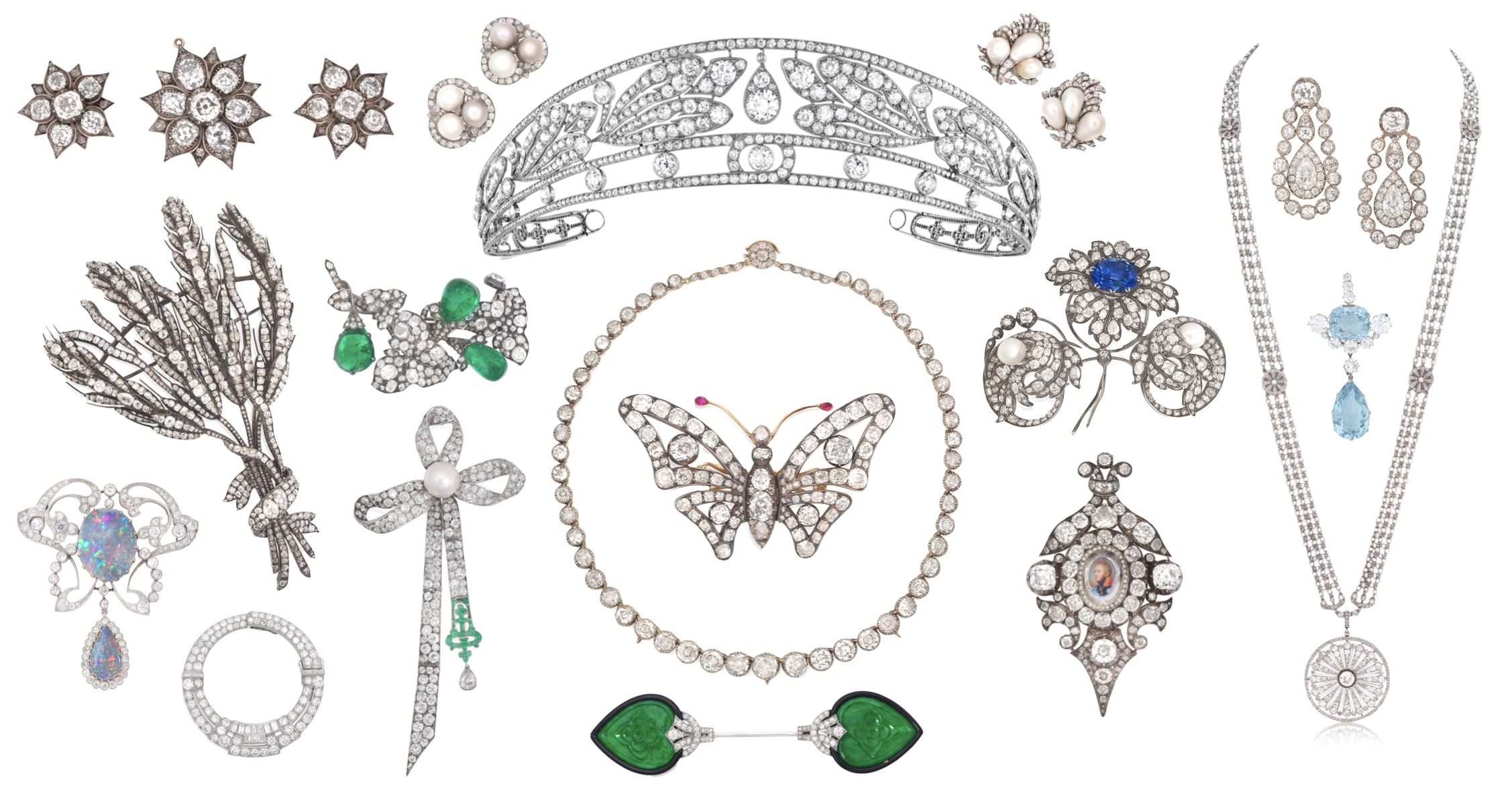
Opal And Diamond Brooch
Estimate: £15,000 – £20,000

An Opal and Diamond Brooch, of scrolling foliate design, set throughout with old brilliant, old cushion and old single-cut diamonds, with an oval opal cabochon at the centre, in a closed-back setting with engraved foliate detail to the reverse, suspending a pear-shaped opal cabochon and old brilliant-cut diamond drop.
Diamond Double-Clip Brooch
Estimate: £4,000 – £5,000

A Diamond Double-Clip Brooch, circa 1950, of scrolling design, set with brilliant, single and baguette-cut diamonds.
Diamond Double-Clip Brooch
Estimate: £7,000 – £10,000

A Diamond Double-Clip Brooch, each clip with scrolls of baguette and old brilliant-cut diamonds, with circular bombé and concave plaques set with old brilliant-cut diamonds, accented by radiating rows of baguette and brilliant-cut diamonds.
Demantoid Garnet, Pearl and Diamond Dragonfly Brooch
Estimate: £8,000 – £12,000

A Demantoid Garnet, Pearl and Diamond Dragonfly Brooch, circa 1890, the abdomen set with a graduated row of circular-cut demantoid garnets, between wings of old cushion-cut diamonds, accented by larger circular-cut demantoid garnets.
Sapphire and Diamond Floral Spray Brooch
Estimate: £18,000 – £20,000
Property of a Prominent International Family

A Sapphire and Diamond Floral Spray Brooch, circa 1890, the oval-cut sapphire weighing 15.94 carats, forming the centre of a flowerhead, highlighted by old pear, cushion and rose-cut diamonds, surmounted to either side by similarly set foliate scrolls each with a natural pearl terminal, in silver and gold.
Emerald and Diamond Brooch
Estimate: £25,000 – £35,000
Property of a Prominent International Family

An Emerald and Diamond Brooch, circa 1880 Realistically modelled as ivy leaves, set throughout with old cushion, old brilliant and rose-cut diamonds, issuing three pear-shaped cabochon emerald ‘buds’, from rose-cut diamond surmounts, set in silver and gold.
Diamond Wheatsheaf Jewel
Estimate: £25,000 – £35,000

A Diamond Wheatsheaf Jewel, realistically modelled as four ears of wheat, tied with ribbon forming a wheatsheaf, set throughout with old cushion, old pear and rose-cut diamonds, mounted in silver and gold.
This neo-classical jewel is impressive in its lifelike scale and realistically modelled form. Ears of wheat or épis de blés, were one of the most prominent decorative themes in jewellery under the First French Empire and the reign of Napoleon. This period was stylistically marked by a revival of classical antiquity, inspired by recently excavated archaeological sites such as Pompei and Herculaneum. Ears of wheat are an attribute of Ceres, the Roman goddess of agriculture, the harvest, fertility and prosperity. They were often executed as separate diamond, gold and silver brooches that could be arranged freely on a dress or in the hair, either separately or combined into wheat sheaves.
The brooch in this lot likely formed part of a larger jewel, possibly a tiara as evidenced by the numbers engraved on the stems, ‘1’, ‘2’ and ‘5’ with the ‘3’ and ‘4’ now missing. A small number of very similar tiaras are known, including one attributed to court jeweller and founder of the House of Chaumet, Marie-Étienne Nitot, worn by Princess Pauline Borghese (1780-1822), sister of Napoleon Bonaparte at his Coronation in the Cathedral of Notre Dame in 1804. In a painting of Princess Mary Adelaide, Duchess of Teck (1833-1897) by Hermann Schmiechen of 1882, a similar tiara is depicted (see Munn, G., Tiaras, a History of Splendour, 2001, ill.pp.174-175, plates 156-157). The twelve trainbearers of Queen Victoria also wore ears of wheat at the 1837 Coronation, expressing the hopes of the nation for a prosperous and abundant new reign (see Scarisbrick, D., Jewellery from Renaissance to Art Déco 1540-1940, Japan, 2003, p.115). During the 19th century, ears of wheat also featured prominently in wedding jewellery as symbols of abundance and prosperity. One of the earliest diamond tiaras from the Russian crown jewels, composed of ears of wheat and cornflowers, was favoured for weddings by the Romanovs (see Munn, ill.p.271, plate 245).
Pearl and Diamond Earclips
Estimate: £15,000 – £20,000
Jewels from a Private Family Collection

Natural Pearl and Diamond Earclips Each set with three natural pearls of varying white and grey tints, within trefoil surrounds set with old cushion and rose-cut diamonds, diamonds approximately 3.85 carats total, converted from a late 19th century jewel.
Pearl and Diamond Earclips
Estimate: £15,000 – £25,000
Jewels from a Private Family Collection

Natural Pearl and Diamond Earclips, each set with baroque-shaped natural pearls,within a plume of old cushion-cut diamonds, one later replacement cultured pearl, converted from a late 18th century jewel, cased by S.J. Phillips, 113 New Bond Street, London, W1.
Jade, Enamel and Diamond Jabot Pin
Estimate: £8,000 – £12,000

A Jade, Enamel And Diamond Jabot Pin, circa 1925, each terminal with a foliate carved jade plaque to a black enamel surround, accented by old brilliant and single-cut diamonds
Mario Buccellati Pearl and Diamond Pendent Earrings
Estimate: £4,000 – £6,000
A pair of Pearl And Diamond Pendent Earrings, circa 1930, attributed to Mario Buccellati, each pierced and hollow drop of rose-cut diamond quatrefoil and foliate motifs, issuing pearl accents, articulating within a rose-cut diamond cap and suspended from a similarly-set surmount.
Pearl, Diamond And Emerald Bow Brooch
Estimate: £14,000 – £18,000
Property of a Prominent International Family

A Pearl, Diamond and Emerald Bow Brooch with a stylised bow, set with a natural pearl to the centre, set with old brilliant-cut diamonds, issuing two articulated tassels, with similarly set diamonds, calibré-cut emerald detailing suspending an old pear-cut diamond drop, mounted in platinum.
Van Cleef & Arpels Diamond ‘Un Cercle’ Clip
Estimate: £15,000 – £20,000

A Van Cleef & Arpels: Diamond ‘Un Cercle’ Clip, circa 1930, of pierced annular form, pavé-set throughout with graduated old brilliant-cut diamonds, accented by baguette and step-cut diamonds.
Aquamarine And Diamond Brooch
Estimate: £10,000 – £20,000

An Aquamarine And Diamond Brooch, circa 1890 and later, the cushion-shaped aquamarine accented by old brilliant-cut diamonds with knifewire detail, terminating with a detachable pear-cut aquamarine drop via a similarly-cut diamond link, accompanied by an associated surmount set with old brilliant-cut diamonds, mounted in gold, silver and platinum, 1890s – 1930s composite.
Diamond Butterfly Brooch/Hair Ornament
Estimate: £15,000 – £20,000
A Collection of Aristocratic Jewels from The Sidmouth Family

A Diamond Butterfly Brooch/Hair Ornament, Mid-19Th Century, the thorax and openwork wings set throughout with old brilliant, old cushion and rose-cut diamonds, the rose-cut diamond head issuing ruby cabochon antennae, mounted in silver and gold,
Diamond Floral Bracelet, Brooch, And Hair Ornament
Estimate: £15,000 – £20,000
A Collection of Aristocratic Jewels from The Sidmouth Family


A diamond floral bracelet, brooch and hair ornament combination, 19th century. Each flowerhead is set with old brilliant, old cushion, old single and rose- cut diamonds, the circa 1860 bracelet strap of flexible linking, mounted in silver and gold.
Diamond Pendent Earrings
Estimate: £10,000 – £15,000
A Collection of Aristocratic Jewels from The Sidmouth Family

A pair of diamond pendent earrings, 19th century. Each articulating openwork drop set throughout with old cushion-shaped diamonds, accented by a central old pear-cut diamond, in pinched-collet settings
Diamond Rivière Necklace
Estimate: £15,000 – £20,000
A Collection of Aristocratic Jewels from The Sidmouth Family

A Diamond Rivière Necklace, the old brilliant and old cushion-cut diamonds in pinched collet settings, graduating in size towards the centre, mounted in silver and gold, cased by Carrington & Co., Jewellers, 130, Regent St., London, W.
The Sidmouth Portrait Diamond Jewel
Estimate: £80,000 – £120,000
A Collection of Aristocratic Jewels from The Sidmouth Family


The Sidmouth portrait diamond jewel of Emperor Alexander I of Russia, circa 1810. The central portrait miniature is painted in watercolour depicting Alexander I (1777–1825), Emperor of Russia (1801-1825), wearing his uniform and the breast star of the Imperial Russian Order of St. Andrew, beneath a portrait-cut diamond, in a closed-back rose-cut diamond setting, set within a later surround of old brilliant and old cushion-cut diamonds, featuring scroll and foliate motifs. Addington was involved in the arrangements for Alexander I of Russia’s visit to England in 1814, and it is likely that the Sidmouth jewel was presented to him as a diplomatic gift on that occasion.
Dame Nellie Melba’s Cartier Seed Pearl And Diamond Sautoir
Estimate: £60,000 – £80,000
From the Collection of Dame Nellie Melba

A Cartier Belle Époque seed pearl and diamond sautoir, circa 1910, originating from the personal collection of the celebrated opera singer, Dame Nellie Melba (1861-1931). Designed with seed pearl linking, accented at intervals by scroll and floral spacers millegrain-set with old brilliant, old single and rose-cut diamonds, suspending a circular pendant, pierced with a radiating floral motif, millegrain-set with similarly-cut diamonds, signed Cartier Paris.
From the Collection of Dame Nellie Melba (1861–1931);
Thence by descent

Dame Nellie Melba’s Cartier sautoir reflects a new fashion for round openwork ‘disc’ pendants suspended from long necklaces that emerged towards the end of the first decade of the 20th century. Cartier, Georges Fouquet and Vever were amongst the Parisian houses that produced them and diamonds and pearls dominated these designs. While Fouquet and Vever were inspired by lace and naturalistic forms, Cartier favoured the geometry inspired by the Islamic world, a region the Cartier brothers explored extensively (see Possémé, É., Cartier, Islamic Inspiration and Modern Design, Paris, 2023, pp. 175-177). This period was also defined by the revolutionary use of platinum, of which Cartier were an early pioneer. The design of this jewel exemplifies Cartier’s mastery of this precious metal and their innovative designs during an era that was also defined by the more traditional garland style. Presented at auction for the first time since Dame Nellie’s ownership of the jewel, this sautoir by Cartier Paris is a highly desirable survivor of the firm’s output during this era and a window into the life and personality of an Australian cultural icon. A black and white photograph of Dame Nellie wearing her Cartier sautoir graced the cover of Time magazine (weekly edition: 18th April 1927). For a necklace with similar seed pearl linking by Cartier, see Bachet, O., In The Beginning Was The Line, Cartier Art Deco drawings 1910 – 1930, 2024, ill.p.38.
Born Helen Porter Mitchell in Richmond, Victoria, Dame Nellie Melba was an Australian coloratura soprano and the first Australian to achieve international recognition as a classical musician. She was the eldest of seven children born to David Mitchell (emigrated from Forfarshire, Scotland in 1952) and Isabella Ann Dow (1833–1881). Melba first performed in public at the age of six and her mother died when she was twenty. Her father found success as a builder and moved the family to Mackay, Queensland, where Melba quickly attracted attention as a singer and pianist. In 1882, she married Charles Nesbitt Frederick Armstrong (1858–1948) in Brisbane and they had a son, George in 1883. The marriage was unsuccessful and the couple would later divorce in 1900. From 1884, Melba began performing as a professional opera singer in her beloved Melbourne, the city which inspired her stage name. After a brief stint in London, she studied in Paris and performed in Brussels before establishing herself as the leading soprano at Covent Garden from 1888. She soon achieved international fame and success, performing throughout Europe, St Petersburg and New York City, where she debuted at the Metropolitan Opera in 1893. Melba’s repertoire was selective – she sang no more than twenty-five roles and was closely identified with ten. She was best known for her performances in French and Italian opera. Melba had perfect pitch and an exceptional purity of tone that appealed to her audiences around the world.

In 1909, Melba undertook a “sentimental tour” of Australia, which included many remote towns and covered 10,000 miles (16,000 km). Melba was in Australia at the outbreak of the First World War and she threw herself into fundraising significant sums for charity to support the war effort and the wounded. In recognition of this service, Melba was created a Dame Commander of the Order of the British Empire in March 1918.
The following decade saw Melba embark on a series of “farewell” appearances, which included concerts in Sydney, Melbourne and Geelong, earning her the Australian expression, “More farewells than Dame Nellie Melba!”. Melba’s voice was immortalised in numerous recordings throughout her career. Her final farewell to Covent Garden on 8th June 1926 was both broadcast and recorded by His Master’s Voice. She taught at the Melbourne Conservatorium and helped the careers of younger singers while continuing to sing herself during the final months of her life. News of Melba’s passing in Sydney at the age of 69, quickly spread across the English-speaking world, and her funeral was a major national event with a motorcade over a kilometre long. Newspaper headlines around the globe announced, “MELBA IS DEAD” and her headstone, designed by Sir Edwin Lutyens, bears the words of Mimì in Puccini’s La Bohème – “Addio, senza rancor” (Farewell, without bitterness).
Boucheron Diamond Bandeau Tiara
Estimate: £200,000 – £300,000
Jewels from a Private Family Collection

A Boucheron Diamond Bandeau Tiara, the openwork bandeau with a central pear-shaped drop, the principal old brilliant-cut diamond, weighing 3.60 carats, between scrolls, quatrefoils and stylised olive leaves graduating in size towards the centre, set throughout with old brilliant, old single and rose-cut diamonds, accented by collet-set old brilliant-cut diamonds between similarly-set borders, mounted in platinum
Mary Ethel, Viscountess Harcourt née Burns (1874–1961);
Her daughter, Doris Mary Thérèse, Baroness Ashburton née Harcourt (1900–1981);
Thence by descent
The commission of this tiara was given to Boucheron in London on 18th July 1924, four months before Doris Harcourt’s wedding to Alexander, 6th Baron Ashburton (1898-1991) on 17th November 1924. One of the “Bright Young Things”, Doris was the eldest of four children born to Lewis Harcourt, 1st Viscount Harcourt (1863-1922) and Mary Ethel Burns. Known affectionately as “May” and “Minnie”, Mary was the beloved daughter of the wealthy American financier, Walter Hayes Burns (1838–1897) and his wife, Mary Lyman Morgan (1844–1919). Mary Morgan’s eldest brother was John Pierpont Morgan (1837-1913), the preeminent investment banker who dominated Wall Street during the Gilded Age. In addition to intrinsic wealth, Mary Ethel Burns inherited her discerning eye from the Morgans who were all collectors. She married Lewis Harcourt on 1st July 1899 and her father commissioned Boucheron to supply the most exquisite wedding trousseau ever seen, instructing Mary to chose and order everything her heart desired without limitations. Mary remained a devoted client of Boucheron, the Parisian jeweller the Burns family historically favoured. Mary continued to commission an extraordinary number of jewels from the firm throughout her lifetime, including many tiaras, of which the present lot is one. The resulting jewellery collection Mary amassed was one of the most spectacular ever created by Boucheron. It is understood that the present lot was commissioned as a wedding gift from Mary to her daughter Miss Doris Harcourt. Referring to the society wedding of Miss Burns and Lewis Harcourt, Society magazine The Sketch commented on the bewildering display of gifts, including a ‘diamond tiara from the bride’s mother glittering and twinkling in the tall glass case’. (The Sketch, 26th November 1924). Coverage on the wedding was extensive, with further jewels noted throughout press reporting ‘half [of] London was present to witness the ceremony, performed by the Bishop of Winchester… after the ceremony a reception was given at Brook Street, attended by quite eight hundred guests… there were over 700 magnificent presents’ of which numerous jewels were listed, including, ‘a ruby and diamond ring, diamond aigrette, sapphire and diamond horseshoe brooch and diamond earrings, a diamond crown, sapphire half-hoop bracelet, diamond half-hoop bracelet, and a ruby and diamond bracelet’ (The Gentlewoman, 8th July 1899).

In 1856, the crown jeweller, Bapst, created a comb for Empress Eugenie using old mine-cut diamonds from the French Crown jewels. This elaborate head ornament issued nine diamond pendants referred to as pampilles, which tapered to a point. At the historic auction of the French Crown Jewels in 1887, Tiffany purchased four of Empress Eugenie’s pampilles and sold two of them to Junius Spencer Morgan (1813-1890), the patriarch of the merchant banking family and Mary Ethel Burns’ grandfather. Junius Spencer Morgan held Empress Eugenie’s diamond pampilles in trust for his granddaughter and placed them in the safe care of her father in 1888. Mary later remounted the twenty-eight old mine-cut stones from the comb à pampilles into a scalloped fringe necklace. She also inherited a love of fine jewels from her mother, Mary Morgan, who would leave her with an enviable collection consisting of many superb coloured gemstones and significant heirlooms. It is through Mary’s mother that the Harcourts acquired the famous ‘Harcourt Emeralds’ which produced two of the most notable jewels in the Harcourt collection: the magnificent emerald and diamond tiara created by Boucheron in 1904 (remodelled by Mary Ethel Burns in 1920) and the emerald and diamond necklace made by Cartier in 1920 – both of these impressive jewels were worn by Mary at the 1937 coronation of George VI. The same tiara was later worn by her daughter, Lady Ashburton, at the coronation of Elizabeth II in 1953.

The diamond bandeau tiara by Boucheron exemplifies the fashion for platinum jewels and an enduring classical style. In ancient Greece and Rome, crowns made of leaves or fashioned as leaves in precious metals were awarded for a wide variety of achievements and worn on important ceremonial occasions. Typically associated with gods and goddesses, wreaths appeared on currency and various insignia. Every four years, the wild olive tree that grew at Olympia provided the branches for the crowns awarded in honour of Zeus at the ancient Olympic Games. The bay laurel tree was similarly used for the crowns awarded at the Pythian Games at Delphi in honour of Apollo. Laurel wreaths were also bestowed upon victorious generals celebrating their triumphs for Rome. Generals awarded with lesser celebration rituals wore wreaths of myrtle. Oak leaves symbolising strength and endurance were favoured for gold funerary crowns – the main type of wreath to survive from the ancient world. Significant archaeological discoveries made during the 18th and 19th centuries have inspired a widespread and long-lasting fascination with antiquity and a cultural awareness of ancient artefacts has continually resurfaced. Such artefacts include gold head ornaments found in the cemeteries of Etruria, and at the ancient Roman sites of Pompeii and Herculaneum. Revived as a motif during the First Empire and the inspiration for ‘the garland style’ of the Belle Époque era, the wreath remained popular well into the early 20th century. Laurel wreaths are typically associated with glory, honour and victory. Olive branches by contrast, were an attribute of the goddess, Athena and symbolise peace, prosperity, hope, fertility and longevity, making them a fitting motif for wedding jewellery. Of similar design to the present lot, a diamond tiara composed of twin olive branches by Cartier was commissioned for Princess Marie Bonaparte (1882-1962) on the occasion of her marriage to Prince George of Greece and Denmark (1869-1957) in 1907. The olive branch motif was evocative of the tiaras worn by Princess Marie’s ancestors during the reign of Napoleon and served as a fitting motif for her future in Athens (see Tiara: Dignity and Beauty – the Story of the Tiara, Japan, 2007, pp.178-179 and p. 279, ill.no.82). This versatile tiara could be worn in a number of different configurations. Set with eleven large cushion-shaped diamonds, the central pear-shaped diamond drop was interchangeable with a large diamond star motif.

Rooted in antiquity, the Harcourt diamond bandeau tiara reflects Mary Ethel Burn’s exquisite taste, her longstanding relationship with Boucheron and the lasting impact of American heiresses on both the English nobility and British society. On the eve of her daughter’s wedding, Viscountess Harcourt placed her trust again in Boucheron for this important commission that signifies celebration and optimism for the future. Just over a century later, this exceptional tiara forms part of her remarkable legacy.