There are many striking antique Jewels coming up for Auction this month, with a Fabergé Frame, Fabergé Flowers and Presentation Boxes from Tsar Nicholas II and Empress Alexandra Feodorovna are among spectacular pieces from the Stream Family Collection on Auction at Christie’s in New York City this week!
Christie’s A Treasured History: The Stream Family Collection | 10 June 2026


Thank You to Chrisite’s for inviting our team to preview the auction and to Sarah of NYC Royal Watcher for their wonderful photos!
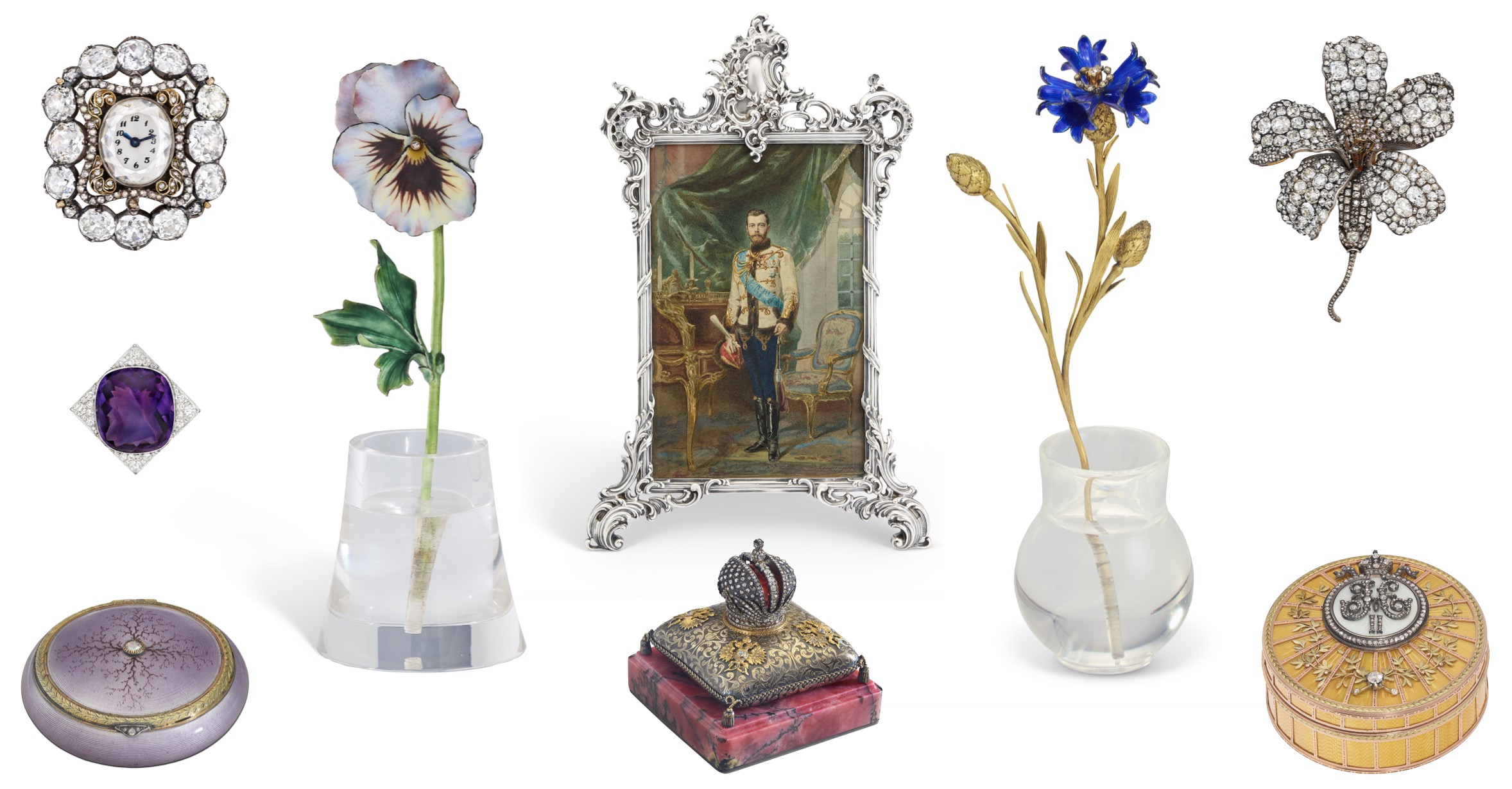
Antique Diamond Watch-Brooch
Estimate: USD 30,000 – 50,000


An Antique Diamond Watch-Brooch, with manual movement, portrait, old and rose-cut diamonds, silver-topped gold, 18k and 14k yellow gold (Swiss marks), circa 1900, numbered.
Antique Diamond Flower Brooch
Estimate: USD 40,000 – 60,000


An Antique Diamond Flower Brooch, central stamen elements en tremblant, old and rose-cut diamonds, silver-topped gold, circa mid 19th century, 14k yellow gold pinstem of later addition, later black Hammer Galleries fitted case
An Exquisite Tiffany & Co. Art Deco Emerald and Diamond Bracelet
Estimate: USD 300,000 – 500,000

An Exquisite Tiffany & Co. Art Deco Emerald And Diamond Bracelet. Square cushion pyramidal emerald cabochons, marquise, square and old-cut diamonds, platinum, circa 1930, signed Tiffany & Co., bracelet was previously shortened and is accompanied by an additional emerald station original to the bracelet.
An Important Imperial Silver Frame With The Portrait Of Emperor Nicholas Ii
Estimate: USD 50,000 – 70,000

An Important Imperial Silver Frame With The Portrait Of Emperor Nicholas II, by Fabergé, Workmaster Julius Rappoport, St. Petersburg, Circa 1890, Scratched Inventory Number Partially Visible ‘171(?)’. Rectangular, cast with scrolling foliage and rocaille, with wooden back and strut, enclosing a portrait of Nicholas II in the uniform of the Life Guards Hussar Regiment by Dmitri Benckendorff (1844-1919), watercolor on paper laid on cardboard.
Collection of Empress Alexandra Feodorovna (1872-1918), Alexander Palace, Tsarskoe Selo, until 1917.
Almost certainly sold by the Soviet government to Armand Hammer in the 1920s / early 1930s.
With Hammer Galleries, New York, by the late 1930s.
Acquired by Matilda Geddings Gray (1885-1971) from Hammer Galleries, New York, in the late 1940s / early 1950s.
By descent to Matilda Gray Stream (1924-2023) and descendants.

This rare and important silver frame containing a portrait of Emperor Nicholas II is clearly visible in a photograph of the 1902 Von Dervis Exhibition in St. Petersburg, where it appears among other works belonging to Empress Alexandra Feodorovna, the wife of Nicholas II. The exhibition was held only for a week from 8 to 15 March 1902, and was organized under the patronage of Alexandra Feodorovna in aid of the Imperial Women’s Patriotic Society Schools.
Dowager Empress Maria Feodorovna, the Grand Duchesses, and members of the aristocracy, many of them prominent patrons of Fabergé, exhibited treasures from their private collections. The exhibition was a great success, and the collection of the Imperial Easter Eggs by Fabergé attracted particular interest from visitors. The event was documented by the celebrated photographer Carl Bulla (1855-1929), whose photographs serve as an invaluable historical record, especially for objects with Imperial provenance.
A photograph of the Silver Salon at the Winter Palace, taken circa 1900, features the present frame within the interior. Another photograph from the album of Nicholas II, taken in the same room in January-February 1901, depicts Grand Duchess Victoria Melita and her daughter, Princess Elisabeth, together with Nicholas II’s daughters Maria, Olga and Tatiana, with the frame clearly visible on the side table.

One of the early Hammer Galleries catalogues from the late 1930s to early 1940s confirms that the present frame was formerly part of Alexandra Feodorovna’s personal collection at the Alexander Palace. It was almost certainly sold to Armand Hammer by the Soviet government in the late 1920s to early 1930s, during a period when he acquired significant quantities of Russian works of art from Soviet authorities, including objects from the personal collections of the Romanov family.
A Jeweled And Guilloché Enamel Gold-Mounted Silver-Gilt Compact
Estimate: USD 10,000 – 15,000

A Jeweled And Guilloché Enamel Gold-Mounted Silver-Gilt Compact By Fabergé, Workmaster Henrik Wigström, 1904-1908, Scratched Inventory Number 14972. Circular, enameled overall in purple over a reeded guilloché ground, the hinged cover and base painted en grisaille with dendritic design, the cover centered by a diamond, with gold laurel-chased border and a diamond-set thumbpiece, with mirror to interior of cover, interior gilt, marked on interior base with ‘Fabergé’ in Cyrillic and workmaster’s initials; in a fitted Wartski wooden case
Purchased by Sir Frederick John Gerard, the 3rd Baron Gerard (1883-1953) from the London branch of Fabergé on 21 December 1907 for £14 10s.
With Wartski, London.
An Amethyst And Diamond Gold And Platinum Brooch
Estimate: USD 20,000 – 30,000

An Amethyst And Diamond Gold And Platinum Brooch, of lozenge form, the platinum mount centering a large cushion-cut amethyst, the corners set with diamonds, the reverse with pin, loop and a safety chain, with a mount for conversion to a pendant (pendant loop missing), marked on pin and loop with ‘Fabergé’ in Cyrillic and workmaster’s initials; in the original fitted Fabergé wooden case.


Part of the remaining Fabergé jewelry stock, exported by Eugène Fabergé from Russia to Stockholm in July 1919.
A Jeweled, Enamel, Silver And Rock Crystal Study Of A Pansy
Estimate: USD 150,000 – 220,000

A Jeweled, Enamel, Silver And Rock Crystal Study Of A Pansy, by Fabergé, St. Petersburg, Circa 1915, Scratched Inventory Number 24898. In a tapering cylindrical rock crystal vase, a light green enameled silver stem terminating in a painted enamel flower in shades of blue, yellow, pink, and brown, centering a gold-mounted diamond, set with green enameled sepals on the back, with three green enamel leaves on the stem, apparently unmarked; in a fitted Hammer Galleries wooden case

By repute, the collection of Emperor Nicholas II (1868-1918) and Empress Alexandra Feodorovna (1872-1918).
Almost certainly sold by the Soviet government to Armand Hammer in the late 1920s / early 1930s.
Acquired by Matilda Geddings Gray (1885-1971) from Hammer Galleries, New York, in the late 1940s / early 1950s.
By descent to Matilda Gray Stream (1924-2023) and descendants.
Pansies were a favored flower amongst Fabergé’s royal and imperial patrons, most notably used in the decoration of the 1899 Imperial Pansy Easter Egg, given by Emperor Nicholas II to Empress Maria Feodorovna. Another example closely related in both technique and design is a remarkable mechanical pansy flower concealing miniature portraits of the children of Nicholas II and Alexandra Feodorovna, now housed in the Moscow Kremlin Museums. It was presented by Nicholas II to his wife in 1904 to commemorate their tenth wedding anniversary.
The Hammer Galleries invoice for the present pansy records its provenance as in the collection of Emperor Nicholas II and Alexandra Feodorovna. Notably, a pansy flower with the scratched inventory number ‘24896’, differing by only two digits from ‘24898’ on the present lot, was acquired by Nicholas II from Fabergé in December 1915. It was one of the last flower studies purchased by the Imperial family (see R. Gafifullin, Fabergé Items of Late XIX – Early XX Century in the Collection of the State Museum of Pavlovsk, vol. IX, Part I, St. Petersburg, 2013, p. 310, no. 5879).
A Jeweled, Enamel, Gold And Rock Crystal Study Of A Cornflower
Estimate: USD 150,000 – 220,000

A Jeweled, Enamel, Gold And Rock Crystal Study Of A Cornflower, by Fabergé, St. Petersburg, circa 1900, in a bulbous rock crystal vase, a finely textured gold stem terminating in a flowerhead, the trumpet-shaped petals enameled in translucent royal blue, with rose-cut diamond-set stamens, with two finely-chased gold buds, apparently unmarked; in a fitted Hammer Galleries wooden case.
By repute, the collection of Emperor Nicholas II (1868-1918) and Empress Alexandra Feodorovna (1872-1918).
Almost certainly sold by the Soviet government to Armand Hammer in the late 1920s / early 1930s.
Acquired by Matilda Geddings Gray (1885-1971) from Hammer Galleries, New York, in the late 1940s / early 1950s.
By descent to Matilda Gray Stream (1924-2023) and descendants.
The Hammer Galleries invoice for this cornflower records its provenance as in the collection of Emperor Nicholas II and Alexandra Feodorovna at the Alexander Palace in Tsarskoe Selo. Although this flower does not have a Fabergé scratched inventory number that would confirm the exact provenance, it is very likely that it was acquired by Armand Hammer through sales of the Imperial collections arranged by the Soviet government in the late 1920s to early 1930s.
Several Fabergé cornflower studies are known, including those in the State Hermitage Museum, St. Petersburg (previously in the Yusupov Collection), in the Royal Collection Trust, London, and in the collection of Virginia Museum of Fine Arts, formerly part of Lillian Thomas Pratt collection. Further examples of cornflower studies have appeared at auction in recent years: Sotheby’s, London, 27 November 2012, lot 560, and Christie’s, London, 24 November 2014, lot 215.
An imperial Russian Jeweled and enamel Silver, Gold And Rhodonite Hand Seal And Stand
Estimate: USD 6,000 – 8,000

An imperial Russian jeweled and enamel Silver, Gold And Rhodonite Hand Seal And Stand, the stand formed as a square rhodonite base supporting a silver-gilt cushion finely engraved with scrolling foliage and applied with gold Imperial double-headed eagles at corners set with diamonds, with a detachable hand seal at the center, the cylindrical gold body with a ruby and diamond-set rim, surmounted by the Imperial crown part-enameled in translucent red and set with rose-cut diamonds, the lapis lazuli matrix engraved with the cypher of Tsesarevich Nicholas Alexandrovich, future Emperor Nicholas II, beneath the Imperial crown.

Tsesarevich Nicholas Alexandrovich (1968-1918), future Emperor Nicholas II.
Acquired by Matilda Geddings Gray (1885-1971) from Hammer Galleries, New York, 9 October 1946.
By descent to Matilda Gray Stream (1924-2023) and descendants.
Gold Imperial Presentation Snuff Box
Estimate: USD 100,000 – 150,000
A rare and important jeweled and guilloché enamel two-color gold Fabergé Imperial Presentation Snuff Box, circular with hinged cover, the sides and cover enameled in yellow over sunburst and wavy guilloché ground, within dash-and-dot gold rims, the cover applied with a circular medallion enameled in opalescent white over a sunburst guilloché ground, centering a diamond-set cypher of Emperor Nicholas II beneath the Imperial crown, within a diamond-set rim, the cover further applied with a green gold laurel wreath set with a large diamond.

Acquired by the Imperial Cabinet of Emperor Nicholas II from Fabergé for 1,150 roubles on 18 December 1901.
Presented by Emperor Nicholas II to Nikolay Adamovich Savich-Zablotskiy (d. 1903), Head Inspector of the Kursk-Kharkiv-Sevastopol Railway, on 2 April 1903.
Presented by Emperor Nicholas II to Lieutenant General Apollon Nikolaevich Makarov (1840-1917) on 23 December 1905.
Presented by Emperor Nicholas II to Professor Dmitry Oskarovich Ott (1855-1929), the court obstetrician and personal physician to Empress Aleksandra Fedorovna, on 2 May 1906.
Presented by Emperor Nicholas II to Lieutenant General Akim Mikhailovich Zolotarev (1853-1912), on 11 June 1908.
Presented by Emperor Nicholas II to Major General Stefan Paprikov (1858-1920), Minister of Foreign Affairs of Bulgaria, on 7 April 1909.