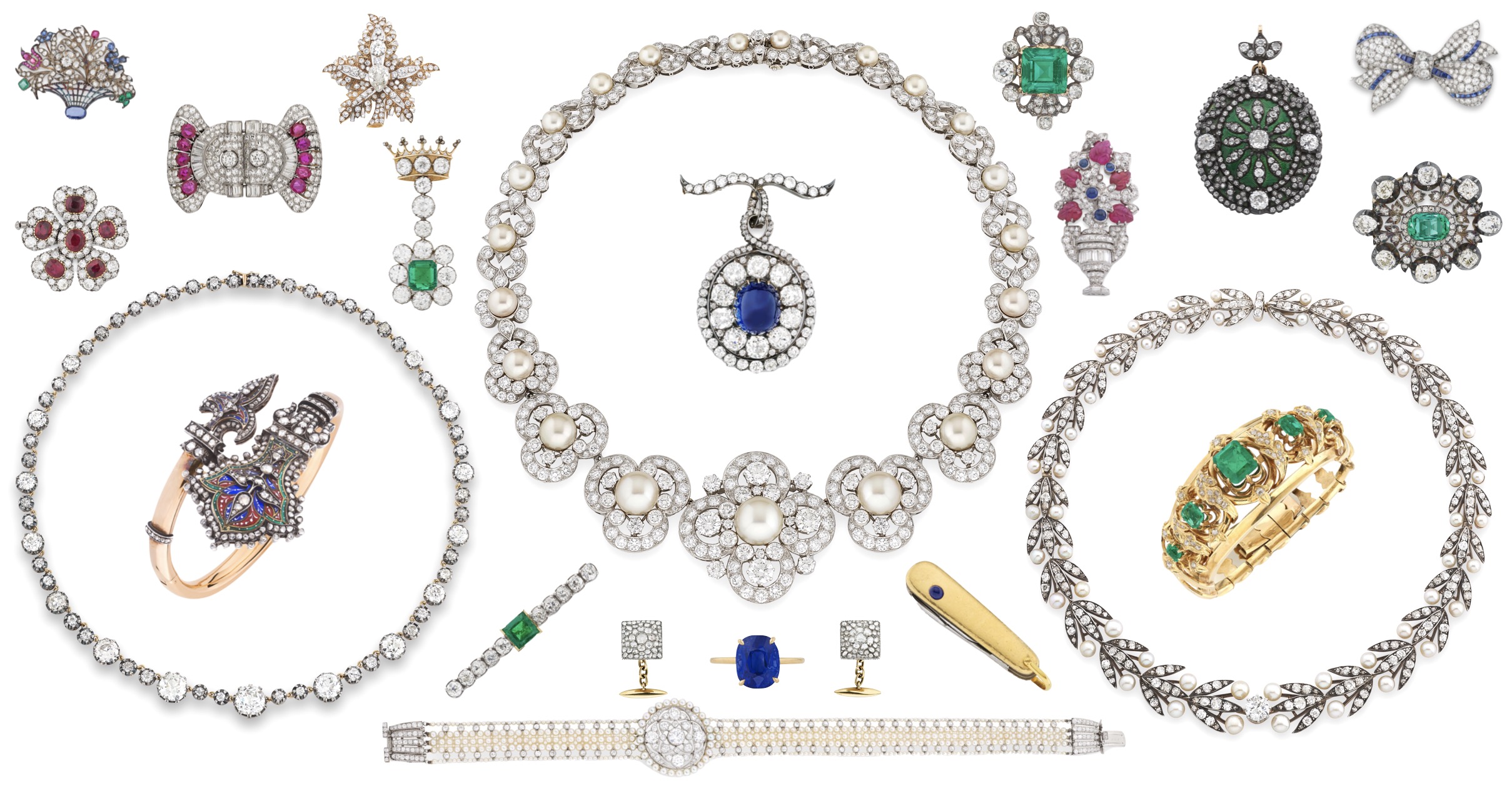
There are many striking antique Jewels coming up for Auction this month, with a Necklace from Queen Mary and the Duchess of Beaufort, a Bracelet given by Empress Eugénie, and pieces from Tsar Ferdinand of Bulgaria are among the spectacular Antique Jewels going on Auction at the Phillips ‘Geneva Jewels’ Auction in Geneva next week!
Phillips Geneva Jewels | 9 November 2026


We were graciously welcomed at the viewing of the Phillips Geneva Jewels yesterday and got to see nearly all of the following jewels in person, which was quite a delight!
Diamond Cufflinks
Estimate: CHF5,000–7,000
Formerly in the collection of Tsar Ferdinand I of Bulgaria

Gold And Sapphire Pocket Knife
Estimate: CHF5,000–7,000
Formerly in the collection of Tsar Ferdinand I of Bulgaria

Emerald, Diamond And Gold Bracelet
Estimate: CHF38,000–55,000
Formerly from a French Noble Family

Presented by Empress Eugénie of the French to Françoise Laurence Staouëli de La Rochelambert, daughter of the Marquis de La Rochelambert, who married Olivier de La Poëze, Chamberlain of Emperor Napoleon III. She became Lady of the Palace of Empress Eugénie in 1855.
Diamond and Enamel Pendant
Estimate: CHF20,000–30,000

Anne Caulfeild, née Bermingham (1780–1876), was an Anglo-Irish aristocrat and courtier. In 1802, she married Francis Caulfeild, 2nd Earl of Charlemont, becoming the Countess of Charlemont. She later served as a Lady of the Bedchamber to Queen Victoria from the beginning of the Queen’s reign until 1854, a position of considerable social and courtly importance.
Before her appointment at court, Lady Charlemont was celebrated as a beauty and was a prominent figure in aristocratic society. Lord Byron expressed his admiration for her beauty in his Letter to the Rev. W. L. Bowles on the Strictures of the Edinburgh Review, dated 7 February 1821:
“But always excepting the Venus de Medicis, I differ from that opinion, at least as far as regards female beauty; for the head of Lady Charlemont (when I first saw her nine years ago) seemed to possess all that sculpture required for its ideal.”
Her beauty attracted the attention of Prince Regent, later George IV, who commissioned a miniature of her as Psyche for his collection. She was also portrayed by leading artists of the period, including Sir Thomas Lawrence and Anne Mee.
Sapphire Ring
Estimate: CHF125,000–200,000
Formerly from a French Noble Family

By family tradition, this sapphire, in the original mount illustrated, was given by a French nobleman to his sister on the occasion of her wedding in 1893.
Thence by descent to the present owners.
Hennell Pearl and Diamond Necklace
Estimate: CHF125,000–180,000
From Queen Mary and the Duke and Duchess of Beaufort


A magnificent Hennell Cultured Pearl and Diamond Necklace, from Queen Mary and the Duke and Duchess of Beaufort, is a recreation of Queen Victoria’s iconic Golden Jubilee Necklace supposedly created for Queen Mary’s niece, the Duchess of Beaufort.
Queen Mary gifted the necklace to her niece Mary, Duchess of Beaufort. It was sold in 1986 and later sold by Sotheby’s in 2004
It’s catalogue references that it was made by Hennell in 1928 for Queen Mary. The London jeweller Hennell was commissioned to make the necklace in 1928 as a reproduction of Queen Victoria’s Golden Jubilee necklace, which had been presented to Queen Victoria in 1888 to celebrate her Golden Jubilee in 1887, celebrating fifty years on the throne.
Hennell’s necklace was nearly identical to the original. Queen Victoria’s original was set with diamond and pearls around a crowned trefoil centre individual pieces could be detached and worn as a brooch or bracelets.


Queen Victoria received the striking Pearl and Diamond Necklace from a contentious group of Aristocratic Ladies on her Golden Jubilee in 1887, which later became a lifelong favourite of the late Queen.
The Golden Jubilee necklace was inherited by the Crown and became a favourite of Queen Elizabeth II. She wore it for her first State Opening of Parliament in 1952.


In the mid-1960s, Queen Victoria’s Golden Jubilee Necklace was replicated, without the Crown element, for Princess Alexandra of Kent, the Hon. Lady Ogilvy, whose Necklace can also be worn with turquoises.
Boucheron Pearl And Diamond Necklace/Tiara
Estimate: CHF70,000–100,000


The famed jewellery house Boucheron was founded in 1858 by the eponymous Frédéric Boucheron, master jeweller and gem expert. Boucheron was the first jewellery house to appear at the celebrated Place Vendôme, Paris, where the house still exists to this day.Boucheron jewels have been exhibited throughout time at some of the most important jewellery expositions, including the 1876 Philadelphia Centennial, the 1889 and 1900 Expositions Universelles (World Fairs) in Paris and the 1925 Exposition des Arts Décoratifs in Paris. With salons located all over the world, Boucheron jewellery continues to be known for its elegant designs and superior finishes.
Cartier Diamond and Seed Pearl Choker
Estimate: CHF65,000–85,000


Ruby and Diamond Double-Clip Brooch
Estimate: CHF5,000–7,000

Lacloche Ruby, Sapphire and Diamond Brooch,
Estimate: CHF26,000–35,000

Diamond Necklace
Estimate: CHF75,000–100,000

René Lalique Emerald and Diamond Bracelet/Tiara
Estimate: CHF70,000–100,000

This creation exemplifies René Lalique’s profound knowledge of botany and his ability to translate the essential characteristics of nature into avant-garde designs. Here, the olive, Olea europaea, is rendered through round and oval cabochon emeralds, representing olives at different stages of growth as they appear on the same branch.
Since biblical times, the olive tree has symbolized peace, longevity and eternity. Lalique’s renowned Peace brooch, presented by the City of Paris to Edith Wilson, wife of President Woodrow Wilson, in 1918, is another celebrated expression of this symbolism. This bracelet represents one of Lalique’s earliest uses of the olive motif.
Emerald and Diamond Brooch
Estimate: CHF22,000–28,000

Diamond and Gem-Set Brooch
Estimate: CHF8,500–12,000

Emerald and Diamond Brooch
Estimate: CHF8,500–12,000

Sapphire and Diamond Brooch
Estimate: CHF12,000–17,000

Boucheron Diamond, Enamel And Gold Bracelet
Estimate: CHF35,000–50,000
Property of an important Private Collector

The famed jewellery house Boucheron was founded in 1858 by the eponymous Frédéric Boucheron, master jeweller and gem expert. Boucheron was the first jewellery house to appear at the celebrated Place Vendôme, Paris, where the house still exists to this day.Boucheron jewels have been exhibited throughout time at some of the most important jewellery expositions, including the 1876 Philadelphia Centennial, the 1889 and 1900 Expositions Universelles (World Fairs) in Paris and the 1925 Exposition des Arts Décoratifs in Paris. With salons located all over the world, Boucheron jewellery continues to be known for its elegant designs and superior finishes.
Emerald And Diamond Brooch
Estimate: CHF55,000–65,000

Ruby and Diamond Brooch
Estimate: CHF20,000–28,000

Emerald And Diamond Brooch
Estimate: CHF400,000–600,000


A very fine emerald and diamond brooch, late 19th century, set with a step-cut emerald weighing 7.96 carats, within a surround of old mine and old European brilliant-cut diamonds, suspended from a line of three similarly cut diamonds, surmounted by a crown accented with old European, cushion modified brilliant- and single-cut diamonds.
Rozet & Fischmeister Sapphire And Diamond Brooch
Estimate: CHF830,000–1,230,000

In 1881, a landslide in the remote Kudi Valley, in the Pádar region of Kashmir, exposed a remarkable deposit of blue crystals. Situated on the northeast wall of the valley, near the village of Sumjam in the Himalayas, the deposit lies at an altitude of approximately 4,500 metres. Its extreme elevation and difficult terrain made the locality accessible for only a few months of the year.
The discovery revealed sapphires of an intense blue colour, often compared to that of the cornflower, combined with the characteristic soft, velvety appearance for which Kashmir sapphires would become renowned. In 1882, the newly discovered sapphires reached the markets of Simla, then the summer capital of British India, where their colour and quality were swiftly recognised by jewellers. Having initially been exchanged by local traders for everyday commodities such as salt, these crystals were suddenly transformed into objects of considerable commercial value as their fame spread rapidly through the Indian jewellery trade. Recognising their significance, Maharaja Ranbir Singh of Jammu and Kashmir took control of the deposit, dispatching troops to guard the mines and prohibit private trading.

The richest period of production followed between approximately 1882 and 1887. The original deposit, known as the Old Mine, yielded some of the finest and largest crystals ever recovered. By 1887, the initial pocket had been exhausted. Although further exploration and intermittent mining followed, none rivalled the exceptional production of those first few years.
It was this brief but prolific period that established Kashmir sapphires as the benchmark against which other sapphires would come to be judged. Their distinctive appearance is defined by an intense, highly saturated blue colour and microscopic inclusions that create their characteristic velvety lustre and subtle haziness, qualities that enhance rather than detract from their beauty.
More than a century after their discovery, Kashmir sapphires retain an unrivalled place in the world of coloured gemstones. Their prestigious provenance and enduring allure continue to captivate collectors the world over, with the finest untreated stones commanding top prices at auction and finding their way into distinguished jewellery collections.