Yesterday, The Royal Collection announced the highly anticipated ‘Royal Jewellery: From Coronations to Keepsakes’ Exhibition will open at The King’s Gallery at Buckingham Palace in June 2027, which will bring together more than 300 pieces of Royal Jewellery from the 16th century to the present day in the first exhibition ever to explore 500 years of British Royal Jewellery.

Jewellery worn by monarchs from Henry VIII and Charles II to Queen Victoria and Queen Elizabeth II will be shown alongside paintings, designs and documents from the Royal Collection and Royal Archives, revealing powerful stories of politics, diplomacy, identity, faith, grief and love across five centuries.
The exhibition will run for nine months and will be accompanied by a book of the same name, which will be the first comprehensive study of the British royal jewellery collection ever published.

Caroline de Guitaut and Kathryn Jones, co-curators of the exhibition, said, ‘This unprecedented exhibition will bring together some of the most important and spectacular royal jewels in British history, many never exhibited publicly before. Each jewel carries with it a human story: of love and loss, power and politics, family and faith. Together, they have borne witness to the defining moments of royal lives and offer a deeply personal insight into the individuals and relationships that have shaped the monarchy across generations.’

From the work of early royal goldsmiths to designs by some of the world’s most celebrated jewellery houses – including Garrard & Co, Cartier, Boucheron and Fabergé – the exhibition will explore the evolution of royal jewellery and its continuing role in shaping the image of monarchy today.


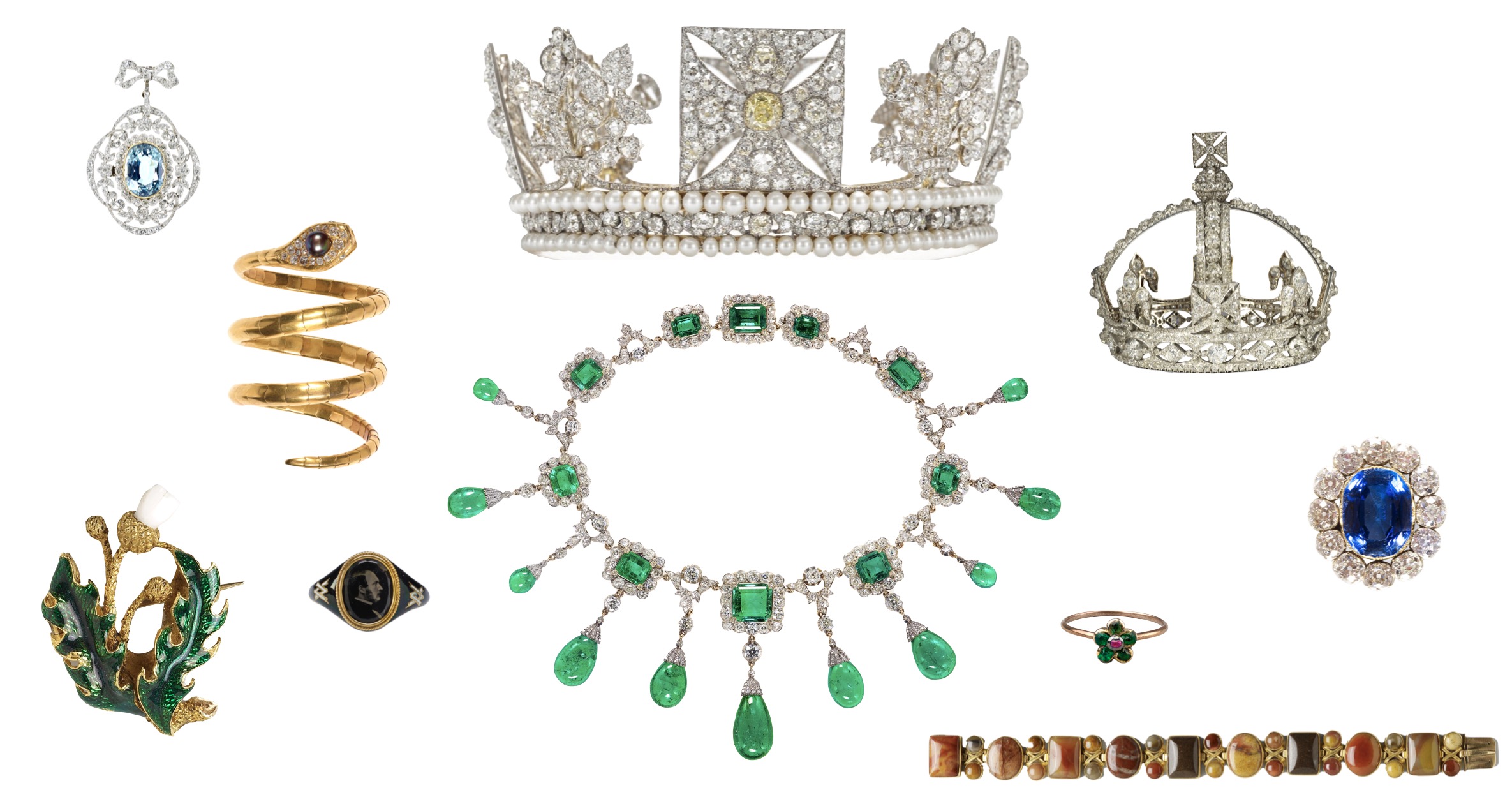
While the Crown Jewels will not feature in the exhibition and will remain on show at the Tower of London, visitors will see magnificent jewels created for coronations and major royal occasions. Among them are the Diamond Diadem, made for George IV’s extravagant coronation and later immortalised in coins, banknotes and stamps bearing the image of Queen Elizabeth II, and Queen Victoria’s Small Diamond Crown, so closely associated with the monarch that it was placed on her coffin during her lying in state.

At the heart of the exhibition will be a display exploring jewellery associated with every queen and consort from Queen Charlotte to Queen Elizabeth II, tracing changing fashions from Georgian splendour and Victorian sentimentality to sleek Art Deco styles and bold mid-century designs. Among the items on show for the first time will be Queen Charlotte’s set of garnet jewels, newly connected to the Queen through recent research; Queen Alexandra’s articulated serpent bracelet, set with diamonds and a black pearl; a Fabergé aquamarine and diamond pendant given to the future Queen Elizabeth II by her grandmother Queen Mary; and the spectacular Greville Emerald and Diamond Necklace, part of Dame Margaret Greville’s celebrated bequest to Queen Elizabeth The Queen Mother.


The exhibition will reveal how royal jewellery has preserved intimate stories of love, loss and family life. Particularly moving are jewels and keepsakes associated with Queen Victoria and Prince Albert, tracing their lives from courtship and marriage to parenthood and bereavement. Highlights include Victoria’s first ring, worn in infancy; the diamond brooch Albert gave her on the eve of their wedding; a bracelet set with pebbles collected on their first journey alone together; a thistle brooch featuring their eldest daughter’s first milk tooth, removed by Albert himself; and Victoria’s mourning ring, set with Albert’s photograph and their intertwined cyphers.

Beyond the personal, jewellery emerges as a powerful expression of loyalty, legitimacy and dynastic ambition amid the political turbulence of the 16th and 17th centuries. Visitors will encounter jewellery linked to the cult of Charles I after his execution, including the cufflinks he is said to have worn on the scaffold, handed to his loyal supporters and shown publicly for the first time. Remarkable survivals such as these demonstrate how jewellery was used not only to commemorate the past, but also to shape perceptions of the monarchy for generations to come.

Some of the highlights of the Exhibition will include:


Rundell, Bridge & Rundell, 1820.
Queen Victoria’s Small Diamond Crown

Garrard & Co., 1870.
Greville Emerald and Diamond Necklace

The magnificent Emerald Necklace worn by Queen Camilla at the German State Banquet last year was an inheritance from the famed Dame Margaret Greville, which was notably worn by the late Queen for her final Diplomatic Reception.
Queen Victoria’s Wedding Brooch, 1840.

Given by Prince Albert to Queen Victoria on the eve of their wedding.
Necklace From Queen Charlotte’s Set Of Garnet Jewels, late 18th century.

Queen Alexandra’s articulated Serpent Bracelet, 1870.


Queen Alexandra (right), wearing her articulated serpent bracelet, pictured with her sister, Dowager Empress Marie Feodorovna of Russia, 1908.
Fabergé Aquamarine and Diamond Pendant, 1909.

Given to Queen Mary by her husband King George V. Later given to her granddaughter, the future Queen Elizabeth II.
Queen Victoria’s first ring, c.1820–5.

Attributed to Garrard, Bracelet, 1841.
Features pebbles collected by Queen Victoria and Prince Albert on their first journey alone together after marriage.

Brooch, 1847, set with the first milk tooth of Queen Victoria and Prince Albert’s eldest child, Princess Victoria.
The brooch is inscribed to record that the tooth was pulled by Prince Albert.

Attributed to John Jabez Edwin Mayall, Mourning Ring for Prince Albert, 1861.

Cufflinks said to have been worn by Charles I on the scaffold, c. 1640.


After being invited to attending the previews of the ‘Edwardians: Age of Elegance’ Exhibition and the ‘Queen Elizabeth II: Her Life in Style’ Exhibition in the King’s Gallery at Buckingham Palace over the past two years, we are hoping that we will be invited back to Buckingham Palace for the opening of this spectacular Exhibit next year!