Today marks the 175th Anniversary of the Birth of Queen Olga of Greece, who was born on this day in 1851! The Russian Grand Duchess who married the first Greek King and was the grandmother of the Duke of Edinburgh among Royals from Greece, Spain, the United Kingdom, Romania, Serbia, and Italy, Queen Olga possessed a spectacular Jewellery Collection which included this Diamond Coronet!
Emerald Parure | Greek Ruby Parure | Diamond Coronet | Turquoise Parure | Diamond Rivière | Pearl Brooch | Jewels of Queen Olga of Greece

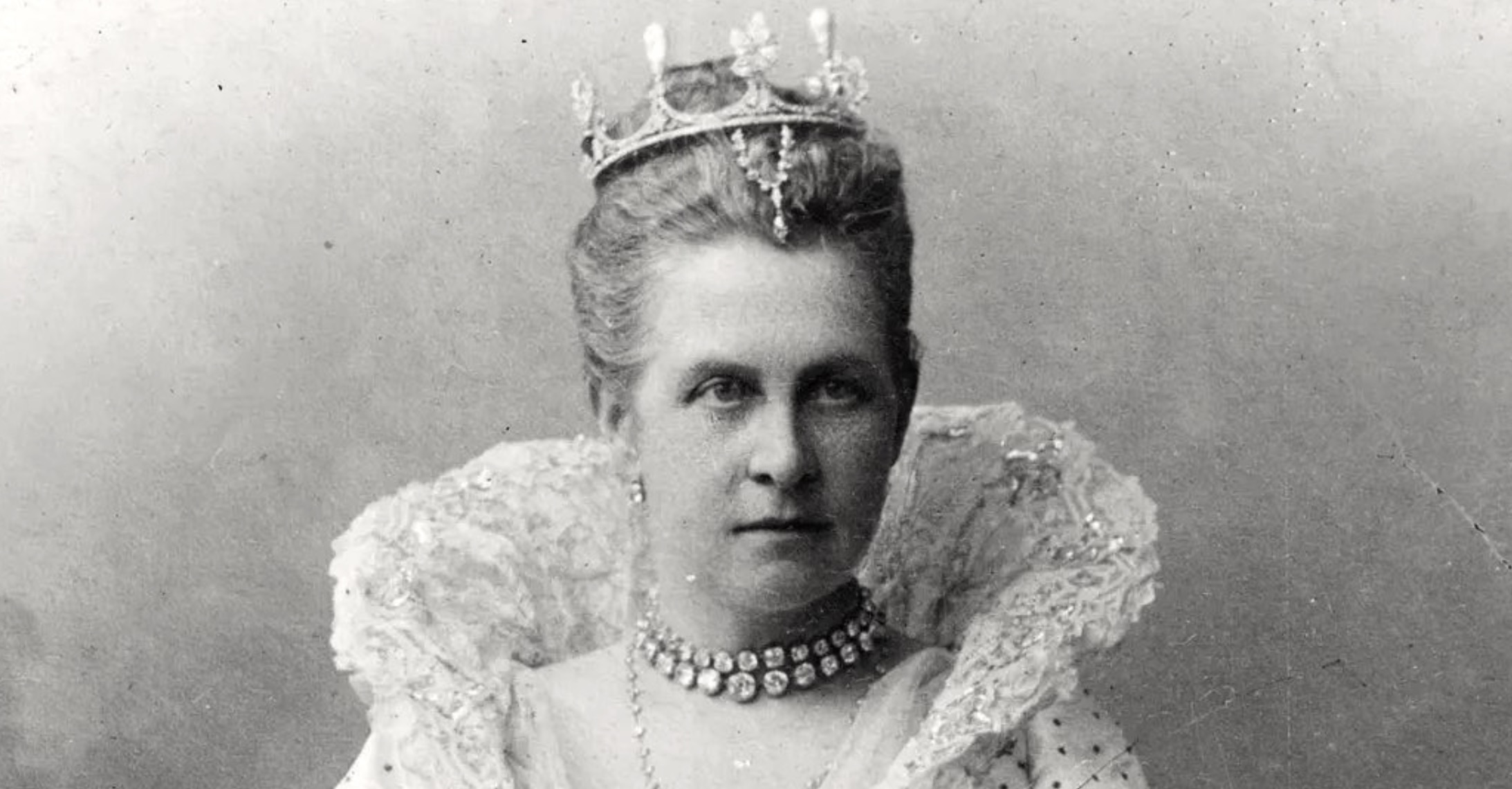
Composed of detachable Diamond Floral Elements atop a Diamond Coronet base, the exact origin of this Coronet is not known but it may have likely been among the wedding gifts given to Grand Duchess Olga when she married King George I of Greece in 1867.
The diadem appears to perhaps have been a coronet, wrapping around the wearer’s head. The piece’s diamond festoon base features a series of toppers that appear to have been interchangeable. In some images, the tiara appears to be topped by small round pearls.

The Diamond Coronet, topped with pearls, may have been depicted on Queen Olga in a portrait painted in the late 1860s, quite soon after her marriage.


Queen Olga notably wore the Diamond Coronet for a series of official portraits in the 1880s, paired with a large diamond floral corsage, which appears to coordinate with the elements atop the Coronet.

The Diamond Coronet also appears in a portrait of Queen Olga by Jean Doukas.

Queen Olga often wore the Diamond Coronet for Court Ceremonies as well, as she was described in 1888:
I looked up, and there was the stately form of King George, conspicuous with his orders and blue ribbon. Beside him, on his arm, was Queen Olga, a diamond tiara sparkling on her head.”


Around 1900, Queen Olga added pear-shaped Pearls atop the Coronet for what appears to have been a Costume Ball.

After being widowed, Queen Olga spent much of the First World War in her native Russia, at her brother’s Pavlovsk Palace, making a tumultuous escape, with only the swift actions of her lady-in-waiting, Miss Baltazzi, managing to save her jewels from the Bolsheviks, who ransacked the Palace. Prince Christoper wrote:
My mother had some beautiful jewels. Her rubies were famous, for my father had delighted in collecting them for her, saying that of all stones they suited her white skin best.
To her intense relief she was able to get her jewels out of Russia through the clever muse of her lady-in-waiting, Miss Baltazzi. It was by no means easy, for jewels were being smuggled over the frontiers almost every week, either by escaping nobility and their friends (usually foreigners attached to one of the embassies) or by thieves, who worked in regular gangs.
Their method of getting hold of the jewels was most ingenious. They had spies whose business it was to keep a watch both on the great families known to possess beautiful jewels and on the various Commissariats. Thus they knew more or less who was under suspicion and they would wait their opportunity until the house was raided and arrests made. Then in the confusion one or two of their number would enter it disguised either as soldiers or servants and get possession of the jewels, whose whereabouts they had previously ascertained. It was a risky proceeding, for the punishment was death, but their organisation was so close that they went undetected for a long time. They generally worked in conjunction with professional smugglers, usually Poles or Finns, who were willing to take their plunder out of the country for a share in it. But after a while their activities were observed and a close watch was kept on every frontier.
My mother had to be particularly careful as her jewels, especially one magnificent set of emeralds, were known to be of great value and had therefore probably been marked down. The lady-in-waiting made a box for them herself, not daring to trust it to anyone else. One day a Greek student called at the house to see Miss Baltazzi with a package of books which were exactly the same size and shape as the box of jewels. When he left he still carried his package, but the box was in it and the books left behind.
He went straight to the Danish Legation and delivered over the jewels, which were sent to Copenhagen.

While many of Queen Olga’s other jewels, like the Greek Emerald Parure, Ruby Parure, Diamond Rivière, Pearl Corsage Brooch, and Turquoise Parure passed down through her various descendants, the fate of the Diamond Coronet remains unknown. It could have been used to reset the Emerald Parure around 1914, or inherited by one of her other children who could have sold it off.


Greek Emerald Parure
Greek Ruby Parure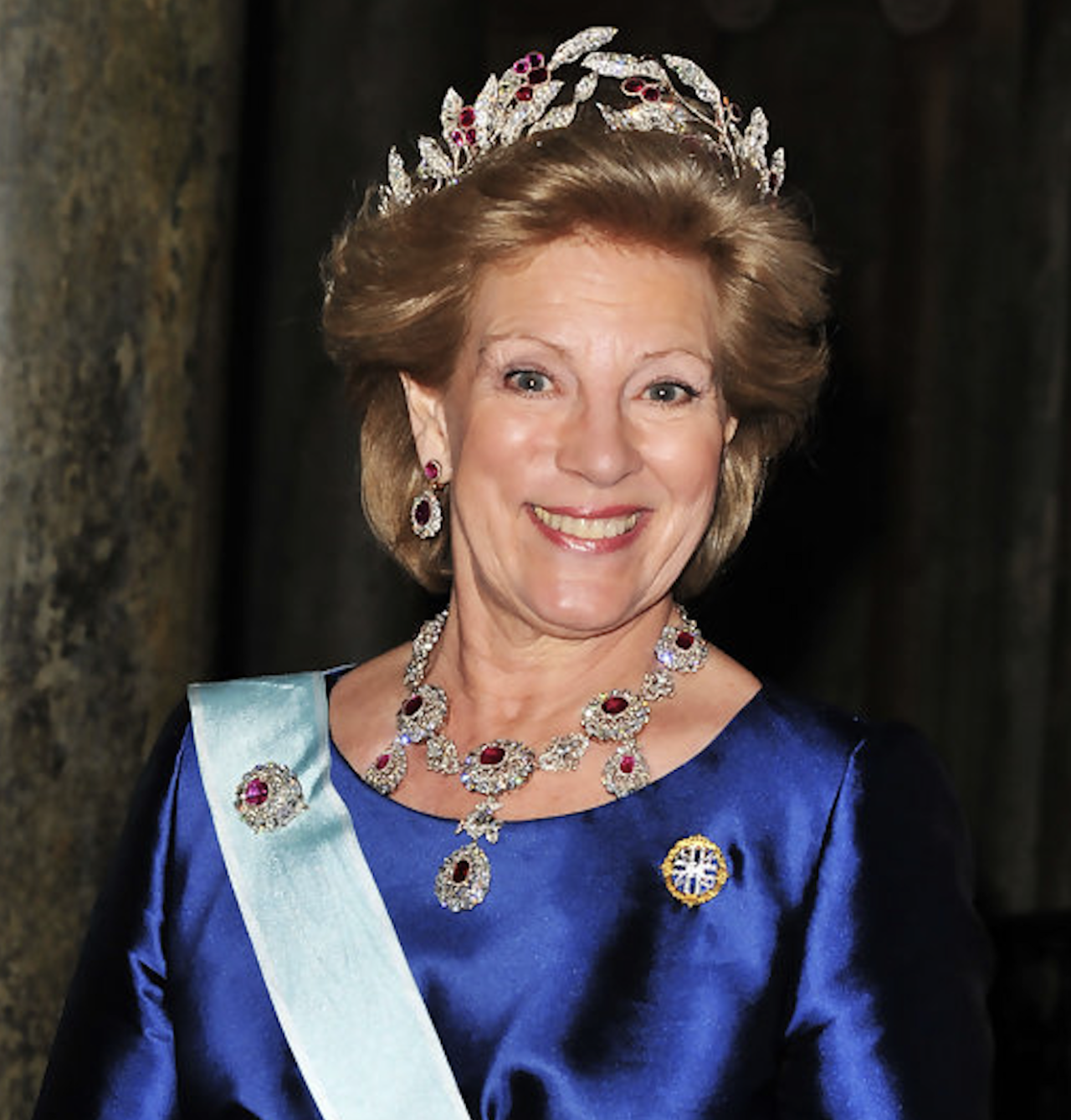
Khedive of Egypt Tiara
Antique Corsage Tiara
Pearl and Star Tiara
Diamond Stars
Aquamarine Pendant
Diamond Sautoir
Modern Diamond Necklace
Sapphire Necklace
Van Cleef & Arpels Ruby Necklace
Van Cleef & Arpels Suite