Today marks the 100th Anniversary of the Death of Queen Olga of Greece, who passed away on this day in 1926! The Russian Grand Duchess who married the first Greek King and was the grandmother of the Duke of Edinburgh among Royals from Greece, Spain, the United Kingdom, Romania, Serbia, and Italy, Queen Olga possessed a spectacular Jewellery Collection which made a dramatic escape from Revolutionary Russia!
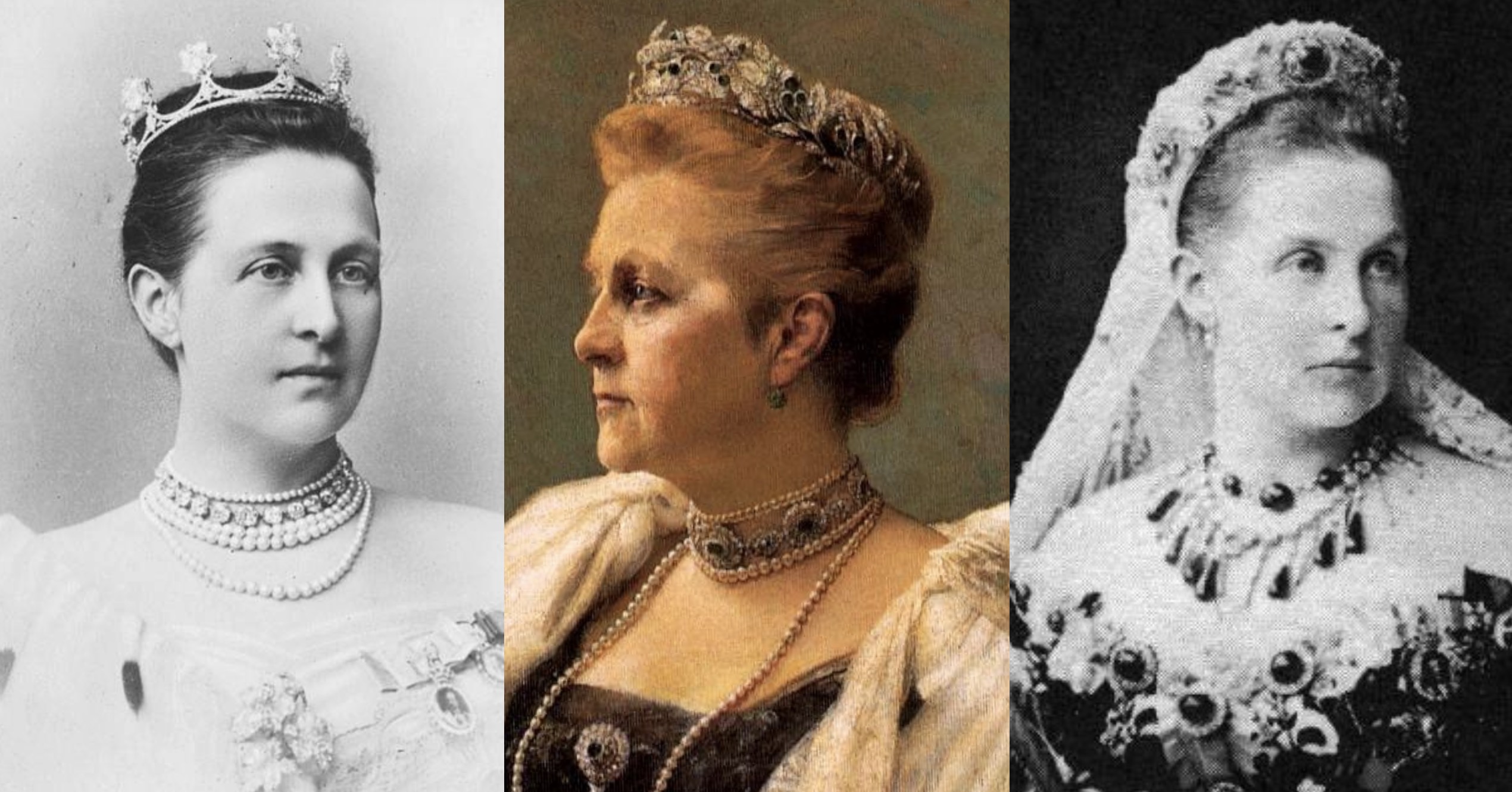
Greek Emerald Parure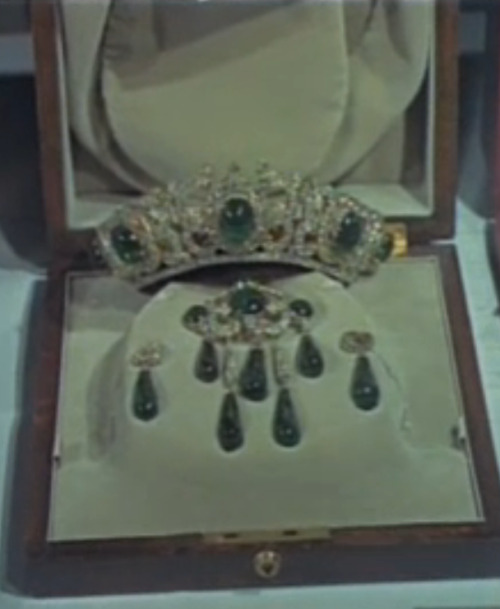

Origin: A Wedding Gift in 1867, likely from her mother Grand Duchess Alexandra Iosifovna of Russia
Fate: Given to her elder son, King Constantine I, and passed down the main line of the Greek Royal Family to Queen Anne-Marie of Greece
My mother possessed some perfect emeralds, including a cabochon as big as a bird’s egg. When I was eighteen, I borrowed it to wear at a masked ball in Athens, to which I had been invited. The guests came in historical Polish costumes and the jewel was an important accessory. She gave me the stone, warning me several times to take great care of it. I had fastened it as brooch to my hat. The last notes of the mazurka played and I was talking with my friends, when my sister-in-law, Princess Nicolas came over to me and said: ” The emerald on your hat is the largest I have ever seen. Can I look at it?” As soon as she took it from my hands, the stone came apart from its brooch setting and fell to the ground. Emeralds, unlike diamonds, are very fragile jewels and can shatter like glass. We stood stiff as stone as we watched the jewel roll on the carpet, toward the marble floor and feared the worst. Words cannot describe, how relieved I was, when I saw it stop its course, unharmed.”

My mother’s jewels seemed fated to undergo adventures in my hands. Many years later she and I were staying in Paris when she was obliged to return to Greece sooner than she had expected. I was to join her there a week later, stopping in Rome on the way. At the last moment she remembered that her famous emerald parure was at Cartier’s in Paris being reset, and begged me to take charge of it as soon as it was ready and bring it to her in Athens. “Tam going to give it to Tino for his silver wedding . . . so whatever you do, don’t lose it” . . . she besought me… . “It is not even insured,”
Before I left Paris M. Cartier delivered the jewels over to me, andI put them into my small valise, which J decided not to let out of my hands on the journey. I was not altogether at peace at the thought of travelling alone with jewels to the value of hundreds of thousands of pounds, and more than relieved to arrive in Rome without adventure. The first thing I did when I walked into the Grand Hotel was to deposit the precious package in the safe in the manager’s office.
I was to continue my journey to Athens next day, travelling by boat from Brindisi.
I was settling myself comfortably into my seat while the train steamed slowly out of the station when I made the dreadful discovery that I had forgotten my mother’s jewels !
They were perfectly safe, of course, in the custody of the hotel, but knowing how disappointed she would be, I felt that I could not arrive in Athens without them and confess my carelessness. I was racking my brains for a way out of the difficulty when I thought of my friend the special detective.
I summoned him into the carriage and told him what had happened. As I had guessed, he was a person of resource. He immediately suggested that when we arrived in Brindisi he should go back to Rome, collect the jewels and bring them on to me in Athens. This seemed 2 good plan, and we carried it out, I watched his departure with a sinking heart. He was my one hope ! Of course, my mother’s first question was: “ Where is my emerald parure ?” I regret to say that I lacked the courage to make a truthful reply and only mumbled something about it not being ready and being sent on by a special messenger. Fortunately she was contented with that.
But I was more than thankful to see my little Italian detective make his appearance at the Palace, forty-eight hours later, smiling and efficient as ever, carrying a white package which he placed in my hands. The sum I had to part with for railway fares, to say nothing of the gold watch with which I presented him as a souvenir of the occasion, made me regret my lapse of memory!
Greek Ruby Parure

Origin: An Anniversary Gift from King George I but likely an older Russian Royal Heirloom
Fate: Inherited by her second son, Prince Nicholas, and worn by his wife, Grand Duchess Elena Vladimirovna, and their daughters, Princess Olga of Yugoslavia and Princess Marina, Duchess of Kent, before being left to Queen Frederica of Greece, who gave it to Queen Anne-Marie of Greece as a wedding gift in 1964.
My mother had some beautiful jewels. Her rubies were famous, for my father had delighted in collecting them for her, saying that of all stones they suited her white skin best.
To her intense relief she was able to get her jewels out of Russia through the clever muse of her lady-in-waiting, Miss Baltazzi. It was by no means easy, for jewels were being smuggled over the frontiers almost every week, either by escaping nobility and their friends (usually foreigners attached to one of the embassies) or by thieves, who worked in regular gangs.

Their method of getting hold of the jewels was most ingenious. They had spies whose business it was to keep a watch both on the great families known to possess beautiful jewels and on the various Commissariats. Thus they knew more or less who was under suspicion and they would wait their opportunity until the house was raided and arrests made. Then in the confusion one or two of their number would enter it disguised either as soldiers or servants and get possession of the jewels, whose whereabouts they had previously ascertained. It was a risky proceeding, for the punishment was death, but their organisation was so close that they went undetected for a long time. They generally worked in conjunction with professional smugglers, usually Poles or Finns, who were willing to take their plunder out of the country for a share in it. But after a while their activities were observed and a close watch was kept on every frontier.
My mother had to be particularly careful as her jewels, especially one magnificent set of emeralds, were known to be of great value and had therefore probably been marked down. The lady-in-waiting made a box for them herself, not daring to trust it to anyone else. One day a Greek student called at the house to see Miss Baltazzi with a package of books which were exactly the same size and shape as the box of jewels. When he left he still carried his package, but the box was in it and the books left behind.
He went straight to the Danish Legation and delivered over the jewels, which were sent to Copenhagen.
Diamond Rivière

Origin: A Wedding Gift in 1867
Fate: Given as a wedding gift to her granddaughter, Princess Olga of Yugoslavia, in 1923, and sold by her descendants at auction in 2006.

The splendid diamond necklace once belonged to Queen Olga of Greece who was born a daughter of Grand Duke Konstantin Nikolayevich of Russia, himself a son of Tsar Nicholas I of Russia. When she was sixteen years old she met the young Danish-born King George I of Greece during his trip to Russia to meet with his sister Dagmar, the Danish wife of Tsar Alexander III. Olga and King George I fell in love and married in 1867. It is possible that the diamond necklace was one of her wedding presents as the time and splendour seems to be appropriate.
Queen Olga gave the diamond necklace to her granddaughter Princess Olga of Greece and Denmark – probably on the occasion of her wedding with Prince Paul of Yugoslavia in 1923, three years before Queen Olga’s death.
Pearl Corsage Brooch

Origin: Unknown, but possibly a Wedding Gift in 1867
Fate: Inherited by her son, Prince George, and worn by his wife, Princess Marie Bonaparte. Auctioned at Sotheby’s in 2010.
Turquoise Parure
Origin: Not known but modelled after a Parure of Oriental Turquoise made by Fabergé for the Russian Crown Jewels
Fate: Inherited by her youngest son, Prince Christopher, and sold by his widow, Princess Françoise, at the start of the Second World War.
Greek Emerald Parure
Greek Ruby Parure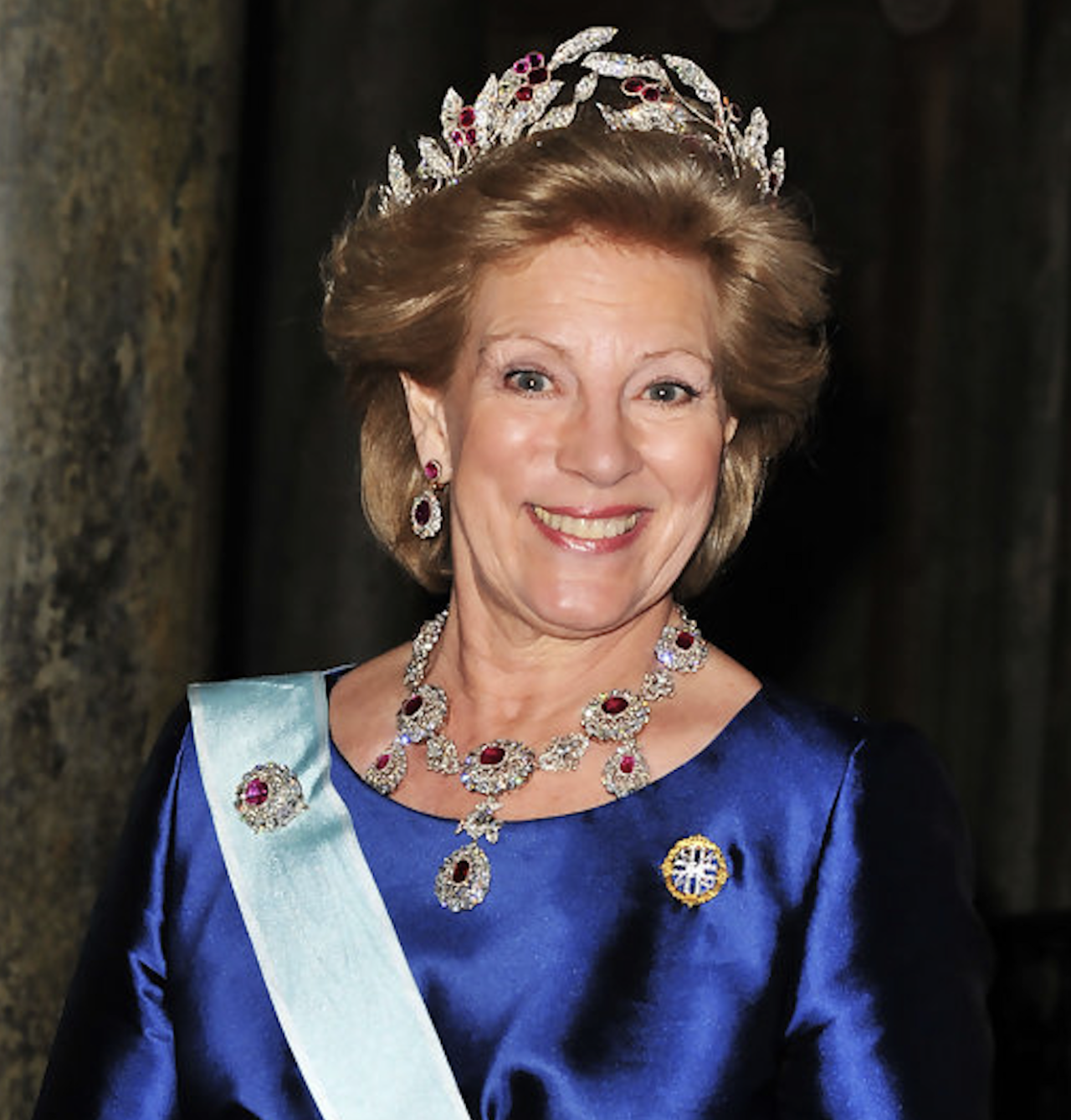
Khedive of Egypt Tiara
Antique Corsage Tiara
Pearl and Star Tiara
Diamond Stars
Aquamarine Pendant
Diamond Sautoir
Modern Diamond Necklace
Sapphire Necklace
Van Cleef & Arpels Ruby Necklace
Van Cleef & Arpels Suite
The first King of Greece was Otto I.