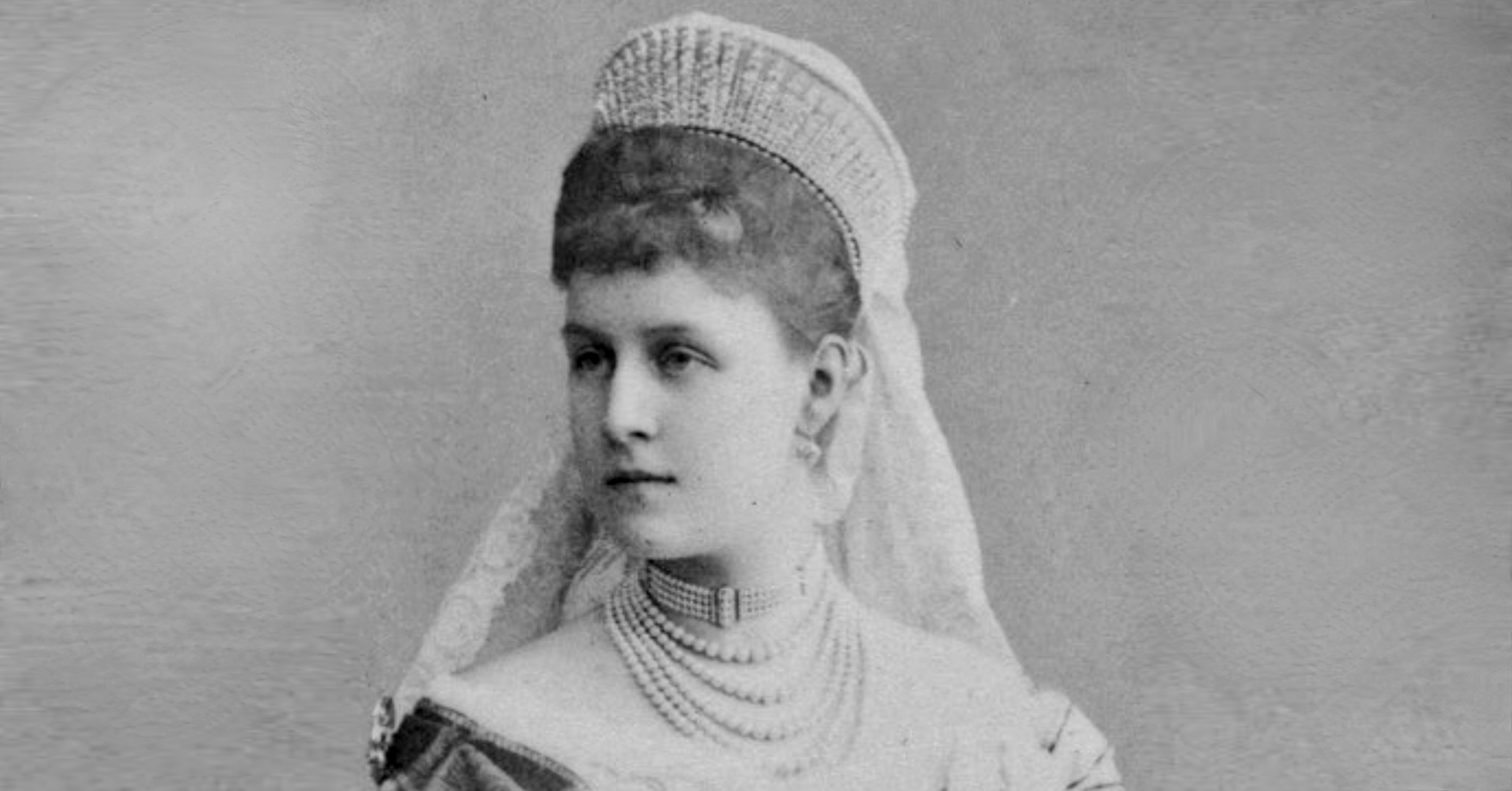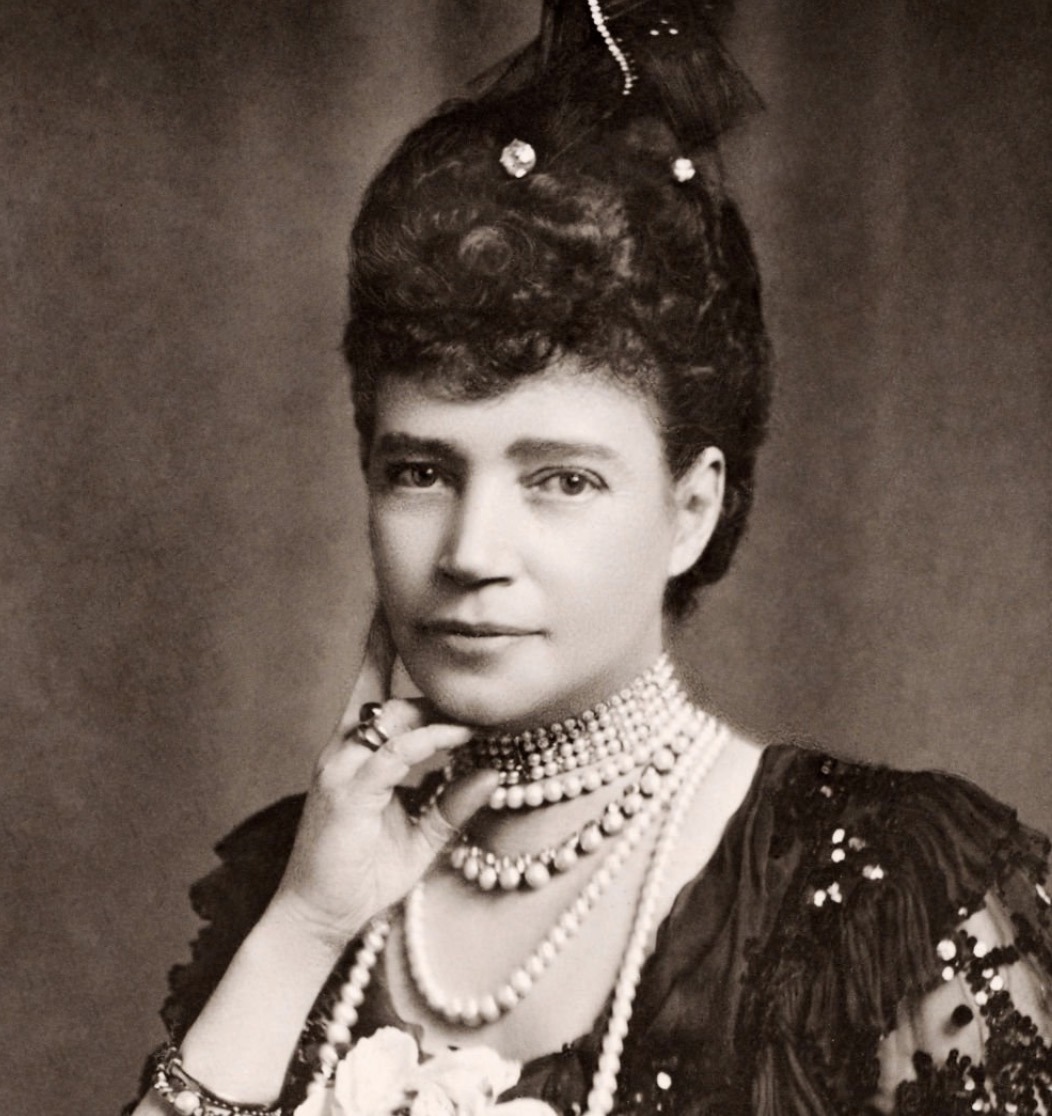
Today marks the 135th Anniversary of the Death of Grand Duchess Alexandra Georgievna, who tragically died in childbirth on this day in 1891! The Greek Princess who married a Russian Grand Duke had a spectacular Jewellery Collection which included this magnificent Diamond Fringe Tiara!

When Princess Alexandra of Greece and Denmark, daughter of King George I and Queen Olga of Greece, married Grand Duke Paul Alexandrovich of Russia, the son of the Tsar Alexander II, in 1889, she received many spectacular wedding gifts which included this traditional Diamond Fringe Tiara, which originates from the design of a Russian Kokoshnik.


Grand Duchess Alexandra Georgievna notably wore the Diamond Fringe Tiara for a portrait in Court Dress, paired with a massive Pearl and Diamond Corsage Brooch.

After Grand Duchess Alexandra Georgievna’s death in childbirth with Grand Duke Dmitri Pavlovich, her jewellery was inherited by her widower, Grand Duke Paul, with some pieces set to given to their daughter, Grand Duchess Maria Pavlovna, while others were reset for his second wife, Princess Paley. When Grand Duchess Maria Pavlova married Prince Wilhelm of Sweden, Duke of Södermanland in 1908, Grand Duchess Alexandra Georgievna’s Jewels were brought out, as she recalled:
Here, upon the billiard table, were spread the jewels, the furs, and the laces of my mother. My father wanted to divide them between Dmitri and myself before my marriage. In silence my father and aunt bent over the dusty jewel cases containing the old-fashioned settings and the tarnished precious stones, uncleaned, neglected now for almost twenty years. How many memories of which they no longer dared to speak–these objects brought to light! This fortune without lustre, spread out in front of me, half of it soon to be mine, did not impress me at all. Jewels were a part of our attire, they represented to me no more than a customary ornament. I saw no material value in them. While my father and my aunt discussed the way of dividing the jewels, the Countess and I examined the furs.

Grand Duchess Maria Pavlovna divorced in 1914, and the Grand Duchess returned to Russia with her jewels, which included a Cartier Sapphire Tiara, Grand Duchess Elizabeth Feodorovna’s Emerald Tiara, and Fabergé Diamond Chain, as well as her mother’s Diamond Fringe Tiara. She remarried to Prince Sergei Putyatin in 1917, and it was her parents-in-law who managed to retrieve her Jewels from the Bank in Moscow before they were confiscated:
The old Putiatins had succeeded, before private property belonging to the imperial family was finally confiscated, in taking my diamonds from the bank in Moscow. My mother-in-law made a sort of jacket which she wore under her dress; into this she sewed the greater part of the jewels The tiaras, which it was impossible to flatten, she tucked in the crowns of her hats.
As we needed money at that time we were obliged to sell some of the things–a difficult procedure; first, because there were no buyers; second, because we feared to attract attention. So only the small pieces were sold. The rest of the jewels we decided to keep in the house. Although this was very risky, there was nothing else to do.

Out of all the jewels, Grand Duchess Maria Pavlovna in particular mentions hiding a Diamond Fringe Tiara in a bottle of ink, which was put in full sight on her desk.
The problem now was to hide them. Already we had learned that during searches, attention was mainly directed upon chimneys, curtains, upholstered seats, pillows, and mattresses. Avoiding all such places, we found others, some of which, I must say, spoke well for our ingenuity. I had, for instance, a diadem in an old setting, consisting of diamond rays strung on a wire. I bought a large bottle of office ink and emptied it out; then, having unstrung the rays, I dropped them to the bottom of the bottle and poured paraffin over them. The last step was to pour back the ink. Since a large label surrounded the bottle, it was all but impossible to make out its contents. It stood for months on my desk in full sight of everybody.
Other things we fastened in home-made paperweights; still others in empty cocoa tins; dipped afterwards in wax and provided with a wick, they appeared to be ends of large church candles. We adorned the with spirals of gold paper and sometimes lighted them before the ikons to divert the attention of the servants.

The Grand Duchess managed to make a daring escape from Russia during the Revolution of October 1917, with most of her jewels having been sent earlier to Sweden:
My jewels concealed in the bottle, the jewelled paper-weight, and the candles had been sent to Sweden, when the opportunity had presented itself some time previously. I now sold some small pieces to provide us with money for the trip, and besides this, I sewed into my stays and my hat two or three brooches.

In 1919, Grand Duchess Maria Pavlovna’s Jewels were returned to her by the Crown Prince and Crown Princess of Sweden in London, as she recalled:
That same spring the Swedish Crown Prince and Crown Princess came to London from Stockholm and brought with them detailed news of my eldest son, and also my jewels. This was the first time since my divorce that I had come into contact with the Swedish royal family again. Of the Crown Princess I had kept the pleasantest of memories but, when she let me know of her intention to come and see me personally and bring me my jewels, I was somewhat taken aback.
The jewels were sent over from Sweden just as they had been delivered there from Russia- in the singular wrappings which were meant to conceal them from Bolshevik eyes in case of a raid on our house at Petrograd. They had been rather ingeniously hidden away in ink bottles, paper weights, and imitation wax tapers. Luckily for me the Swedes upon receiving this assortment of miscellaneous objects believed what they had been told, which was that they contained my jewels, I was quite astonished to recover them. They were extricated, some with great difficulty, from their complicated hiding-places and deposited in a bank. We were now running short of money and were obliged to turn to the jewels, which were our sole resource.
Business people, and amongst them the famous Colonel Boyle who had managed our departure from Odessa, advised me to arrange an auction at Christy’s and sell my jewels all at the same time; in this way I would have had some capital which might have permitted me to live, if not in luxury, at least free from worry. But I would not hear of such an arrangement and refused to listen to my advisers. I valued my jewels mainly because of the memories connected with them; the greatest part of them had been inherited, and I had always felt as though they had only been entrusted to me for as long as my life should last and that my duty was to pass them on.
All these tiaras, bracelets, and brooches in their old-fashioned settings were the only tangible bond with the past grandeur, not only my own but that of my grandmother’s and great-grandmother’s. Each time that I was obliged to part with a piece of jewellery I remembered its history, and, when it passed into the hands of the buyer, a bit of the past went with it. I realized the wisdom of the advice given me when it was too late and when the amount of my jewels had been reduced to such an extent that it was impossible to save anything.
Later on in Paris the market was flooded with Russian jewels. Their owners usually entertained exaggerated ideas about their value, but the dealers knew exactly who possessed important sets or collections of stones and, if they were offered for sale, came to an understanding not to overbid each other. Thus the most beautiful things went for practically nothing. The gradual sale of my jewels, which lasted over several years, constituted one of the painful experiences of my life as a refugee.

Grand Duchess Maria Pavlovna eventually opened a Russian embroidery shop, and in 1922, to fill an order for Chanel, she sold the Emerald Tiara to King Alexander of Yugoslavia, by when the Diamond Fringe Tiara had already been sold.
After The Russian Revolution, when money was urgently needed for survival, I had to change my mind and sell my jewellery collection. At that time, it was almost my only source of income.
Naturally additional jewels had to be sold, and it was precisely to avoid this that I had started to work. I had parted with most of them now except for two important pieces: my pearls and a large collection of emeralds, both of which I had hoped to be able to keep. I soon came to the conclusion, however, that the emeralds would have to go. But wanting to be cleverer than I had been in London when I began to sell my jewels I made up my mind to dispose of the entire collection at once.
All the circumstances surrounding this transaction were particularly painful. The emeralds were famous, and the dealers had decided to get them cheap. I felt this as soon as I had them valued, before even offering them for sale. Although I was finally forced to sell them at far below their value, the sum I derived from them was quite important. The news that I was in possession of a comparatively large amount of cash spread instantaneously, and we once more became a prey to all kinds of designing people.