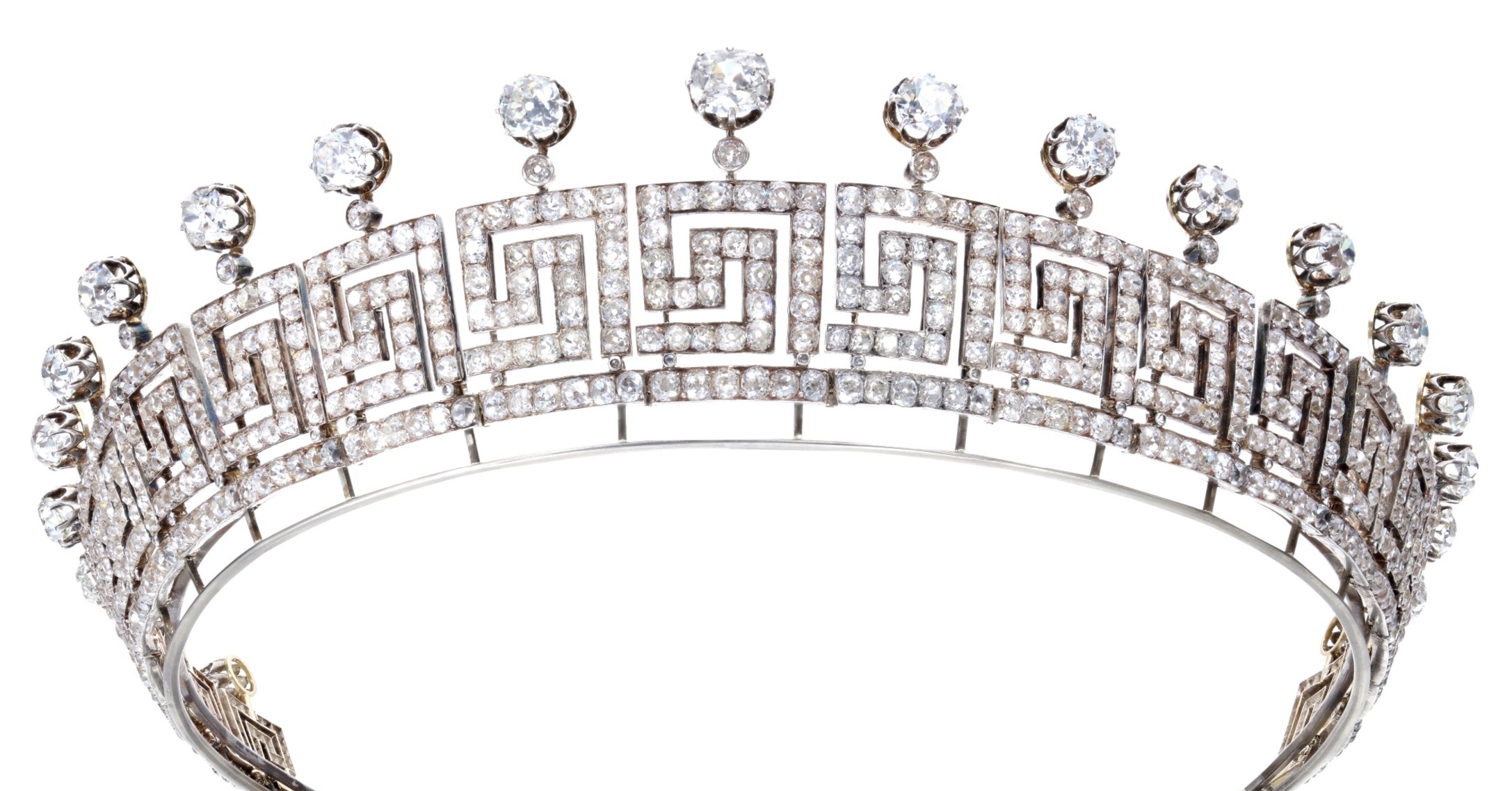
Among the many spectacular Royal and Noble Jewels on Auction in Geneva next week is the magnificent Mellerio Diamond Tiara of the first Countess of Paris, which is among the highlights of the Sotheby’s ‘Royal & Noble Jewels’ Sale!


A Mellerio dits Meller Diamond Tiara of meander design, set throughout with old mine-cut diamonds, accented by rose-cut diamonds, unsigned, detachable to be worn as a necklace; circa 1862 with later alterations.
The transformable diamond tiara was created by Mellerio dits Meller, the oldest jeweller on Place Vendôme, for the London International Exhibition of 1862. During the 19th century, the concept of a World Fair gained widespread popularity following the Great Exhibition of 1851 at the Crystal Palace. World Fairs became events held every few years to offer a showcase for the best each country had to offer in terms of industry and the arts. When Mellerio dits Meller exhibited at the 1862 World’s Fair, France was at the peak of the economic expansion and modernisation under the Second Empire of Napoleon III.


The selection of jewels presented by Mellerio at the World’s Fair, and in particular this highly important tiara, showed the influence of Ancient Greek and Roman art. This was a direct reflection of Napoleon III’s acquisition of the Campana collection for the Louvre in 1861. The Campana collection was assembled by Giampietro Campana (1809-1880) and encompassed many highly important archeological finds including notable ancient jewels. Acquiring part of this collection for the Louvre was an important prestige project for France to establish itself at the vanguard of world culture. Therefore, the timeless Greek key or meander design of the tiara, references both classical antiquity as well as the direct historical context in which it was made in order to showcase the glory and prestige of France.

When Princess Marie Isabelle d’Orléans married the Count of Paris, the Head of the House of Orléans, in 1864, she received a magnificent Sapphire Parure from their grandmother, Queen Marie-Amélie, and this spectacular Mellerio Diamond Tiara from her father, the Duke of Montpensier.
Paradoxically, though the tiara is inspired by a prestige project of the Second French Empire, it would become part of the collection of the dynasty that represented the previous regime: the Orléans family. In 1864, Antoine d’Orléans, the Duke of Montpensier and Galliera (1824-1890), the youngest child of King Louis Philippe acquired the exquisite piece for his eldest daughter Marie Isabelle when she married Philippe d’Orléans (1838-1894), the Count of Paris, the pretender to the French throne.
In 1864, when Marie Isabelle of Orléans (1848-1919) married Philippe d’Orléans, the Count of Paris (1838-1894), her parents gifted her this diamond tiara by Mellerio dits Meller. The bride’s father Antoine d’Orléans, the Duke of Montpensier and Galliera (1824-1890), was the youngest child of King Louis Philippe and Queen Marie Amélie who ruled France under the July Monarchie from 1830 to 1848. In 1846, he married the Spanish Infanta Louise-Fernande (1832-1897), the sister of Queen Isabella II of Spain. When the couple married their oldest daughter Marie Isabelle to her first cousin the Count of Paris, it was a clear dynastic statement fortifying the Orléans dynasty which until the mid-1880s retained a sizeable political support for a possible return to the French throne. The Count and Countess of Paris had eight children: Amélie Queen of Portugal, Philippe Duke of Orléans, Hélène Duchess of Aosta, Isabelle Duchess of Guise, Louise Princess of Bourbon-Two Sicilies and Ferdinand Duke of Montpensier.

The Mellerio Diamond Tiara was left by the Countess of Paris to her youngest son, the Duke of Montpensier, and later worn by his wife, María Isabel González de Olañeta e Ibarreta, Marchioness of Valdeterrazo, who wore the Tiara in the 1920s.
Marie Isabelle of Orléans bequeathed her diamond tiara by Mellerio to her youngest son Ferdinand of Orléans, Duke of Montpensier (1884-1924). He married the Spanish aristocrat María Isabel González de Olañeta e Ibarreta, Marchioness of Valdeterrazo in 1921. The latter wore the tiara during the 1920s and for the remainder of her life.

The Duke of Montpensier mysteriously passed away in 1924 and the Duchess was found to be the beneficiary, and after her death in 1958, the Mellerio Diamond Tiara was among the inheritance of her former Secretary turned secret husband.
In his will he had left a treasure trove of jewels and objets d’art to the head of the Maison de France. However, Aunt Bellina confiscated his drugs until he made a new will in which she would be the beneficiary. Then, strangely enough, he took an unusually large dose of drugs and died. Aunt Bellina inherited everything. Her sisters-in-law would never see her again.


The fate of the Tiara remained unknown until it has now come up for auction in the Sotheby’s ‘Royal & Noble Jewels’ Sale, with a presale estimate of 300,000 – 500,000 CHF Lets Hope we see the Tiara again soon!
Orléans Sapphire Parure
Orléans Sapphire and Pearl Tiara
Action Française Tiara
Coty Emerald Tiara
Diamond Bracelet Bandeau
Empress Joséphine’s Diamond Tiara
Chaumet Curvilinear Tiara
Queen Marie-Amélie’s Pearl Earrings
Countess of Paris’ Diamond Earrings
Sapphire Necklace Tiara

Orléans Sapphire Necklace Tiara
Orléans Sapphire and Pearl Tiara
Württemberg Diamond Tiara
French Crown Sapphire Earrings
Diamond Comb
Empress Eugénie’s Pearl Tiara
Orléans Sapphire Parure
Empress Eugénie’s Diamond Bow Brooch
French Crown Pearl Brooch
Maison Chaumet

‘Paris: City of Pearls’ Exhibition
I was in Buckingham Palace when the Queen died
Royal and Noble Jewels at the Victoria and Albert Museum