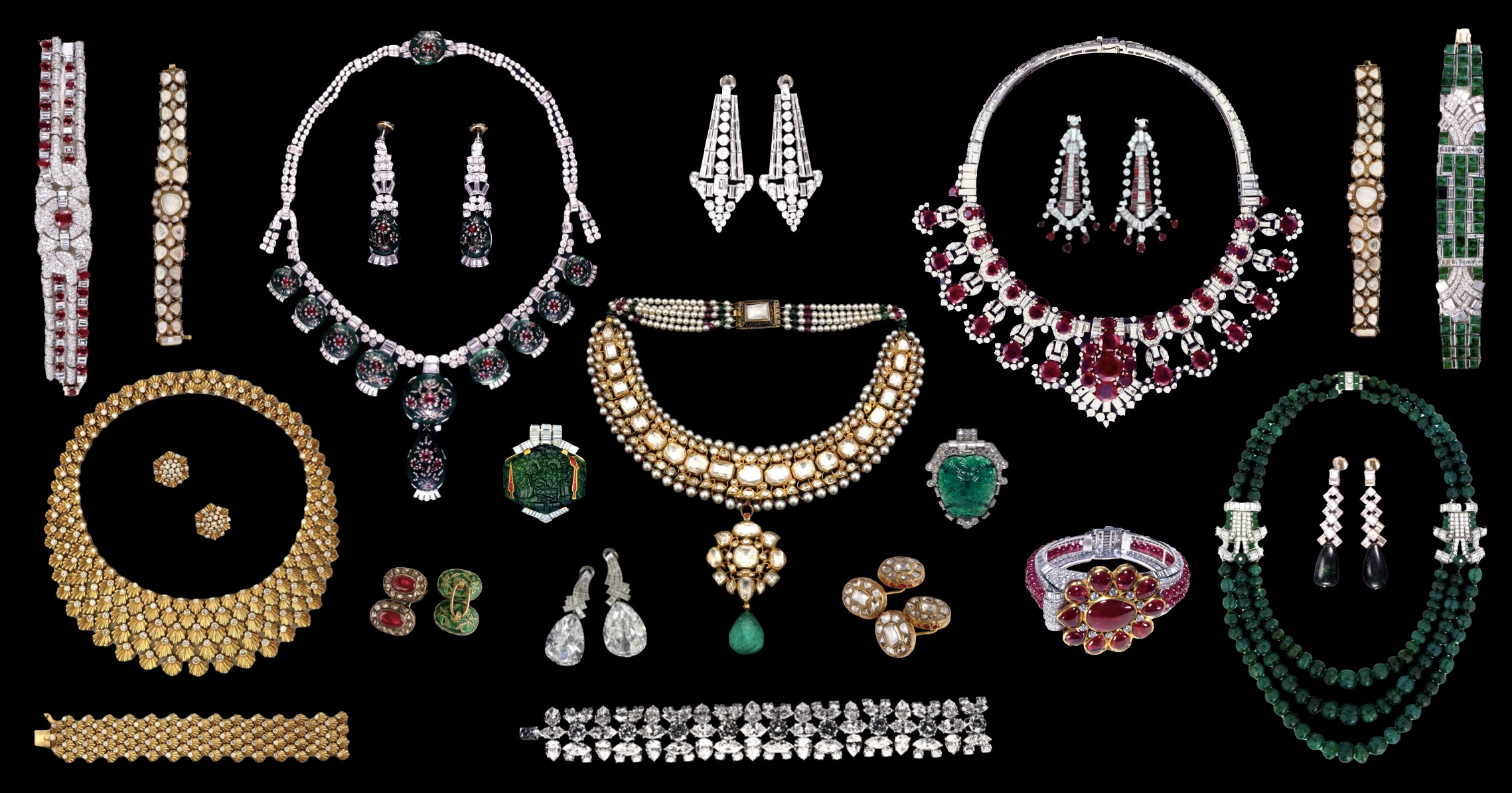
Tomorrow marks the Anniversary of the Birth of Maharani Gayatri Devi of Jaipur! The Cooch Behar Princess who married the dashing Maharaja of Jaipur, becoming the glamorous Maharani who won the world’s largest landslide election victory and was later jailed by the Indian Government ‘playing badminton with the prostitutes & murderesses’, Maharani Gayatri Devi possessed a spectacular jewellery collection, which she gave to the British Museum exactly 25 years ago!


Disillusioned by the state of India and its government, especially after being jailed during the Emergency, the Maharani of Jaipur seems to have anonymously donated some of her most prominent jewels to the British Museum around 2001, which included her Cartier Emerald Suite, Cartier Ruby Suite, Bulgari Gold Suite.


Though it is set to be known as an ‘Anonymous Gift’ until 2029, we wanted to reveal the provenance. Most of the Maharani’s Jewels are in Display Case 14 in Room 47 – Europe 1800-1900 of the British Museum, while the Indian Jewels are on display in the adjacent Islamic Art Gallery.

The cabochon emeralds inlaid with ruby and diamond flowers are Indian work of the 18th-19th century, set in the Western style with baton diamonds. They were probably intended for an Indian necklace in origin and have been re-used by Cartier to create a hybrid piece in the style of the 1930s.
 v
vCartier themselves travelled widely in India, to seek commissions from Indian clients who wanted their jewels reset in platinum in the Western taste and to bring back quantities of Indian stones and pearls which were then mounted for Western clients. Fashionable and artistic society in London and Paris adopted the exotic Indian style. At the international exhibition held in Paris in 1925, Cartier’s showpieces were set with magnificent carved Mughal emeralds.
Cartier Ruby and Diamond Necklace and Earrings

The central element of the necklace detaches for wear as a clip brooch. Maker’s marks. Contained in original fitted green leather Cartier case, with standard Cartier stamp in gilt lettering inside the lid

Stiff collars worn tight round the neck were fashionable in the early post-war years. Like many such necklaces, the central element detaches for wear as a clip brooch. The pointed clasp with its fancy-cut diamond is an integral part of the collar.

Although cased together by Cartier, the earrings are different in style from the necklace so must have been made at a different time and were not designed to match. They are unmarked.


Set of gold and diamond necklace (a) and earrings (b and c) in original box and bracelet (d) also in original separate box. The diamonds are set in tiny scallop shells with minimal links to give great suppleness. Maker’s marks on necklace and bracelet. Complete with original fitted Bulgari cases, one for the necklace and earrings, and a separate one for the bracelet, both covered in pink leather, the necklace case with central front opening forming two wings, each stamped in black on the silk lining: BVLGARI ROMA, the bracelet case similarly stamped in gold instead of black.

bought by donor in Rome circa 1953-54


Necklace of diamonds set in gold with pendant of diamonds and teardrop emerald. Pearls along edges of diamonds and in five rows at clasp, strung with rubies and emeralds. Enamel floral patterns on reverse. Thirty main diamonds.

Necklace, emerald beads with diamond and platinum settings, formed of strings of emerald beads, three graduated strings at the front and two strings of smaller beads at the back, secured with a pairs of diamond and emerald-set elements at each side and a barrel-shaped clasp at the back, also set with diamonds and emeralds. The diamonds in the clasp are all baton or baguette-cut, the emeralds table-cut; the side elements are set with a mixture of round and baguette-cut diamonds, and table-cut emerads. At the base of each element is an emerald bead encrusted with a small diamond. Maker’s mark. In original fitted red leather Cartier case with gilt tooling; the lid with central front opening forming two wings at each side, each printed in gold letters on the silk linin.

The Indian taste for uneven beads with smooth surfaces was thought barbaric by some in Europe, where the Western tradition was used to sparkling faceted stones. Cartier London made many necklaces with strings of beads in the late 20s and 30s for both Indian and Western clients. They were often combined with traditional Western-style diamond clasps. The baton cut is a long narrow rectangular shape that was popular between the wars. The beads in this necklace were probably date from the 18th or 19th century.
Cartier themselves travelled widely in India, to seek commissions from Indian clients who wanted their jewels reset in platinum in the Western taste and to bring back quantities of Indian stones and pearls which were then mounted for Western clients. Fashionable and artistic society in London and Paris adopted the exotic Indian style.

Emerald and Diamond Earrings
Pair of earrings, platinum and diamonds, in the form of a series of four lozenges from which hang with mismatching pear-drop emeralds. The diamonds are baton cut for the lozenges, with a square cut diamond at the join of each lozenge. Screw fittings.
These earrings were made to be worn with the necklace 2001,0505-1 and are probably contemporary with it, but they are unmarked and their manufacturer is unknown. The two emerald drops are quite different in shape. Both are Columbian in origin, like the emeralds in the necklace. The geometric settings with square and baton cut diamonds set in platinum are typical of the 1930s.

Cartier Ruby Bangle
Bangle, diamonds and a double row of rubies in asymmetrical platinum setting with a 19th century Indian central motif of a flower set with cabochon rubies and diamonds in gold, the back enamelled with flowers. The rubies in the central gold motif are all tear-drop shaped and face inwards, except for one, at the side, which faces outwards, presumably to make them fit round the central egg-shaped ruby. They are set in the characteristic Indian ‘kundan’ method.
The central motif with its enamelled flower sprays in white and green on a red ground on the reverse is characteristic of Jaipur work. The inner row of diamonds at the front however, bordering the central egg-shaped ruby, are an addition made by Cartier. To set off this antique Indian ornament Cartier have created a complete contrast: an up-to-date asymmetrical rigid scroll edged with geometric baton diamonds. The two rows of strung ruby beads preserve the Indian character of the central motif, but their colour is completely different: the rubies set in gold have taken on much of the gold colour of the setting that encloses them.
For the ‘kundan’ setting method, see O. Untracht, ‘Jewelry Concepts and Technology’ London 1982, p. 614, from which the following is taken: The word ‘kundan’ in Hindi means pure gold, and is applied to a flush stone closed setting type commonly practiced in India in the ancient past and still used today. A flat setting is gouged out of the gold, the stone placed into it, and a strip of folded pure gold foil is anchored by pressing it down with a burnisher into the space between the stone and the setting flange. The gold strip is then pressed completely around the stone and burnished down. Because pure gold is completely weldable in a cold state simply by compression, it forms a solid wedge that permanently holds the stone in place.

Diamond Earrings

Cartier Diamond and Emerald Clip Brooch
Diamond and platinum clip brooch (a) containing a carved hexagonal Indian emerald with figural subject inlaid with gold and ruby cypress trees, one with a bird. The inlay is executed in gold in the Indian ‘kundan’ technique, each tree set with specially shaped foiled rubies within the gold inlay. The bird’s eye is a tiny disc of pale blue glass. In the centre, a female figure seated on the throne, offering a bunch of grapes to a smaller male figure on her lap, with standing attendant female figures at each side, holding fly whisk (right) and playing stringed musical instument (left). Both have elaborate headdresses. Below the throne, an antelope and a cow (?).
The stone has a gold frame with four gold clips at top and bottom to hold it in place. The angled edges of the stone point up and down, and the setting is designed to echo the pointed shape with a single kite-shaped diamond at the base and rows of baguette-cut diamonds at top and bottom, set to follow the angled edge of the stone. A barrrel loop at the top consisting of three rows of horizontally-set baguette diamonds forms the hinge for the double prong fitting at the back. At the base is a hinged angled bar with snap loop enabling it to be lifted up. Two reverse pointing short prongs are attached to the frame at the top to secure the brooch firmly.

Cartier Diamond and Emerald Clip Brooch
Diamond and platinum clip brooch containing a carved Indian emerald, with hinged fitting for the double prong at the top and set with round and baguette-cut diamonds, forming a lotus-like flower head. The stone itself is Mughal late 17th-early 18th century and bears on the front a single bloom with radiating petals, the tips of which are turned over creating a three-dimensional effect. At the back the carving depicts a triple leaf with surrounding foliage. The stone is drilled at top and bottom with suspension holes for hanging on a necklace. The setting forms a cage at the back to secure the stone; when the hinged double prong fitting is opened, a pair of short reverse pointing prongs is visible on the upper bar of the cagework frame to hold the brooch firmly in place.
This emerald was probably carved in the late Mughal period in view of the rather geometric nature of the flower on the front of the stone. It does not have the chevron pattern round the sides normally found on earlier Mughal stones. The drilling for the suspension holes has been done from both sides at an angle in the typical Mughal manner.
For further discussion of Cartier’s Indian style and their use of emeralds, see J. Rudoe, ‘Cartier 1900-1939’, exhibition catalogue, British Museum 1997 (revised ed. New York 1999). See also S. Stronge, ‘Cartier and the East’, in ‘Cartier. Papers of the Symposium held by the British Museum and the Society of Jewellery Historians in 1997’, published as ‘Jewellery Studies’ vol 9, 2001, pp. 65-77.

Diamond Bracelets
Gold, enamel, and diamond bracelet with 12 pairs of diamonds and large central diamond, surrounded by ten smaller diamonds. Red floral enamal decoration on white enamel ground on reverse. One of a pair, in a red leather Piaget box.

Bracelet
Diamond and ruby flexible platinum bracelet with three central interlocking rings and chains in the form of a dimaond cylindrical loop that passes through the outer rings on each side and is flanked by dimaond and rubies. Pull out barrel clasp.
This and the following bracelet illustrate the two approaches, one geometric, the other fluid and curvy, that ran in parallel in the later 1930s. This bracelet has a rounded three-dimensional feel with its central rings and cylindrical chains forming a loop at each side. The emerald bracelet (2001,0505.12) has a flatter, more rigid feel with its square-cut stones.

Bracelet
Diamond and emerald flexible platinum bracelet with square cut emeralds and baton-cut and round diamonds.
This bracelet was probably made in India but in the Western taste. Together with the previous bracelet it illustrates the two approaches, one geometric, the other fluid and curvy, that ran in parallel in the later 1930s. While the ruby bracelet (2001,0505.11) has a rounded three-dimensional feel with its central rings and cylindrical chains forming a loop at each side, this bracelet has a flatter, more rigid feel with its square-cut stones.

Bracelet
Diamond and platinum bracelet set with circular, navette and pear-shaped diamonds, held together by minimal settings. Tongue made of white gold. Marks.
Harry Winston (1896-1978) opened his first shop in1932. He bought the famous blue ‘Hope’ diamond from the collection of Evalyn Walsh McLean and soon became known for his rare stones. This bracelet typically uses fancy-cut stones such as marquise (pointed oval) and pear shapes, the most difficult and expensive to cut, held together magically by minimal settings. Ambaji Shinde, chief designer at Winston from 1961-2001, created many such designs. A number of these are illustrated in A.Gregory, ‘Harry Winston. Rare Jewels of the World’, Paris 1998 (unpaginated).

Ring
Gold finger-ring set with large 19th century Mughal pyramidal emerald, bordered with baton cut diamonds. Contained in rectangular red leather box with deep yellow velvet pad in base and cream silk lining to lid, printed with retailer’s name: ‘Chimanlal Manchand & Co. BOMBAY. 4.’
This pyramidal emerald was probably mounted in its platinum and diamond setting around 1940 in India. The large chunky setting is Western in taste: the diamonds are all baton cut (in the shape of a long narrow rectangle). But the stone has been set upside down: the pyramid is actually the lower part of the stone or ‘pavilion’; the faceted surface or ‘table’ is at the bottom and cannot be seen. A Western jeweller is unlikely to have set it like this.


Cufflinks
Pair of gold and enamel cuff-links set with diamonds and a ruby.
Pair of cuff-links, enamel and gold with ruby and diamonds, one half oval, the other half with one octagonal stone and one oval. 20th century
Pair of cuff-links, diamonds set in gold. In purple velvet box
Pair of cuff-links, octagonal, enamel and gold. 20th century. In purple velvet box with 2001,0521.36, 37 & 39. No. S55

Diamond Pendant
Pear shaped diamond pendant mounted in a simple platinum setting formed of a double wire frame.
Diamond Belt
Belt with large diamonds set in gold, enamelled on the back. Gold thread.