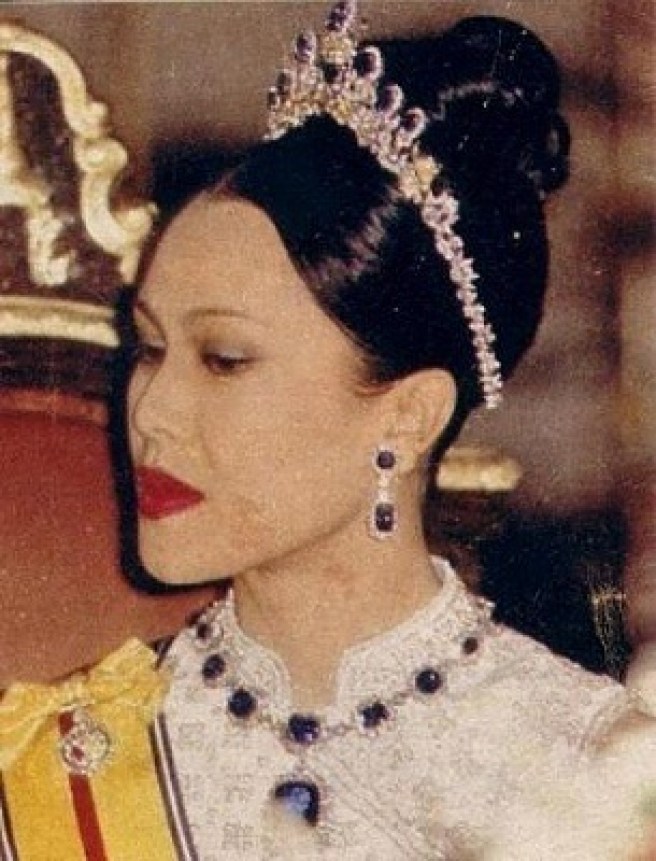
Earlier this week, we were in Paris to visit the spectacular ‘La Mode en Majesté’ Exhibition at the Musée des Arts Décoratifs in Paris, which celebrates the intersection of Thai Royal Textile Traditions and French Haute Couture for the 170th anniversary of diplomatic relations between Thailand and France, and the 340th anniversary of first contact between Siam and France!


Over one hundred exceptional outfits and accessories from Queen Sirikit, Queen Suthida and Princess Sirivannavari are on display ‘La Mode en Majesté’ Exhibition, which showcases the eight official styles of Chud Thai Phra Ratchaniyom and highlights Queen Sirikit’s historic collaboration with couturiers Pierre Balmain and Erik Mortensen, alongside embroideries from Maison Lesage.
Featuring over one hundred exceptional outfits and accessories, the exhibition showcases the royal wardrobes, highlighting the eight styles of traditional Thai costumes designed by Her Majesty Queen Sirikit in collaboration with a team of local Thai historians and designers. Furthermore, the exhibition illuminates the unique history of cultural and artistic dialogue, marked by over thirty years of collaboration between Her Majesty Queen Sirikit and the fashion designer Pierre Balmain, and subsequently continued with the Balmain and Lesage fashion houses.
This exhibition is organized in collaboration with the Queen Sirikit Museum of Textiles (QSMT) in Thailand and the Sustainable Arts and Crafts Institute of Thailand (SACIT). The exhibition is part of the celebrations marking the 340th anniversary of the first diplomatic relations and the 170th anniversary of the establishment of diplomatic relations between France and Thailand.

Siam-France relations began in the 17th century with diplomatic missions connecting the courts of King Narai of Ayutthaya and King Louis XIV at Versailles in 1685-1686. Two centuries later, King Mongkut (Rama IV) entered into a Treaty of Friendship, Commerce and Navigation in 1856, ushering in a new era of Franco-Siamese exchange. In the 20th century, this dialogue took on a unique form when Her Majesty Queen Sirikit commissioned the Parisian fashion designer Pierre Balmain to create her Western wardrobe and help reform traditional Thai dress.
Presented for the first time in France, nearly 200 objects are brought together-including garments worn by members of the Thai royal family alongside accessories, textiles, photographs and contemporary creations by Thai designers.


THAILAND AND FRANCE A DIALOGUE THROUGH DRESS
Across centuries, garments have served as visual statements through which Thailand presented its identity, dignity and cultural refinement to the world. Tracing the evolution of Thai royal dress as a meeting point of tradition, craftsmanship and international exchange, the exhibition reveals how garments, textiles and embroidery serve as powerful expressions of Thailand’s cultural identity and diplomacy.


From the 1960s, Her Majesty Queen Sirikit played a pivotal role in shaping the modern image of Thai dress. She introduced a distinctive range of female national dress styles for the international stage. In collaboration with the Parisian couturier Pierre Balmain, Thailand’s rich textile traditions were adapted through haute couture techniques.
The garments displayed here reveal how Thai textile traditions, court dress and French couture techniques came together to form a distinctive visual language.


THE EIGHT STYLES OF THAI DRESS FROM ROYAL VISION TO NATIONAL IDENTITY
The Eight Styles of Thai Dress mark a defining moment in the modern history of the Thai national identity. Conceived under the vision of Her Majesty Queen Sirikit in the mid-20th century, they transformed historical court attire into a modern system of national identity.
In preparation for state visits to Europe and the United States in 1960, Her Majesty initiated research into historical Thai court dress and developed eight formal styles for women, known as Chud Thai Phra Rajaniyom (Thai outfits of royal favour), each designed for specific social and ceremonial occasions, a tradition now nominated for UNESCO’s Representative List of the Intangible Cultural Heritage of Humanity.


Garments from members of the Thai royal family including Her Majesty Queen Sirikit, Her Majesty Queen Suthida Bajrasudhabimalalakshana and Her Royal Highness Princess Sirivannavari Nariratana Rajakanya–demonstrate how these forms remain a living tradition within the royal family today.


CELEBRATION OF HANDS TRADITIONAL THAI CRAFTSMANSHIP
This room pays homage to the artisans behind Thai crafts-manship. Yan lipao basketry, damascening and nielloware were once used to create items for courtly and everyday life, such as containers, utensils and objects of etiquette known as regalia. This is notably true of bencharong porcelains and metal wares. Over time, these techniques have also been used to create accessories for traditional Thai dress, such as handbags and purses, as well as painted fans. Such creations require the mastery and patience of skilled hands.
Today, they accompany traditional Thai dress, allowing objects once defined by their function to assume new roles within ceremonial attire. Many of these traditions are preserved through the work of the Queen Sirikit Institute, a vocational training centre established at Chitralada Palace. Films document the gestures and techniques that bring these artworks to life.


BALMAIN FOR HER MAJESTY QUEEN SIRIKIT A WARDROBE FOR HISTORY
In 1959, Her Majesty began a close collaboration with the Parisian couturier Pierre Balmain. The wardrobe of Queen Sirikit soon became a powerful expression of Thailand on the international stage.

Working with Balmain and the embroiderer François Lesage, she developed garments that brought together Thai textiles and motifs with haute couture craftsmanship. Over the years, Balmain named more than 20 designs “Bangkok” and “Sirikit”, reflecting the lasting influence of this collaboration.


Created for state visits and official occasions, these garments were conceived with attention to the cultures and customs of the countries visited. Through these couture creations, fashion became diplomacy.
“A queen’s wardrobe goes with her into her country’s history. Her dresses must carry the stamp of enduring elegance and guard against becoming antiquated.” Pierre Balmain, in My Years and Seasons (1964)


BROCADE TEXTILES IN THAI COURT DRESS
Among Thailand’s textile traditions, brocade holds a special place in court culture. Woven with supplementary threads of gold or silver, these richly patterned weavings create shimmering surfaces whose designs signal rank and ceremony.
Historically reserved for royalty and the highest nobility, brocade fabrics were worn by court ladies and members of the royal household. Portraits from the late 19th century, during the reign of King Chulalongkorn (Rama V), show women wearing pleated pha nung skirts and chong kraben trousers draped from these luminous fabrics.
This section presents royal garments and brocade textiles, showing how these traditions–from gold-thread court brocades to regional weaving traditions such as khit, chok and phrae wa- -are kept alive through renewed use in royal and contemporary dress.


MAT MI FROM VILLAGE LOOMS TO PARIS COUTURE
For generations, mat mi (ikat) was woven by village women in north-eastern Thailand, its motifs shaped by memory, belief and local identity. The softly blurred patterns emerge only when the dyed threads are aligned on the loom, revealing the quiet precision of the weaver’s hand.
In the late 20th century, the textile gained wider recognition through the SUPPORT Foundation, which was established by Her Majesty Queen Sirikit to preserve traditional crafts and support rural artisans. Through this initiative, mat mi became an important source of income for village weaving communities.
After the death of Pierre Balmain, Her Majesty continued working with Balmain designer Erik Mortensen, and later with the houses of Dior and Valentino. The garments shown here include creations by Balmain and Dior. Lesages inventive embroidery often highlights the motifs and natural beauty of mat mi.


THE FUTURE OF TRADITION FROM COURT TO CATWALK
Modern Thai dress emerged in the 20th century through the vision of Her Majesty Queen Sirikit, who transformed historical court attire into a living national form. Rather than fixing tradition in the past, this vision allowed Thai dress to evolve while preserving its distinctive identity.
Since then, Thai dress has continued to develop through new interpretations by contemporary designers. Today, what defines contemporary Thai dress rests on three enduring elements: the use of Thai silk, the language of draping and wrapping cloth around the body and new adaptations of the eight styles.
The garments presented here show how designers extend this dialogue between heritage and creativity, renewing Thai dress for the present while remaining unmistakably Thai.