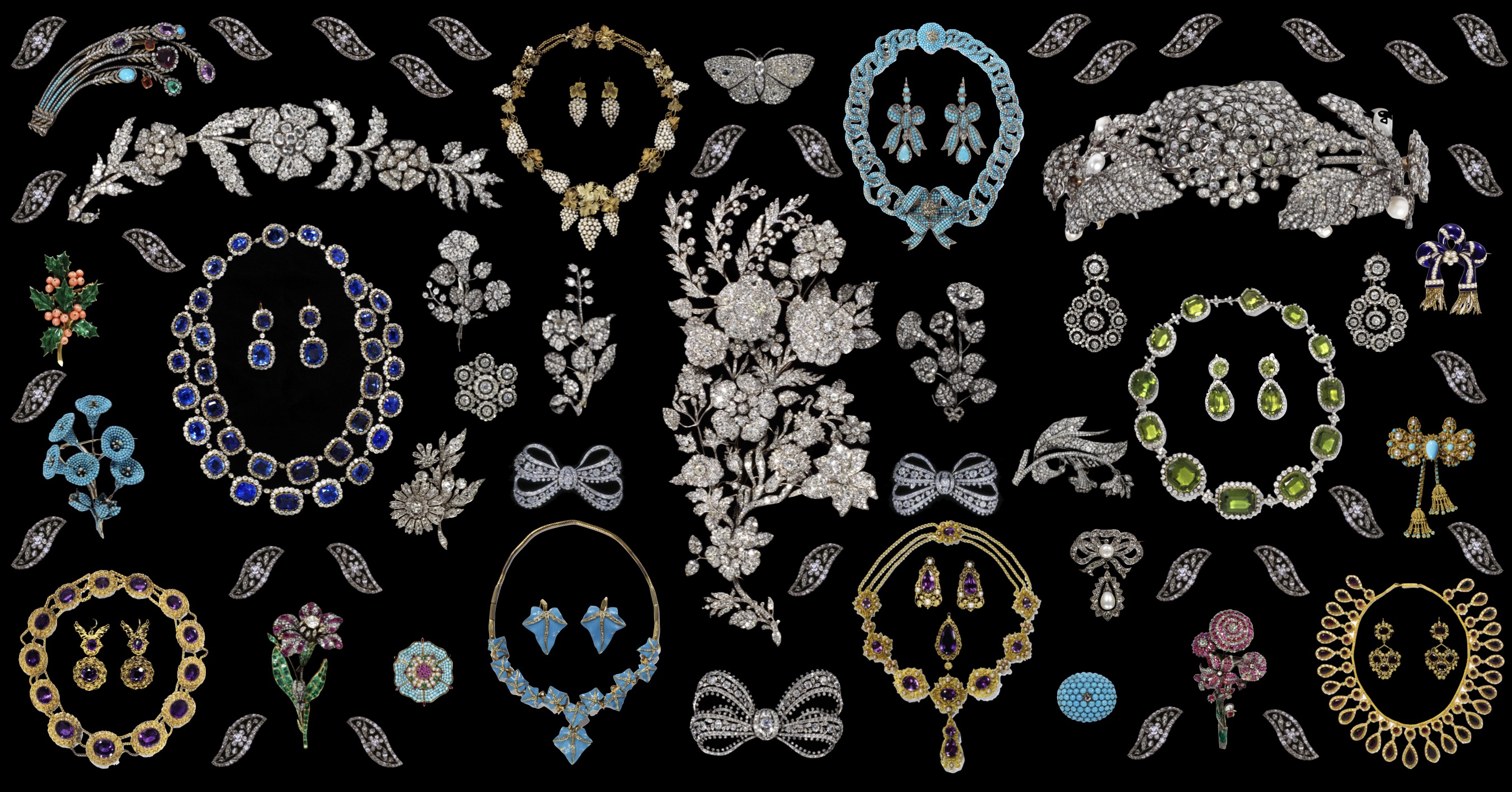
Yesterday marked the 160th Anniversary of the Birth of Jane, Lady Cory née Lethbridge, who was born in 1865. The Socialite and Art Collector left her magnificent Collection of Jewellery from the 18th and 19th Centuries to the permanent collection of the Victoria & Albert Museum in London upon her death in 1947!


When you go through the spectacular Jewel Room at the Victoria & Albert Museum, you often see many of the most magnificent 18th and 19th Century jewels are attributed to the ‘Cory Bequest’.
Lady Cory was a keen pianist, needlewoman and collector, who married Sir Clifford Cory, a Welsh colliery owner and a Liberal politician.
 Diamond and Pearl Tiara
ca.1850
Tiara in the form of a wreath, brilliant-cut diamonds with a few rose-cut specimens in three attached units, set in silver and backed with gold. The basic structure is a wreath of Neoclassical design. The honeysuckle palmette on a trembler a later addition of 1860–80, replacing a damaged flower
Wreaths of flowers and foliage were in fashion throughout the 19th century. Sometimes they included real flowers, or artificial ones made of fabric, wax or porcelain. Here the flowers and foliage consist of diamonds and pearls. At Queen Victoria’s coronation, her attendants wore wreaths of silver corn-ears.
Naturalistic jewellery, decorated with clearly recognisable flowers and fruit, was popular for much of this period. These motifs first became fashionable in the early years of the century, with the widespread interest in botany and the influence of Romantic poets such as Wordsworth. By the 1850s the delicate early designs had given way to more extravagant and complex compositions of flowers and foliage.
At the same time, flowers were used to express love and friendship. The colours in nature were matched by coloured gemstones, and a ‘language of flowers’ spelt out special messages.
 Dress Ornaments
Pfisterer, Leopold
1764
In 1764, the Empress Catherine the Great commissioned the goldsmith Leopold Pfisterer to make a large suite of diamond and Bohemian garnet jewellery. It was composed of a necklace, bracelets and other jewels. On the reverse of the diamond ornaments are tiny holes through which passed threads strung with garnet beads.

Two of the jewels are inscribed with their inventory numbers and gemstone weights in carats. One also has the year of the commission and the monogram of Leopold Pfisterer.

It is rare for such magnificent diamond jewellery to survive intact, because succeeding generations tended to melt it down and re-make it in the latest fashion. The set was formerly part of the Russian Imperial Collection. It was sold by the Bolshevik government after the Russian Revolution of 1917.
 Diamond Spray Ornament
ca. 1850
Naturalistic jewellery, decorated with clearly recognisable flowers or fruit, emerged with the Romantic movement in the early 19th century. It remained popular for many decades. This large spray of assorted flowers has a pin fastening at the back and would have been worn as a bodice ornament.

Some of the diamond flowers are set on springs, which would increase their sparkle considerably as the wearer moved. Over time the floral motifs grew in size and scale, and by the 1850s bouquets had taken on dramatic proportions. Individual flower sprays could be removed and used as hair ornaments.
 Diamond Spray
ca. 1860
By the mid 19th century naturalism in jewellery had come to include movement. Flexible or coiled stalks (tremblers) made the flowers and fruit quiver and glitter when the wearer moved.
The larger floral pieces created a glamorous display on grand occasions but could also be dismantled into smaller, more wearable elements, such as brooches.
Floral jewellery made a touching gift of love or friendship. It could also convey symbolic messages. In The Language of Flowers, first published by Mrs Burke in 1856, the lily of the valley signified a return of happiness, while the convolvulus could have a number of meanings – from the bonds of love to repose or even extinguished hope.
 Bodice Ornaments
ca. 1760
This bow brooch is the largest from a set of three. The bows would have been worn together: the largest on the front of the bodice, the smaller bows on the shoulders. It is rare for such magnificent diamond jewellery to survive intact, because succeeding generations tended to melt it down and re-make it in the latest fashion.
This bow forms part of a set with two smaller bows (M.94&A-1951). The relative sizes of the bows, one larger bow with two smaller ones of approximately equal size, suggest that the large bow would have been worn as a breast ornament, with one bow worn on each shoulder.
A Russian origin has been suggested for the bows, as is the case for other items in Lady Cory’s bequest. They are not listed in the Diamond Fund catalogue compiled at the order of the Bolshevik government and they were not amongst that part of the Russian royal jewellery sold by a syndicate at Christie’s on 16 March 1927. However, Dr. S. A. Amelekhina (State Museums of the Moscow Kremlin) states that the Diamond Fund Catalogue is known to have been incomplete.
The present brooch fittings are later. The bows may originally have been mounted on vertical pins, like examples in the Diamond Fund in the Kremlin (illustrated in Olga W. Gorewa et al., Joyaux du Trésor de Russie, Paris, 1990, p. 51). Dr Amelekhina notes that there were six bows mounted on pins listed in the 1865 inventory of the Diamond Room of the Winter Palace, St Petersburg (Russian State Historical Archive, St Petersburg, complex of documents 468, inventory 43, units 1026 and 1027.
 Sapphire and Diamond Necklace and Earrings
ca. 1850
The necklace was adapted in the 1930s from a single row necklace to a double row, probably for Lady Cory; the accompanying earrings possibly made from parts of the necklace.
 Peridot and Diamond Necklace and Earrings
1st half 19th century
The three large central units of the necklace probably date from about 1810, and may originally have formed part of a tiara or another necklace. The rest of the units, and probably also the earrings (M.118A&B-1951), are of a later date.
 Diamond Spray
ca. 1830-ca. 1870
 Diamond Spray
ca. 1851
 Diamond Spray
ca. 1851
 Spray
Spray
ca. 1880
 Convolvulus
ca.1835-ca.1850
Brooch in the form of a convulvulus flower, gold, pavé-set turquoises and pearls. Naturalistic jewellery, decorated with clearly recognisable flowers or fruit, emerged with the Romantic movement in the early 19th century. It remained popular for many decades. Sentiments or meanings were often attached to particular plants. The convolvulus was thought to symbolise ‘bonds’ or ‘extinguished hopes’.
 Hair ornament
ca. 1820
A love of nature was one of the most universal and respected sentiments in the 19th century. Naturalistic jewellery, influenced by the Romantic movement and the revived Rococo style, developed early in the period. Its success was due to the beauty and wearability of jewelled flowers and foliage, but also to the continuing interest in botany.
Until around 1830 the designs were stylised and delicate. Later, the ever-more precise copies of flowers, leaves, fruit and insects formed extravagant, colourful and complex compositions. Often the ornament included roses, lilies, chrysanthemums and fuchsias, the most fashionable flowers at the time.
 Diamond Earrings
ca. 1860
Distinctions of rank, age, occasion and dress determined what jewellery could be worn and when. One etiquette manual stated that diamonds, pearls and emeralds were for full evening wear only. In the daytime, women were expected to wear less elaborate jewellery.
 Spray Ornament
ca. 1750-1770
 Hair pin
ca. 1830-40
 Ornament
1840-50
By the mid 19th century naturalism in jewellery had come to include movement. Flexible or coiled stalks (tremblers) made the flowers and fruit quiver and glitter when the wearer moved.
The larger floral pieces created a glamorous display on grand occasions but could also be dismantled into smaller, more wearable elements, such as brooches.


 Brooch
ca. 1885
 Brooch
1850-1900
 Aigrette
ca. 1810 (made), ca. 1820-ca. 1835 (altered)
Aigrette, brilliant-cut diamonds, turquoises, an emerald and other coloured stones. Some added subsequently (probably between 1820 and 1835) to increase the polychromatic effect of the piece.
 Pendant
ca.1860
Distinctions of rank, age, occasion and dress determined what jewellery could be worn and when. One etiquette manual stated that diamonds, pearls and emeralds were for full evening wear only. In the daytime, women were expected to wear less elaborate jewellery.
 Earrings
ca. 1835-ca.1840
 Brooch
ca. 1835-ca.1840
 Brooch
ca. 1830

 Turquoise Necklace and Earrings
ca. 1845-ca. 1855
Gold necklace, enamelled in turquoise, set with brilliant-cut diamonds, in the form of ivy leaves, probably made in England, about 1845-55. Pair of earrings, gold, enamelled in turquoise and set with brilliant-cut diamonds, in the form of ivy leaves, probably made in England, about 1845-55

 Necklace and Earrings
ca. 1850
Grapes and vine leaves were a recurrent theme, drawing inspiration from the gold jewellery of the ancient world. The fashion for sets of seed pearl jewellery continued through the Victorian era. This example has an intricate and complex construction. Gold wires provide the framework, and the seed pearls are attached with horsehair or silk.
 Necklace
1835-1845
This necklace looks forward to the naturalistic jewellery that was to become very fashionable in the mid- to late 19th century. The greenish tint to the leaves is an example of the colouring of gold. In this process, different metals are added to pure gold to give an alloy of varying shades and hardness. The matt surface of the leaves was achieved by stippling with a sharp metal point.
 Turquoise Necklace
1835-1840
Turquoise was used in profusion in jewellery of the 19th century. The bright blue colour echoed forget-me-nots, which signified true love in the language of flowers used in sentimental jewellery. It was also traditionally believed to protect its wearer from danger. It was a popular gift to bridesmaids, often in the form of turquoise doves. In 1840, Queen Victoria gave her twelve bridesmaids turquoise brooches in the shape of a Coburg eagle, a reference to Prince Albert’s family.
The motif of the snake swallowing its tail is often found in turquoise jewellery. This ancient symbol, known as the ouroboros, symbolised eternity and can be found as a token of love and in mourning jewellery. The serpent motif was most fashionable in the 1840s. Queen Victoria wore a serpent bracelet to her first council meeting in 1837 and was given a serpent and emerald engagement ring by Prince Albert.
 Earrings
ca. 1835-1840
Pair of earrings, in the form of a twisted peacock feather, gold, pavé-set with turquoises, rubies and pearls.

 Necklace and Earrings
ca. 1825
Gold filigree necklace with cannetille and grainti decoration, set with jade, chrysoprases and rubies, possibly made in France, about 1825

 Amethyst and Gold Necklace and Earrings
ca. 1820s
The original necklace was enlarged with pieces from another set. Similarly the chains were probably added to lengthen the necklace.
The colourful and flamboyant jewellery of the 1820s and 1830s could be set with up to a dozen different stones within a rich gold and coloured gold framework. Special manufacturing techniques and decorative effects were used to achieve an expensive finish using smaller amounts of gold. Although lightly made, this opulent jewellery looked heavier than earlier Neo-classical work.
The highly ornate filigree work of spirals (cannetille) and granules (grainti) added an appealing relief texture, but it was more popular on mainland Europe than in England, where clients preferred more substantial areas of plain gold.
 Gold Filigree Necklace and Earrings
ca. 1820
Necklace, gold filigree with cannetille and grainti decoration, set with emeralds, citrines, sapphires, garnets, rubies, aquamarines, peridots and pearls.
 Turquoise Necklace
1820-1830
Victorian jewellery is rich in sentimental symbolism, used for mourning, love and friendship. Turquoise was used in profusion in jewellery of the 19th century. The bright blue colour echoed forget-me-nots, which signified true love in the language of flowers used in sentimental jewellery. It was a popular gift to bridesmaids, often in the form of turquoise doves. In 1840, Queen Victoria gave her twelve bridesmaids turquoise brooches in the shape of a Coburg eagle, a reference to Prince Albert’s family.

 Turquoise Necklace and Earrings
1850-1860
Necklace of 28 links with a central bow and a boss-shaped clasp, gold, pavé-set with turquoises and with rose and brilliant-cut diamonds. Pair of earrings in the shape of a bow with a turquoise drop, gold, pavé-set with turquoises and with rose and brilliant-cut diamonds.
 Brooch
1830-40
Ornament in the form of a Tudor rose, gold, pavé-set with turquoises, rubies, emeralds and pearls. Originally the centre ornament from a bracelet that has been altered into a brooch. Fitted with a locket back.

 Gold and Garnet Necklace and Earrings
ca. 1835
The style of the setting and use of filigree wires inspired by antique Greek garnet jewellery.
The colourful and flamboyant jewellery of the 1820s and 1830s could be set with up to a dozen different stones within a rich gold and coloured gold framework. Special manufacturing techniques and decorative effects were used to achieve an expensive finish using smaller amounts of gold. Although lightly made, this opulent jewellery looked heavier than earlier Neo-classical work.
The highly ornate filigree work of spirals (cannetille) and granules (grainti) added an appealing relief texture, but it was more popular on mainland Europe than in England, where clients preferred more substantial areas of plain gold.

 Amethyst and Gold Necklace and Earrings
ca. 1820
An English style of chain was added to lengthen the necklace.
Gold, in a variety of treatments, became a dominant element in jewellery from the 1820s. It was used successfully in mesh necklaces and bracelets, gold chain and wire work, also as a foil to gemstones.
The technique of filigree with spirals and granules (cannetille and grainti) was revived in France then copied in England. Jewellers liked the economical use of gold and women appreciated the intricacy of the style.
Coloured golds were also popular. In gold alloy more copper gives a redder gold, while extra zinc or zinc and silver will result in a pale yellow gold
 Brooch
1860-70
The brooch was perhaps made by Crouzet, who worked for all the major Parisian goldsmiths, producing jewellery of fine quality and original design. He is known to have produced similar pieces in the Moroccan taste. The brooch may also have been inspired by the ” moresque ” work of the important Parisian goldsmith Alphonse Fouquet. The jewel may have been suitable for wear during mourning.
 Necklace
ca. 1855-ca. 1870
The design of the necklace, particularly the pearl tassels, have been inspired by India.
Visitors to the Great Exhibition held in London in 1851 greatly admired the Indian jewellery. Its rich appearance was achieved by combining enamelled gold with dense settings of pearls and thinly cut coloured stones.
By the 1860s, as European commercial jewellery lost its appeal in artistic circles, jewellery from the Middle East and India became an important influence. In London, the Art Journal encouraged an appreciation of jewellery from countries such as Syria and Palestine. In Paris, jewellery made in the Moroccan style reflected the French engagement with North Africa.


The Jewels of Lady Cory
Royal and Noble Jewels at the Victoria and Albert Museum
Cartier Exhibition at the Victoria & Albert Museum

Cartier: Islamic Inspiration and Modern Design
Cartier and Islamic Art: In Search of Modernity
I was in Buckingham Palace when the Queen died
Devonshire Diamond Palmette Tiara


Devonshire Tiara
Devonshire Diamond Rivière
Ruby Clasp
Wellington Tiara
Diamond Floral Tiara
Diamond Earrings
Diamond Tassel Earrings
Von Preussen Tiara
Strawberry Leaf Coronet
Diamond Tiara
Foliate Tiara
Bagration Spinel Tiara
Rosebery Tiara
Diamond Necklace
Westminster Myrtle Wreath Tiara
Diamond Fringe Tiara
Duchess of Buccleuch’s Tiaras
Rutland Tiara
Northumberland Tiara
Duchess of Sutherland’s Tiara
Duchess of Bedford’s Tiaras
Marlborough Tiara
Portland Tiara
Duchess of Norfolk’s Sapphire Necklace
Rutland Tiara
Argyll Tiara
Manchester Tiara
Dufferin Tiara
Bath Tiara
Milford Haven Ruby Kokoshnik
Londonderry Tiara
Londonderry Amethyst Parure
Londonderry Pearl Parure
Londonderry Turquoise Parure
Londonderry Diamond Stomacher
Londonderry Emerald Parure
The Girls of Great Britain and Ireland Tiara
Vladimir Tiara

Queen Alexandra’s Kokoshnik Tiara
Belgian Sapphire Tiara
Burmese Ruby Tiara
Brazilian Aquamarine Tiara
Queen Mary’s Fringe Tiara
Queen Mary’s Lover’s Knot Tiara
Queen Victoria’s Oriental Circlet Tiara