Queen Camilla joined King Charles III as he became the first Sovereign to open the Canadian Parliament at the Senate of Canada Building in Ottawa in almost five decades after they arrived in Ottawa on their first Visit as Sovereigns to Canada in the latest of 250 years of Royal Visits to Canada.


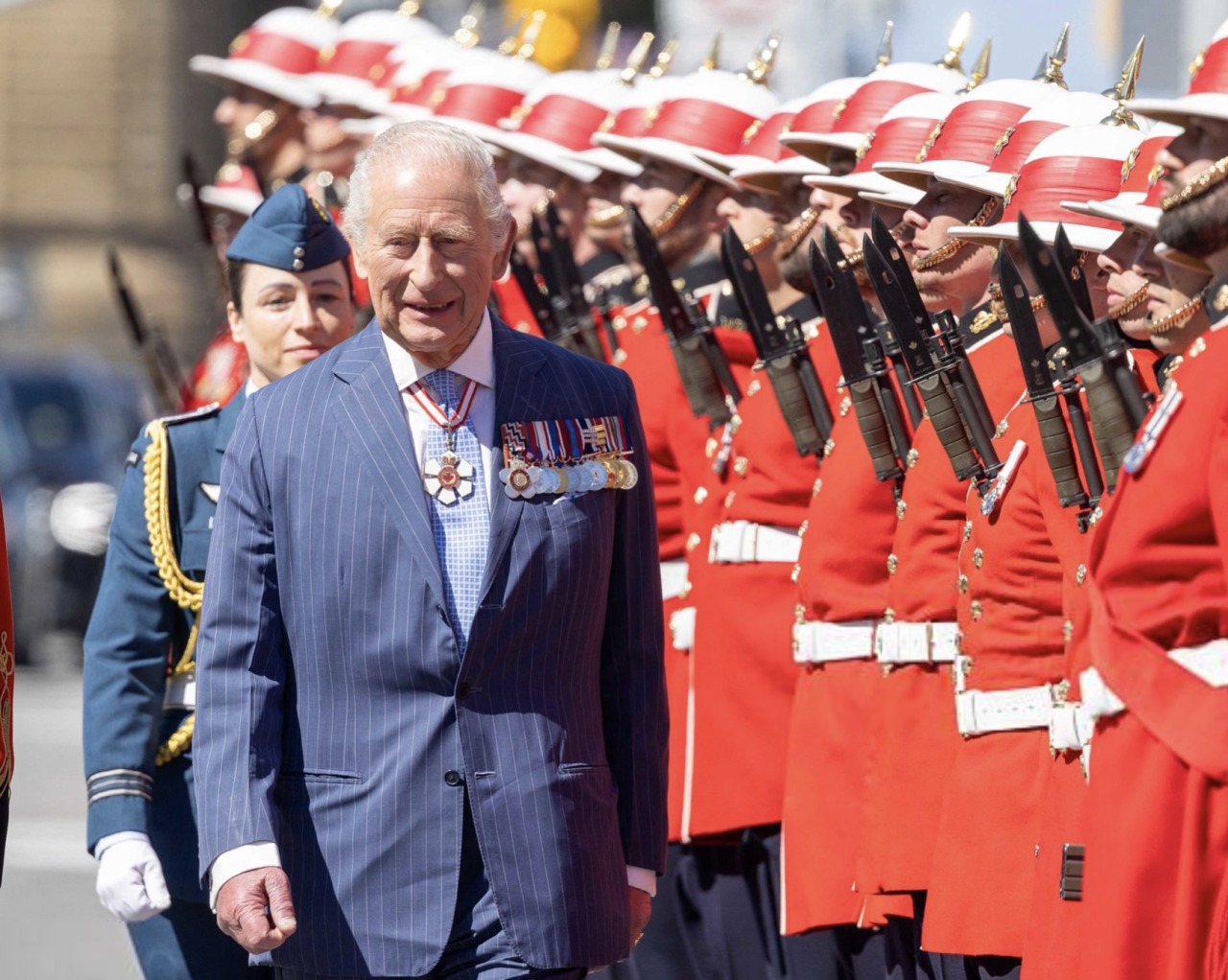

King Charles III and Queen Camilla set out from outside the Bank of Canada for the Senate in Canada’s State Landau, accompanied by twenty-eight horses of the RCMP Musical Ride. At the Senate, the King received full military honours, including a 100-person guard of honour from the 3rd Battalion of the Royal Canadian Regiment, an inspection of the guard and the band, followed by a 21-gun salute.


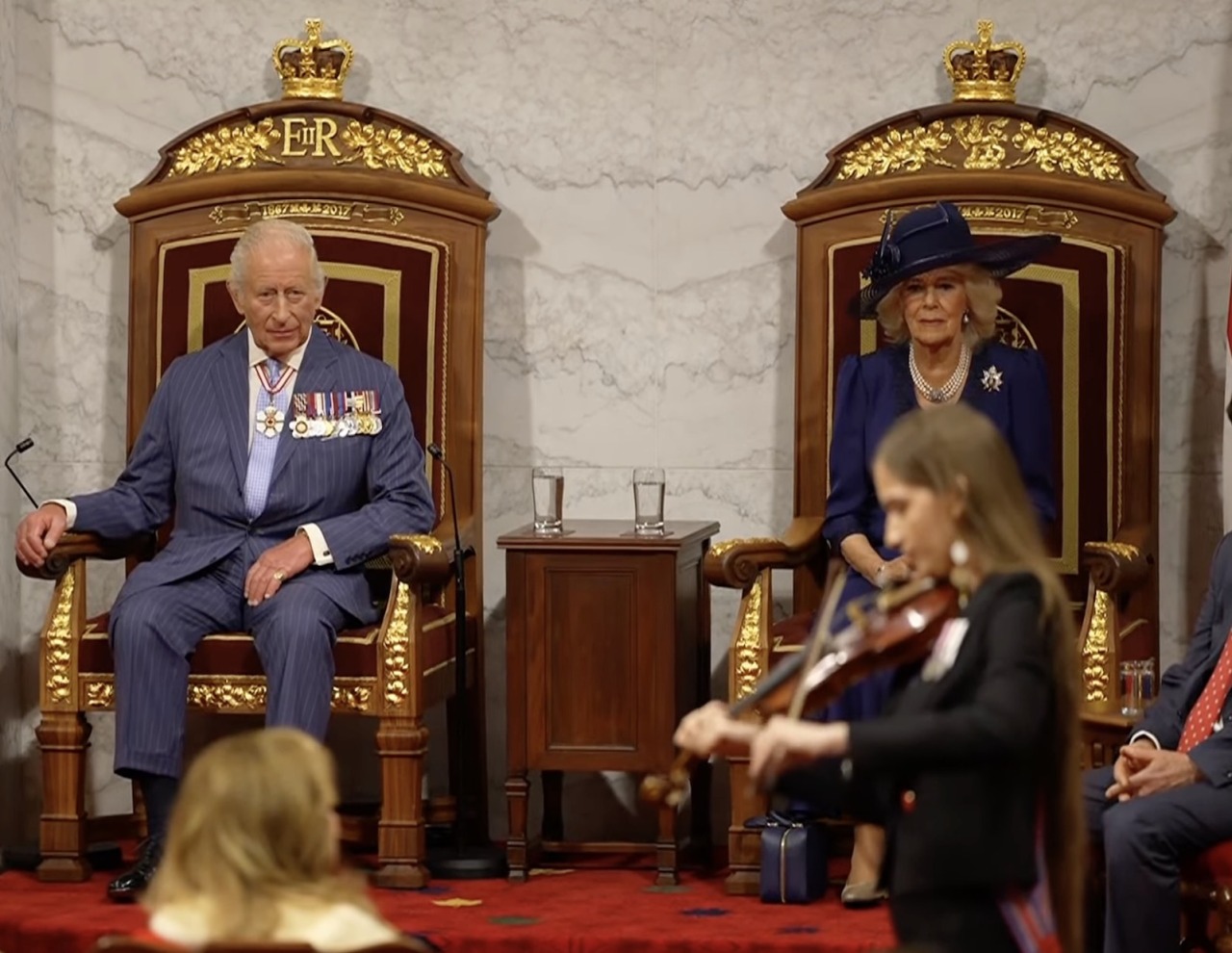

The King then presided over the 45th State Opening of the Parliament of Canada, summoning the House of Commons and greeting people in the intervening twenty-mins before he delivered the Speech from the Throne to the Senate Chamber, outlining the newly-elected government’s agenda.
The occasion is only the second time that the sovereign has opened a Parliament, following Queen Elizabeth II opening the 23rd Canadian Parliament in October 1957, and the third time a sovereign has delivered a Speech from the Throne, marking a significant moment between the head of state and the Canadian people.

King Charles III wore the Insignia of the Order of Canada.


Before concluding their visit to Canada, the King and Queen laid a wreath and flowers at the Tomb of the Unknown Soldier at the National War Memorial on the eve of its 25th anniversary.

Honourable Senators, Members of the House of Commons,
It is with a sense of deep pride and pleasure that my wife and I join you here today, as we witness Canadians coming together in a renewed sense of national pride, unity, and hope.
I would like to acknowledge that we are gathered on the unceded territory of the Algonquin Anishinaabeg people. This land acknowledgement is a recognition of shared history as a nation. While continuing to deepen my own understanding, it is my great hope that in each of your communities, and collectively as a country, a path is found toward truth and reconciliation, in both word and deed.
This is my twentieth visit to Canada, spread over the course of more than half a century, and my first as Sovereign. As I have said before, “Every time I come to Canada… a little more of Canada seeps into my bloodstream – and from there straight to my heart.” I have always had the greatest admiration for Canada’s unique identity, which is recognized across the world for bravery and sacrifice in defence of national values, and for the diversity and kindness of Canadians.
To the First Nations, Inuit, and Métis Peoples – you have welcomed my family and myself to your traditional lands with great warmth and hospitality, for which I am humbly grateful.
This year, we mark the eightieth anniversary of VE Day and VJ Day. On Juno Beach, at Dieppe, on the Somme, at Beaumont-Hamel, at Ypres, and on Vimy Ridge… At those places, and many others, forever etched into our memories, Canadians fought and died alongside our closest allies.
Aujourd’hui, je vois des élus venant d’un bout à l’autre du Canada. De St. John’s, à Terre-Neuve-et-Labrador, de Victoria, en Colombie-Britannique, et d’Arviat, au Nunavut. Je vois des gardiens des droits et libertés garantis par la Charte canadienne. En tant que Roi, je tiens à vous remercier de vous mettre au service de vos compatriotes, d’un bout à l’autre de ce grand et beau pays.
[Today, I see representatives from every part of Canada – from St. John’s, Newfoundland and Labrador, to Victoria, British Columbia, and Arviat, Nunavut. I see the guardians of the fundamental rights and freedoms guaranteed in the Canadian Charter and, as King, I thank you for your service to your fellow Canadians, across the length and breadth of this vast and great nation.]
You speak for your communities, representing an incredible richness of cultures, languages, and perspectives. We owe it to this generation, and those who succeed us, to think and act for the greater good of all. While the world faces unprecedented challenges, generating uncertainties across the continents with regards to peace and stability, economics, and climate change, your communities have the skills and determination to bring a wealth of solutions.
En encourageant la collaboration et en tenant des débats respectueux et constructifs, vous permettrez à ce Gouvernement d’agir de façon audacieuse et juste, pour le bien des Canadiens et des Canadiennes.
[By fostering collaboration and engaging in respectful, constructive debates, you will ensure this Government is capable of bold and fair action to support Canadians.]
It has been nearly seventy years since the Sovereign first opened Parliament. In the time since, Canada has dramatically changed: repatriating its Constitution, achieving full independence, and witnessing immense growth. Canada has embraced its British, French, and Indigenous roots, and become a bold, ambitious, innovative country that is bilingual, truly multicultural, and committed to reconciliation.
The Crown has for so long been a symbol of unity for Canada. It also represents stability and continuity from the past to the present. As it should, it stands proudly as a symbol of Canada today, in all her richness and dynamism.
When my dear late mother, Queen Elizabeth II, opened a new Canadian Parliament in 1957, the Second World War remained a fresh, painful memory. The Cold War was intensifying. Freedom and democracy were under threat. Canada was emerging as a growing economic power and a force for peace in the world. In the decades since, history has been punctuated by epoch-making events: the Vietnam War, the fall of the Berlin Wall, and the start of the War on Terror. Today, Canada faces another critical moment. Democracy, pluralism, the rule of law, self-determination, and freedom are values which Canadians hold dear, and ones which the Government is determined to protect.
The system of open global trade that, while not perfect, has helped to deliver prosperity for Canadians for decades, is changing. Canada’s relationships with partners are also changing.
Il nous faut confronter la réalité : depuis la Deuxième Guerre mondiale, notre monde n’a jamais été aussi dangereux et instable. Le Canada fait face à des défis qui, dans nos vies, sont sans précédent.
[We must be clear-eyed: the world is a more dangerous and uncertain place than at any point since the Second World War. Canada is facing challenges that are unprecedented in our lifetimes.]
Many Canadians are feeling anxious and worried about the drastically changing world around them. Fundamental change is always unsettling. Yet this moment is also an incredible opportunity. An opportunity for renewal. An opportunity to think big and to act bigger. An opportunity for Canada to embark on the largest transformation of its economy since the Second World War. A confident Canada, which has welcomed new Canadians, including from some of the most tragic global conflict zones, can seize this opportunity by recognising that all Canadians can give themselves far more than any foreign power on any continent can ever take away. And that by staying true to Canadian values, Canada can build new alliances and a new economy that serves all Canadians.
The Prime Minister and the President of the United States, for example, have begun defining a new economic and security relationship between Canada and the United States, rooted in mutual respect and founded on common interests, to deliver transformational benefits for both sovereign nations.
Simultanément, le Gouvernement œuvre à renforcer ses relations avec des partenaires commerciaux et des alliés fiables. Sachant que le Canada possède ce dont notre monde a besoin et défend les valeurs que ce monde respecte.
Le Canada est prêt à bâtir une coalition de nations qui partagent ces valeurs – qui croient en la coopération internationale et le libre-échange de biens, de services et d’idées. Dans ce monde nouveau, qui évolue à un rythme frénétique, le Canada tracera la voie à suivre. La démonstration en sera faite dès juin, quand le Canada présidera le Sommet du G7.
[In parallel, the Government is working to strengthen its relationships with reliable trading partners and allies around the world, recognizing that Canada has what the world needs and the values the world respects.
Canada is ready to build a coalition of like-minded countries that share its values, that believe in international co-operation and the free and open exchange of goods, services, and ideas. In this new, fast-evolving world, Canada is ready to lead. This will be demonstrated in June, when Canada convenes the G7 Summit.]
The Government is guided by its conviction that the economy is only truly strong when it serves everyone. Many Canadians are struggling to get ahead. The Government is responding, reducing middle-class taxes and saving two-income families up to $840 a year. It will cut the GST on homes at or under $1 million for first-time homebuyers, delivering savings of up to $50,000. And it will lower the GST on homes between $1 million and $1.5 million.
Le Gouvernement assurera la pérennité de programmes qui permettent déjà aux familles d’économiser des milliers de dollars par année. Notamment ceux pour les garderies et l’assurance- médicament. À ces progrès s’ajoute l’élargissement du Régime canadien de soins dentaires, qui sera bientôt accessible à environ huit millions de Canadiens et de Canadiennes, leur permettant d’économiser plus de huit cents dollars par année, en moyenne.
[The Government will protect the programs that are already saving families thousands of dollars every year. These include child care and pharmacare. In addition to these, the Government has recently expanded the Canadian Dental Care Plan to cover about eight million Canadians, saving the average person more than $800 per year.]
The Government’s overarching goal – its core mission – is to build the strongest economy in the G7. That starts with creating one Canadian economy out of thirteen. Internal barriers to trade and labour mobility cost Canada as much as $200 billion each year. The Government will introduce legislation to remove all remaining federal barriers to internal trade and labour mobility by Canada Day.
Les premiers ministres de plusieurs provinces et territoires ont déjà pris des mesures pour éliminer les obstacles au co merce intérieur. Le Gouvernement va s’appuyer sur ces progrès pour créer, d’ici la fête du Canada, un réel système de libre échange à travers le pays. Il s’agit d’efforts essentiels pour permettre au Canada de réaliser tout son potentiel économique, mais cela reste insuffisant.
[Numerous premiers have already taken vital steps to break down provincial and territorial barriers to trade. Together, we will build on that progress to deliver free trade across the nation by Canada Day. This is critical to unlocking Canada’s full economic potential, but it’s not enough.]
To build Canada strong, the Government is working closely with provinces, territories, and Indigenous Peoples to identify and catalyse projects of national significance. Projects that will connect Canada, that will deepen Canada’s ties with the world, and that will create high-paying jobs for generations.
Given the pace of change and the scale of opportunities, speed is of the essence. Through the creation of a new Major Federal Project Office, the time needed to approve a project will be reduced from five years to two; all while upholding Canada’s world-leading environmental standards and its constitutional obligations to Indigenous Peoples.
The Government will also strike co-operation agreements with every interested province and territory within six months to realize its goal of “one project, one review.”
When Canadians come together, Canada builds things that last.
Éliminer ces obstacles qui freinent l’économie canadienne permettra l’avènement d’une nouvelle ère de croissance grâce à laquelle le Canada va non seulement surmonter des guerres commerciales, mais en émerger plus fort que jamais. Cela lui permettra de devenir une superpuissance en matière d’énergie verte et conventionnelle. De bâtir une stratégie industrielle qui rendra le Canada plus compétitif à l’international, tout en luttant contre les changements climatiques. De bâtir des centaines de milliers de bonnes carrières dans les métiers spécialisés. Et donc de faire du Canada une plaque tournante pour la science et l’innovation.
[By removing these barriers that have held back our economy, we will unleash a new era of growth that will ensure we don’t just survive ongoing trade wars, but emerge from them stronger than ever. It will enable Canada to become the world’s leading energy superpower in both clean and conventional energy. To build an industrial strategy that will make Canada more globally competitive, while fighting climate change. To build hundreds of thousands of good careers in the skilled trades. And to build Canada into the world’s leading hub for science and innovation.]
Critically, the Government will undertake a series of measures to help double the rate of home building while creating an entirely new housing industry – using Canadian technology, Canadian skilled workers, and Canadian lumber. The Government will introduce measures to deliver affordable homes by creating Build Canada Homes. This mission-driven organization will act to accelerate the development of new affordable housing. It will invest in the growth of the prefabricated and modular housing industry. And it will provide significant financing to affordable home builders. The Government will make the housing market work better, including by cutting municipal development charges in half for all multi-unit housing. The Government will drive supply up to bring housing costs down.
To be truly strong, Canada must be secure. To that end, the Government will introduce legislation to enhance security at Canada’s borders. Law enforcement and intelligence agencies will have new tools to stop the flow of fentanyl and its precursors. The Canada Border Services Agency will be given new powers to examine goods destined for export, to prevent the transport of illegal and stolen products, including cars.
Le Gouvernement protégera la souveraineté du Canada en rebâtissant, réarmant et réinvestissant
dans les Forces armées canadiennes. Il stimulera l’industrie militaire canadienne en prenant part au
plan « ReArm Europe » et contribuera ainsi, avec des partenaires européens, à la sécurité
transatlantique. Et il investira pour renforcer sa présence dans le Nord, alors que cette région, qui
est partie intégrante de la nation canadienne, fait face à de nouvelles menaces.[The Government will protect Canada’s sovereignty by rebuilding, rearming, and reinvesting in the Canadian Armed Forces. It will boost Canada’s defence industry by joining ReArm Europe, to invest in transatlantic security with Canada’s European partners. And it will invest to strengthen its presence in the North, which is an integral part of Canada, as this region faces new threats.]
The Government will discharge its duty to protect Canadians and their sovereign rights, from wherever challenges may come at home or abroad. To keep communities safe, the Government will hire 1,000 more RCMP personnel. It will change firearms licensing and strengthen enforcement of yellow and red flag laws. Weapons licences for those convicted of intimate partner violence and those subject to protection orders will be revoked. Through the deployment of scanners, drones and helicopters, additional personnel, and K-9 teams, the Government will stem the tide of illegal guns and drugs across the border.
It will take these steps while protecting the rights of law-abiding gun owners and Indigenous Peoples’ longstanding hunting traditions.
The Government will bring a renewed focus on car theft and home invasions by toughening the Criminal Code to make bail harder to get for repeat offenders charged with committing these crimes, along with human trafficking and drug smuggling.
During this time of great change, Canadians are uniting behind what makes Canada unique.
La langue française et la culture québécoise sont au cœur de l’identité canadienne. Elles définissent le pays que les Canadiens, les Canadiennes et moi aimons tant. Le Canada est un pays où l’on respecte et célèbre les langues officielles et les langues autochtones. Le Gouvernement est déterminé à protéger les institutions qui font rayonner ces cultures et cette identité dans le monde entier, comme CBC/Radio-Canada. Protéger ceux qui nous donnent accès à des aliments frais, sains et de qualité : les producteurs agricoles. Et protéger la gestion de l’offre.
[The French language and the Quebec culture are at the heart of the Canadian identity. They define the country that Canadians and I love so much. Canada is a country that respects and celebrates its official languages and Indigenous languages. The Government is determined to protect the institutions that bring these cultures and this identity to the world, like CBC/Radio-Canada. It will protect the people who give us access to fresh, healthy, and quality food: agricultural producers. And it will protect supply management.]
Nature is core to Canada’s identity. In 2022, Canada convened COP15 in Montréal, which concluded with 196 countries striking a historic agreement to protect thirty percent of their lands and thirty percent of waters by 2030. To this end, the Government will protect more of Canada’s nature than ever before through the creation of new national parks, national urban parks, marine protected areas, and other conservation initiatives.
The Government will always protect the rights and freedoms that the Charter guarantees for every Canadian.
The Government will be a reliable partner to Indigenous Peoples, upholding its fundamental commitment to advancing reconciliation. Central to this commitment is the creation of long-term wealth and prosperity with Indigenous Peoples. For that reason, the Government will double the Indigenous Loan Guarantee Program from $5 billion to $10 billion – enabling more Indigenous communities to become owners of major projects. As Canada moves forward with nation-building projects, the Government will always be firmly guided by the principle of free, prior, and informed consent.
Canada’s immigration system has long been a source of pride for Canadians and of dynamism for the economy. The Government is dedicated to rebuilding the trust of Canadians in immigration by restoring balance to the system.
Le Gouvernement instaurera une limite sur le nombre de travailleurs étrangers temporaires et d’étudiants internationaux, établissant un plafond qui, à partir de deux mille vingt-sept, sera en deçà de cinq pour cent de la population canadienne. Simultanément, il attirera les meilleurs talents dans le monde pour bâtir l’économie. Et il fera savoir aux Canadiens et aux Canadiennes qui travaillent à l’étranger que, s’ils songent à revenir au pays, il n’y a pas de moment plus propice pour le faire.
[The Government will cap the total number of temporary foreign workers and international students to less than five percent of Canada’s population by 2027. By doing this, the Government will attract the best talent in the world to build our economy, while sending a clear message to Canadians working abroad that there is no better time to come home.]
Dans toutes ses actions, le Gouvernement sera guidé par une nouvelle discipline fiscale: dépenser moins, pour que les Canadiens puissent investir plus.
[In all of its actions, the Government will be guided by a new fiscal discipline: spend less so Canadians can invest more.]
Day-to-day government spending – the government’s operating budget – has been growing by nine percent every year. The Government will introduce measures to bring it below two percent.
Transfers to provinces, territories, or individuals will be maintained. The Government will balance its operating budget over the next three years by cutting waste, capping the public service, ending duplication, and deploying technology to improve public sector productivity.
In parallel, the Government will take a series of measures to catalyse new investment to create better jobs and higher i comes for Canadians. The scale of the Government’s initiative will match the challenges of our times and the ambitions of Canadians.
Honourable Senators, Members of the House of Commons,
When my dear late mother addressed your predecessors seven decades ago, she said that in that age, and against the backdrop of international affairs, no nation could live unto itself. It is a source of great pride that, in the following decades, Canada has continued to set an example to the world in her conduct and values, as a force for good.
À vous, et à l’ensemble du peuple canadien, mon épouse et moi-même adressons nos sincères remerciements pour cet accueil des plus chaleureux.
[I wish to express to you and to the people of Canada my heartfelt gratitude, and that of my wife, for the warmth of the welcome which we have received]
As the anthem reminds us: The True North is indeed strong and free!
Members of the House of Commons, you will be asked to appropriate the funds to carry out the services and expenditures authorized by Parliament.
May you honour the profound trust bestowed upon you by Canadians, and may God bless and guide you in all your duties.


King George VI and Queen Elizabeth (wearing the Oriental Circlet Tiara) presided over the opening of the 4th session of the 18th Parliament of Canada during their landmark month-long Tour of Canada in 1939.


In 1957, the Queen wore her Coronation Gown and Queen Alexandra’s Kokoshnik Tiara as she opened the 23rd Canadian Parliament during a brief visit to Canada.


The Thrones of Canada were moved to Parliament Hill for the ceremony marking the centennial of Confederation in 1967.

The Queen (in Queen Alexandra’s Kokoshnik Tiara) opened the 3rd session of 30th Parliament during her Silver Jubilee Tour of Canada in 1977.


King Charles III and Queen Camilla arrived in Ottawa on their first Visit as Sovereigns to Canada, in the latest of 250 years of Royal Visits to Canada.


Upon arrival in Ottawa, King Charles III and Queen Camilla were received by Governor General Mary Simon and Prime Minister Mark Carney in a welcome ceremony at the Airport in Ottawa.


Afterwards, the King and Queen Camilla joined a community event showcasing the rich cultural heritage and diversity of Canada in Lansdowne Park, during which they had the opportunity to meet Canadians from across the country, from a range of organisations.

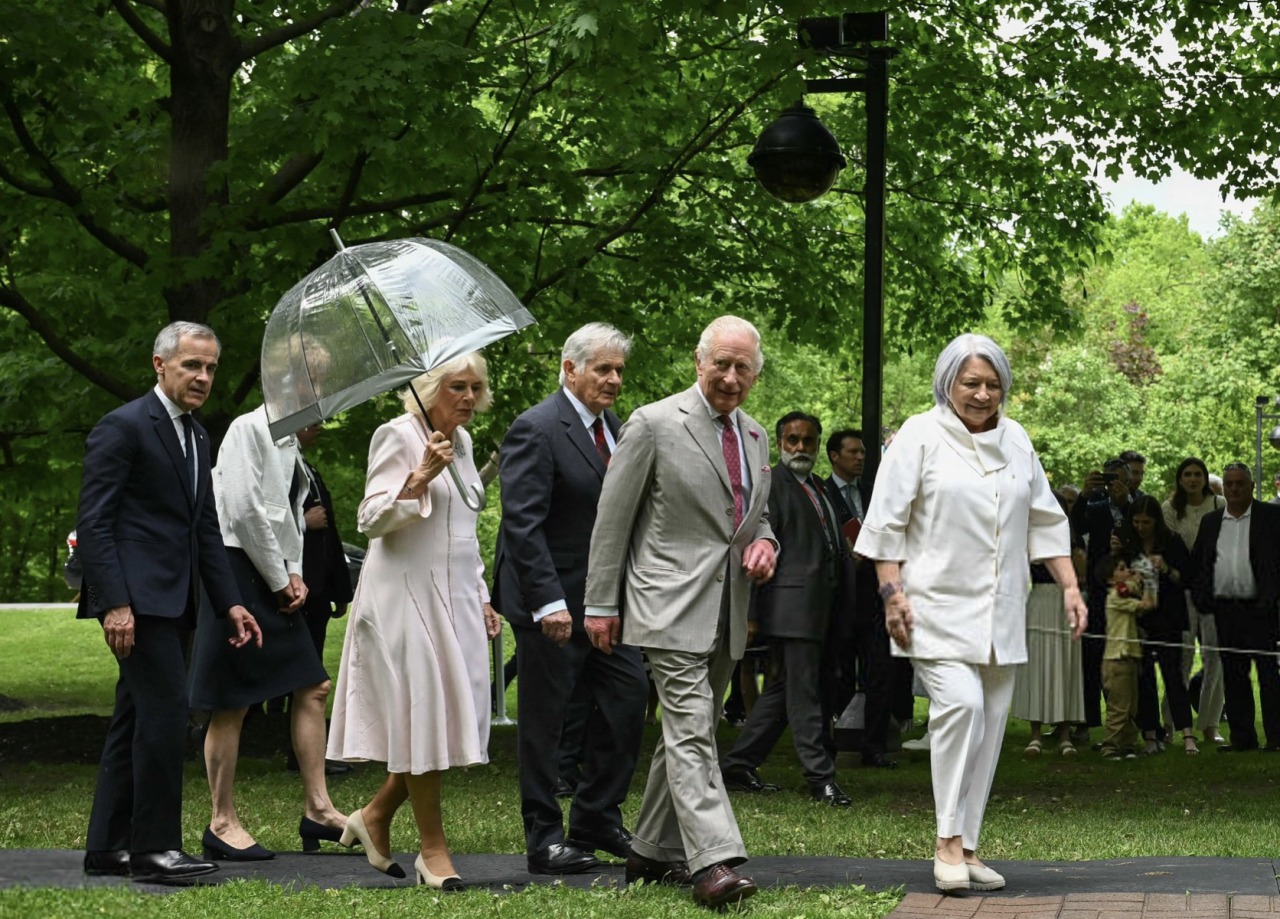

At Rideau Hall, the King and Queen Camilla planted a tree in the grounds to mark the visit, near the site of the sugar maple tree which the then Prince of Wales and Duchess of Cornwall planted during their tour of Canada in 2017.


The King held audiences with the Governor-General and Prime Minister Carney before a short ceremony to swear in the Queen as a member of the Canadian Privy Council.


The first day of the visit concluded with a short reception for Lieutenant Governors from each of the 10 Canadian provinces, and Territorial Commissioners from the three territories.

Queen Camilla is wearing the Queen Mother’s Diamond Maple Leaf Brooch.

King Charles and Queen Camilla are set to undertake their first Visit as Sovereigns to Canada next week, which will be the latest in almost 250 years of Royal Visits to Canada! This will be the King and Queen’s first visit to Canada as Sovereigns, and their first since 2022.


The future King William IV was the first member of the royal family to visit the Newfoundland Colony, the colony of Nova Scotia, and the Province of Quebec, arriving in 1786 and staying until 1788. A few years later, his brother, Prince Edward, Duke of Kent lived in Canada between 1791 and 1800, serving as the Commander-in-Chief of British forces in North America, being called the ‘Father of the Canadian Crown for his contribution to the development of Canada.

The next major Royal Visit to Canada came in 1860, when the then Prince of Wales undertook a two-month tour of Newfoundland, New Brunswick, Nova Scotia, Prince Edward Island, and the Province of Canada in 1860, followed y Prince Alfred’s five-week tour of The Maritimes, Newfoundland, and the Province of Canada in 1861 and Prince Arthur’s stay in Canada in 1869 and 1870. Prince Alfred was the Commander of the Royal Navy’s North Atlantic Squadron between 1878 and 1883 while the future King George V was stationed in the Maritimes in 1882.


In 1878, Princess Louise became the Viceregal Consort when her husband the Marquess of Lorne, was created the Governor General of Canada, becoming very popular during their five-year tenure.


The future King George V and Queen Mary, then the Duke and Duchess of Cornwall and York embarked on a major Tour of all Canadian Provinces between September and November 1901, as part of an eight-month Tour of the British Empire, with the Prince of Wales returning for the Tercentenary of Quebec City in 1908.


From 1911 to 1916, Prince Arthur, Duke of Connaught and Strathearn served as the Governor General of Canada becoming so popular with the Duchess and Princess Patricia that their two-year term was extended up to five years.


In 1919, the Prince of Wales, late King Edward VIII, undertook a major landmark Tour of Canada between August and October, visiting all Canadian Provinces.


King George VI and Queen Elizabeth visited every Canadian Province on their landmark month-long Tour of Canada in 1939, ahead of the outbreak of the Second World War, which was the first visit to North America by the Reigning Monarch.


Princess Alice, Countess of Athlone became the Viceregal Consort when her husband, the Earl of Athlone, was created the Governor General of Canada in 1940, becoming very popular during their six-year tenure.


In 1951, Princess Elizabeth and the Duke of Edinburgh visited Quebec, Ottawa, Toronto, Winnipeg, British Colombia, New Brunswick, Halifax, Charlottetown, and Newfoundland on their first Tour of Canada just a few months before her Accession to the Throne.

The Queen and Duke of Edinburgh made a brief visit to Canada in October 1957 to open the 23rd Canadian Parliament, which was followed by their first State Visit to the United States.


Princess Margaret visited Canada to mark the centennial of the Colony of British Columbia in 1958, visiting seven Canadian Provinces on an extensive four-week Tour to promote Canadian Tourism. Princess Margaret was in Canada again in 1971, in 1980 for the 75th anniversary of Alberta and Saskatchewan’s entry into Confederation, in 1981, in 1986, in 1988, in 1993, and in 1996.


The Queen and Duke of Edinburgh were back for an extensive six-week Tour of Canada in the summer of 1959, to visit every Canadian Province and Territory and to open the Saint Lawrence Seaway, which again was followed by a visit to the United States as ‘Queen of Canada’,


In 1964, the Queen and Duke of Edinburgh were in Canada for the centenary of the Confederation Conferences, returning again in 1967 for the Canadian Centennial.


The Queen Mother returned to Canada for nine Official Tours between 1950 and 2002, marking the centennial of the Black Watch (Royal Highland Regiment) of Canada in 1962, celebrating the 50th anniversary of the Toronto Scottish Regiment in 1965, opening the Royal BC Museum in 1966, taking part in the Canadian Centennial celebrations in 1967, visiting the Toronto Scottish Regiment and presenting the Queen’s Colours to the Black Watch Regiment in 1974, presenting The Queen’s Colours to the Canadian Forces Maritime Command in 1979, attending the Queen’s Plate and celebrating the bicentennial of Niagara-on-the-Lake in 1981, to attend the Queen’s Plate in 1985, to 125th anniversary of the Black Watch (Royal Highland Regiment) of Canada in 1987, and to attend the Queen’s Plate in 1989.


The Prince of Wales and Princess Anne joined the Queen and Duke for a 10-Day visit to Canada in 1970, to mark the centenary of Manitoba’s entry into Confederation as well as the Northwest Territories. Princess Anne and the Queen and Duke were back in Canada to mark the centenary of British Columbia’s entry into Confederation in 1971.


In 1973, the Queen and Duke of Edinburgh were in Canada for the centenary of PEI’s entry into Confederation, tercentenary of Kingston, centennial of the Royal Canadian Mounted Police, returning few weeks later for the Commonwealth Heads of Government Meeting in Ottawa.


The entire Royal Family came to Canada in 1976 to open and attend the 1976 Montreal Olympics, in which Princess Anne participated.


The Queen and Duke were back in Canada the following year, for the Queen’s Silver Jubilee and the open the 3rd session of 30th Parliament.


The Royal Family were back in Canada in 1978, to open the Commonwealth Games in Edmonton while also touring Newfoundland, Saskatchewan, and Alberta.


Four years later, the Queen and Duke of Edinburgh were in Canada to sign the Constitution Act 1982 which formally removed the last vestiges of the British Parliament in Canada.


The then Prince of Wales visited Canada on eighteen different occasions between 1970 and 2022, with the Prince and Princess of Wales making an extensive Tour in 1983, visiting Newfoundland, Prince Edward Island, Nova Scotia, New Brunswick, Ontario and Alberta.


The Queen and Duke visited British Columbia on their visit to Canada in 1983, and marked the bicentennial of New Brunswick and the bicentennial of Ontario in 1984, before visiting British Columbia, Saskatchewan, and Quebec in 1987, with the Commonwealth Heads of Government Meeting in Vancouver.


In 1986, the Prince and Princess of Wales toured British Columbia, visiting Vancouver to open Expo 86, as well as Victoria, Prince George, Kamloops and Nanaimo.


The Queen made a brief visit to Canada in 1990 for the presentation of new Queen’s Colour to the Calgary Highlanders and another short visit in 1992 for the 125th anniversary of Confederation and her Ruby Jubilee.


The Prince and Princess of Wales were in Canada in 1991, visiting Toronto, Sudbury, Niagara Falls, Kingston, and Ottawa, with Prince William and Prince Harry, who also joined the Prince of Wales in Vancouver and Whistler in 1998.


In 1994, the Queen and Duke of Edinburgh were in Canada for the Commonwealth Games in Victoria, visiting Nova Scotia, British Columbia, and the Northwest Territories, waiting a few years due to the Quebec Referendum before their next visit in 1997, for the 500th anniversary of the discovery of Newfoundland.


The Queen and Duke of Edinburgh visited British Columbia, New Brunswick, Manitoba, Ontario, Quebec, and Nunavut to celebrate the Queen’s Golden Jubilee in 2002.


The Queen and Duke were back in Canada in 2005 to mark the centenary of the entry of Saskatchewan and Alberta into Confederation.


The Prince of Wales and Duchess of Cornwall visited British Columbia, Newfoundland and Labrador, Ontario and Quebec on their first joint Tour of Canada in 2009.


The Queen and the Duke of Edinburgh made their final visit to Canada in 2010, to celebrate the centenary of the Canadian navy, attend the Queen’s Plate, open a new terminal at the Winnipeg James Armstrong Richardson International Airport, and lay the cornerstone of the Canadian Museum for Human Rights, amongst other events.


The newlywed Duke and Duchess of Cambridge visited the Northwest Territories, Prince Edward Island, Quebec and Ontario on their fist Tour of Canada in 2011.


The Prince of Wales and Duchess of Cornwall visited Ontario, New Brunswick, and Saskatchewan in 2012 for the Queen’s Diamond Jubilee, and marking the centennial of the start of the First World War and the 150th anniversary of the Charlottetown and Quebec City Conferences in 2014.


The Duke and Duchess of Cambridge were joined by Prince George and Princess Charlotte on their Tour of Western Canada in 2016, visiting British Columbia and Yukon.


The Prince of Wales and the Duchess of Cornwall visited Canada in 2017 for the 150th Anniversary of Confederation with another trip in 2022 for the Queen’s Platinum Jubilee.

Girls of Great Britain and Ireland Tiara
Vladimir Tiara

Queen Alexandra’s Kokoshnik Tiara
Belgian Sapphire Tiara
Burmese Ruby Tiara
Brazilian Aquamarine Tiara
Queen Mary’s Fringe Tiara
Queen Mary’s Lover’s Knot Tiara
Queen Victoria’s Oriental Circlet Tiara
Nizam of Hyderabad Tiara
Plunket Tiara
Five Aquamarine Tiara
Imperial State Crown
George IV State Diadem
Girls of Great Britain and Ireland Tiara
Queen Alexandra’s Kokoshnik Tiara
Burmese Ruby Tiara
The Belgian Sapphire Tiara
Greville Tiara
Delhi Durbar Tiara
Cubitt-Shand Tiara
Queen’s Five Aquamarine Tiara
George IV State Diadem
Queen Mary’s Crown
Queen Mary’s Lover’s Knot Tiara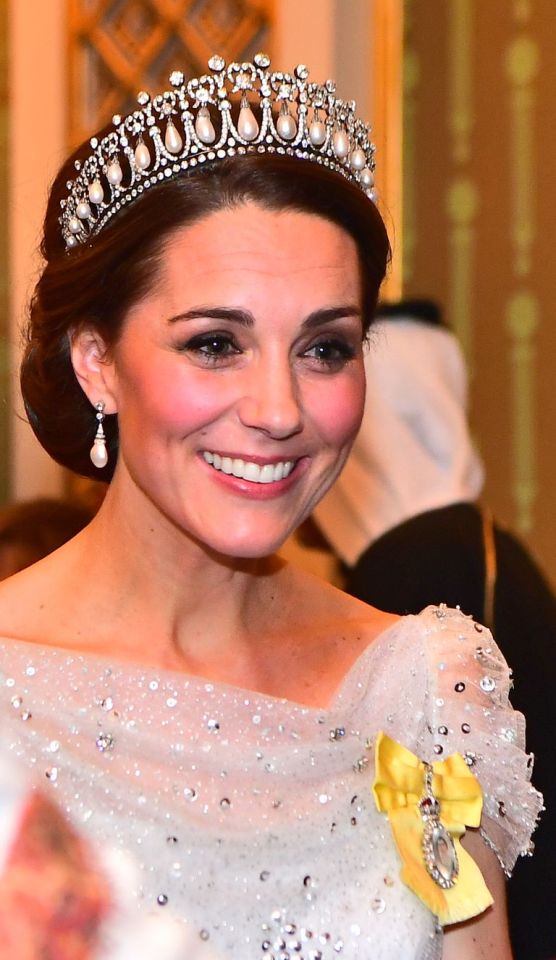


King George VI Festoon Necklace


