En route to Geneva for the Royal and Noble Jewels on Auction, yesterday, I had a long layover in Qatar to view the magnificent Royal and Noble Jewels on display in the ‘Around The World in Jewellery’ Exhibition in Doha, a collaboration between Qatar Museums and L’ÉCOLE School or Jewellery Arts supported by Van Cleef & Arpels, which opened a few days ago and runs until the end of next month!

From 27 October to 26 December 2026, Qatar Museums (QM), in collaboration with L’ÉCOLE, School of Jewelry Arts, supported by Van Cleef & Arpels, presents Around the World in Jewellery, a landmark exhibition exploring jewellery as one of humanity’s most enduring expressions of cultural identity. On view at M7, the exhibition is the largest-ever presentation of jewellery from QM’s collections, complemented by a selection of remarkable creations from the Van Cleef & Arpels patrimonial collection.

Around the World in Jewellery gathers more than 500 pieces of jewellery and art objects, including jewels, artworks, photographs, and sculptures from across cultures, geographies, and historical periods, some of which are being presented to the public for the first time.

Around the World in Jewellery invites visitors on a journey across continents and through millennia to explore one of the most universal forms of human expression. From the earliest ornaments made of shells to contemporary creations jewellery reveals a shared desire to acorn body, express identity, protect loved ones, mark social roles. and transmit memory and belief.

Bringing together exceptional examples from around the world. The exhibition highlights both the diversity of cultural traditions and the questions that unite humanity. Materials drawn from land and sea – shells, feathers, stones, metals and other natural materials ~ were transformed into objects of extraordinary variety and meaning.

The exhibition moves through seven themes shared across cultures; sea and ocean, nature, the cosmos, body adornment, status, customs and ceremonies and protection. It explores now jewellery reflects relationships, traditions, and worldviews shaped over time. Together, these objects reveal jewellery not simply as decoration, but as a means through which societies express values, fears, hopes, and belonging.

United by their shared commitment to the study. preservation and transmission of cultural heritage, this exhibition has been developed through a unique collaboration between Qatar Museums and L’ÉCOLE School or Jewellery Arts supported by Van Cleef & Arpels. Remarkable objects, many presented to the public for the first time have been carefully selected from the collections of the National Collection of Qatar, the National Museum of Qatar. the Museum of Islamic Art, the Lusail Museum and the Van Cleef and Arpels collection.


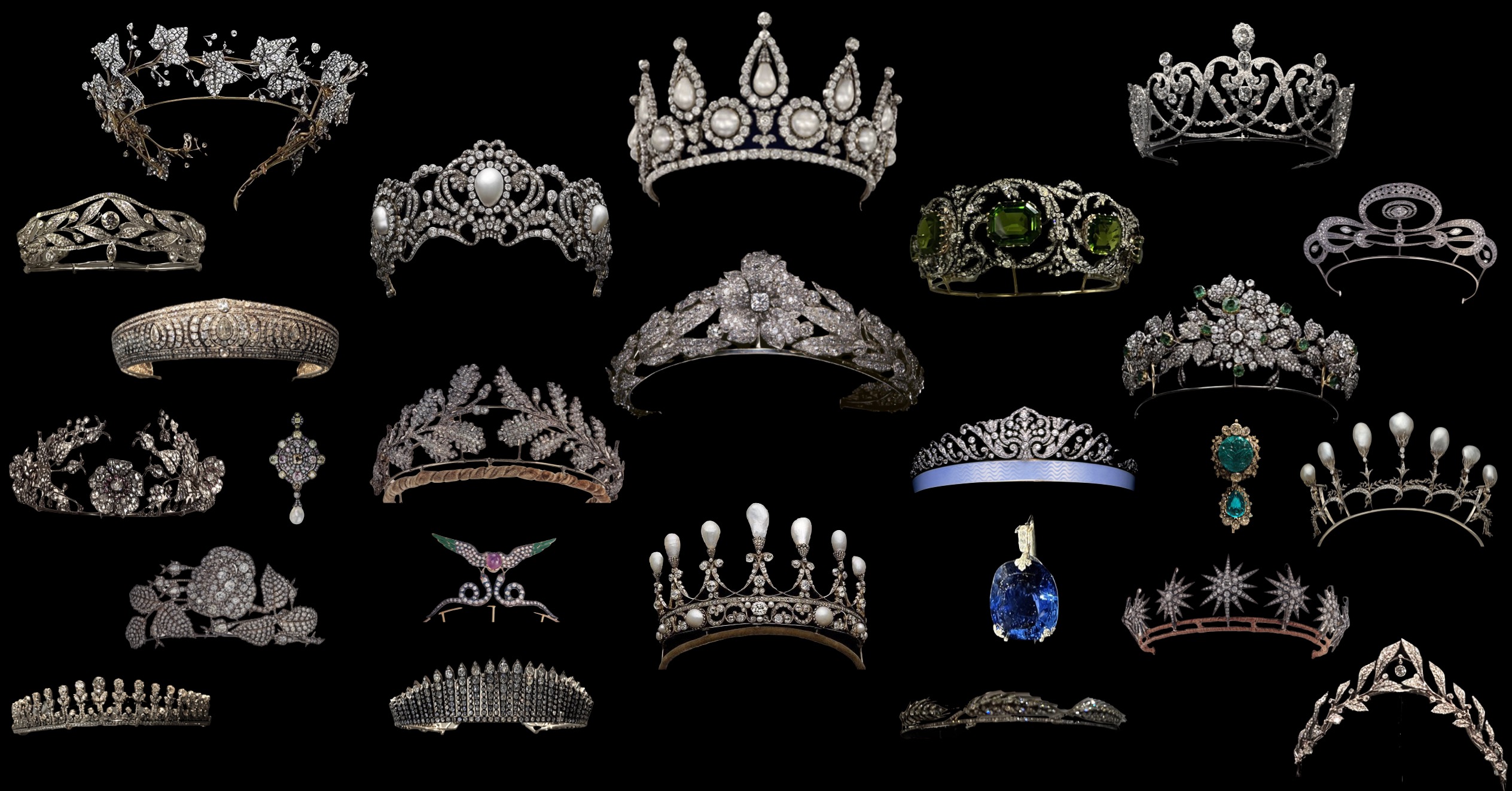
The exhibition begins with a themed space on sea and ocean, particularly the pearl, which was instrumental in the economy of Qatar for centuries. Alongside several traditional, antique and contemporary pearl jewels are four spectacular Pearl and Diamond Tiaras.
 Archduchess Marie Valerie’s Pearl Tiara
A.E. Köchert, Vienna, c. 1913

The magnificent Köchert Pearl and Diamond Tiara of Archduchess Marie Valerie of Austria remained with her descendants for almost a century before being sold at Christie’s in 2005, belonging to the Albion Art Institute before being acquired by Qatar Museums. We last saw it at the Köchert Exhibition at the Royal Palace of Gödöllő last year.
 Saxony Pearl Tiara
Germany, c. 1830

The magnificent Pearl Tiara of Princess Maria Immacolata of Bourbon-Two Sicilies, Princess of Saxony later belonged to the Hanoverian Royal Family and was loaned to Baroness Bruntisfield and a Lady Mayoress of London before being acquired by the Qatar Museums Authority from the Albion Art Institute.

United Kingdom, c. 1878

The magnificent Rosebery Pearl Tiara was created for Rothschild Heiress Hannah, the Countess of Rosebery, and more recently belonged to the Dowager Duchess of Westminster before being sold off in 2011 for £1,161,250.

The Marquise de Keroüartz’s Tiara
Joseph Chaumet, France, 1897
Created by Joseph Chaumet in 1897, this magnificent tiara was commissioned by the Marquis de Keroüartz for his bride, Louise, on the occasion of their marriage in July of that year. As head of an ancient Breton aristocratic family, the Marquis chose one of the most celebrated Parisian jewellery Masons of the period. At the end of the 19th century, tiaras were far more than ornamental accessories but rather served as powerful symbols of lineage, rank and social identity. Chaumet’s refined design reflects this tradition while demonstrating the Mason’s characteristic restraint. Rather than overwhelming the wearer, the delicate structure allows the exceptional pearls to take centre stage, enhancing their luminosity and elegance. At a time when pearls were considered among the most precious of gemstones, the tiara expressed both the prestige of the Keroùartz family and the grace of the young Marquise.


The next room focuses on nature, with feathers, flowers, vines, and insects used as inspiration for jewellery since time immemorial. There is a particularly large display of natural-inspired Tiaras.
In many cultures, humans are not separate from nature, but part of a shared living world with animals and planks. This relationship appears in ornaments made from iridescent feathers, insect wings, animal teeth, and plant fibres.
Such materials do more than decorate the body; they carry the vitality, protection, and prestige associated with the natural world. Through jewellery, people sought to evoke the strength of animals and the beauty and abundance of plants.
This same dialogue appears in fine jewellery traditions, where jewellers reinterpret flowers, leaves, vines, and insects in precious materials. Through close observation of nature, artists transform natural forms into new creations that evoke rather than directly replicate the world around them
 Queen Margherita’s Mellerio Diamond Wreath Tiara
Mellerio dits Meller, France, 1867

The iconic Mellerio Diamond Wreath Tiara of Queen Margherita of Italy was acquired from the Universal Exhibition in Paris in 1867 and remained an heirloom of the House of Savoy for over a century but now belongs Qatar Museums via the Albion Art Institute.
 Archduchess Isabella’s Peridot Tiara
Köchert, Austria, c. 1825

The Habsburg Peridot Parure was the spectacular jewel of the imperious Archduchess Isabella, Duchess of Teschen which remained in a Bank Vault for decades before being worn by Joan Rivers and later owned by Lily Safra.

Oak Leaf Tiara
United Kingdom, c. 1815

Ivy-leaf Garland Tiara
Possibly from France, c. 1845

Coros Tiara
France, c. 1820

Diamond Flower Tiara
Jean Baptiste Fossin, France, c. 1830

Rose Parure
Giuseppe Franconer, Italy, 1883

Laurel Leaf Tiara
United Kingdom, c. 1905


Long before the Invention of writing, the sky shaped how people understood the world. The movements of the sun, moon, and stars guided calendars, rituals, travel, and belles. Across cultures, these celestial bodies also inspired ornament worn on the body,
Through jewellery, communities transformed their understanding of the cosmos into material form, old was often associated with the sun because of its colour and shine, Rounded shapes were widely used to represent the moon, while blue stones mounted in headdresses, pectorale, and other adornments evoked the sky.
By turning celestial forms into wearable objects, jewellery brought the cosmos within human reach, carrying with them a tiny piece of the powers and symbolism they attributed to the stare, the moon, the sun, and the sky.

Solar Disc Tiara
C & A Guliano, England, 1895

Diamond Star Tiara
Garrard, England, c. 1870,
During the second half of the 19th century, advances in astronomy transformed public understanding of the cosmos, while newspaper reports and popular illustrations fuelled widespread interest – and occasional anxiety – about the universe. Jewellers responded to this growing enthusiasm with ornaments inspired by stars, comets, crescents, and celestial light. Garrard, renowned as Britain’s leading royal jeweller, became celebrated for such naturalistic and celestial designs. Combining technical virtuosity with contemporary scientific curiosity, this star tiara captures the Victorian desire to translate the wonders of the heavens into objects of exceptional beauty and fashion.


Adorning the body shapes how people are seen and understood within their societies. Jewellery can mark age, status, and belonging, while highlighting, protecting, or concealing parts of the body. Worn close to the skin, it expresses memory, belief, and identity.
Universally, adornment influences how the body is formed, perceived, and valued. It may alter posture and movement, preserve the body after death, or draw attention to areas associated with vitality, protection, or spirituality.
From head to foot, ornaments structure appearance and gesture, giving meaning to presence and social roles. Through these shared practices, jewellery connects individuals to their communities and wider systems of belief.

Mughal Carved Emerald Brooch
India, Mughal Period, 17th century
This spectacular Carved Emerald Brooch was for centuries one of the heirlooms of the Dukes of Northumberland. The Northumberland Pendant set with carved Mughal emerald framed in diamonds with emerald drop, was worn by Duchess Charlotte Florentia, wife of the third Duke, as Vicereine of Ireland 1828-9. She inherited it from her grandfather Baron Clive of Plassey, or from her father who also served as Governor-General of India. It was auctioned by the Duke of Northumberland at Sotheby’s in 1978.


One of the most spectacular sections of the exhibit is on Status, and features some excite high jewelry pieces, including some Indian and Persian jewels but several European antiques.
Jewellery has long been used to make status visible. Across cultures, ornaments communicate authority, wealth, achievement, and belonging through their scale, materials, craftsmanship, and how they are worn. Rare materials such as gold, pearls, or jade, as well as the skill required to obtain and transform them, increase the prestige of these objects.
Some ornaments reflect status earned through personal achievement, while others express inherited rank and family lineage. Archaeological discoveries show that jewellery marl ed social distinction as early as 30,000 years ago, including in burials where children were laid to rest with elaborate ornaments.
Whether inherited or awarded, jewellery makes social identity visible, transforming power and prestige into something immediately recognised and understood.

Fabergé Tiara
Fabergé, St. Petersburg, Russia, c. 1899

Queen Marie of Romania’s Cartier Sapphire Pendant
Cartier, France, c. 1913

This spectacular 478.68-carat Cartier Sapphire Pendant was coveted by the Spanish Queen before being bought by the Romanian Queen, and was later worn by the Greek Queen but now belongs to Qatar Museums.
Purchased from Cartier in 1921 by King Ferdinand of Romania as a gift for Queen Marie, this magnificent sapphire became one of the most celebrated royal jewels of the 20th century. Weighing an extraordinary 478.68 carats, the cushion-cut blue sapphire, mined in Sri Lanka, is among the largest gem-quality sapphires ever fashioned. Cartier mounted the stone in an elegant diamond setting with floral motifs, allowing its exceptional colour and brilliance to dominate the design. Queen Marie sometimes wore it for official occasions suspended from a diamond necklace, complementing her spectacular Sapphire Tiara. The jewel reflects both Cartier’s refined craftsmanship and the enduring appeal of coloured gemstones in royal collections.
The Royal Hanoverian Garter Insignia
Rundell, Bridge & Co., c. 1835 and 1878
This set belongs to the Order of the Garter, the highest order of knighthood in Britain, established by King Edward III in the 14th century. It includes a ceremonial garter, originally worn around the leg; together with badges and stars worn by members of the order. Its motto, Honi soit qui mal y pense (Shame on whoever thinks ill of it), reflects ideals of honour, loyalty, and service. The fine materials and detailed craftsmanship reflect the prestige associated with one of Britain’s highest honours.

Turban Ornament (Patiala Sarpech)
India, Princely States, c. 1880
This jewelled and enamelled turban ornament, also known as a sarpech, was worn at the front of the turban as a visible marker of status in Mughal India and later periods. Its form, extending across the head, draws attention to the wearer while also displaying the jeweller’s skill in working gold, enamel, and precious stones. Such ornaments became highly recognisable signs of rank, their scale and craftsmanship reinforcing the authority and prestige of those who wore them.

Halo-shaped Tiara
Harman & Co, United Kingdom, 1910-1920
The Diamond Tiara was purchased in the 1930s by Mervyn Horatio Herbert, Viscount Clive, heir of the 4th Earl of Powis, and given to his wife, Vida, Viscountess Clive, It was sold at auction by Sotheby’s on May 17, 2007, fetching 300,000 CHF.

Diamond Tiara
France, 1912

Garland-style Tiara
France, 19th century

Kokoshnik Tiara
United Kingdom, 19th century

Art Deco Halo-shaped Tiara
France, 1930

Diamond Tiara
Italy, 1930


Throughout time, jewellery and amulets have expressed a shared desire for protection and well-being. Often worn close to the body, these intimate objects were believed to guard against illness, misfortune, and harm. Their protective power may lie in their materials, forms, or the symbols and words they carry.
More than adornment, such objects reflect beliefs and practices associated with protection, healing, remembrance, and continuity. They may protect the living, accompany the dead and express hopes for renewal and well-being.
Through these practices, jewellery becomes a way of responding to uncertainty, giving tangible form to hope, fear, and the human need for reassurance.

Spinel Necklace
India, Mughal Period, 17th century


Jewellery has long served as a witness to human experience. The objects gathered here, from around the world and across centuries and continents, reflect a shared human impulse: to shape materials from the natural world into objects that protect, celebrate, and transmit memory, status, and belief.
To look closely at these objects is to encounter the people who made and wore them – their beliefs, relationships, and ways of seeing the world – revealing connections between individuals, communities, and generations. Each piece is both intimate and collective, a link between the body and the community, between the past and the future.
This final display reflects the enduring presence of jewellery in human life, where materials, craftsmanship, and memory continue to connect past and present – a testament to what we share across time.

Emerald and Diamond Tiara
Mellerio dits Meller, France, 1830
Part of the jewellery collection of the Dukes of Leuchtenberg.
It was an absolute pleasure to visit the exhibition!
Around The World in Jewellery runs at the M7 in Doha until 26 December 2026!
Cartier Exhibition at the National Gallery of Victoria in Melbourne
Royal Jewels in ‘Queen Elizabeth II: Her Life in Style’

Dynastic Jewels Exhibition in Paris 
Albion Jewels at the Victoria & Albert Museum
Royal and Noble Jewels at the Victoria and Albert Museum
Cartier Exhibition at the Victoria & Albert Museum
‘Edwardians: Age of Elegance’
Köchert Exhibition at the Royal Palace of Gödöllő
Victoria Eugenia Exhibition at the Royal Palace of Madrid
Maison Chaumet in Paris
Royal and Noble Brooches at Wartski
Cartier: Islamic Inspiration and Modern Design
Cartier and Islamic Art: In Search of Modernity
I was in Buckingham Palace when the Queen died