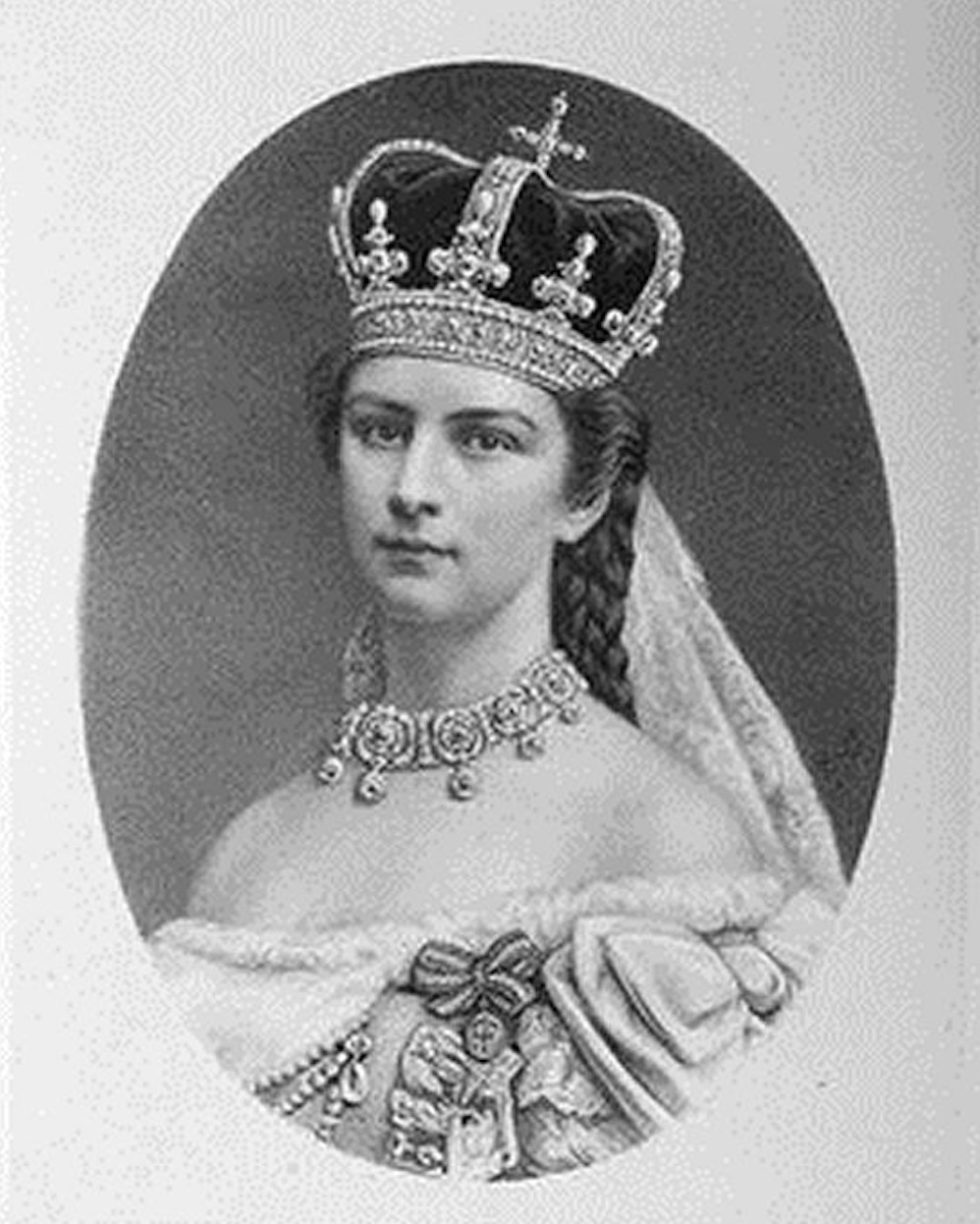
Today marks the 80th Anniversary of the Death of Crown Princess Stéphanie of Austria, who died on this day in 1945! The Belgian Princess who married the Austrian Heir that committed suicide with his mistress, and later married a Hungarian Prince, not much is known about the jewels of the Crown Princess except this striking Chaumet Diamond Tiara!


A magnificent Diamond Tiara composed of a central fleur de lys element, with flanking foliate sprays, the Tiara is rather similar to another Chaumet Tiara made at the turn of the century which does make it unlikely that it is the Tiara given by Emperor Franz Joseph to Princess Stéphanie of Belgium when she married his Heir, Crown Prince Rudolf, in 1881 as has been reported elsewhere, especially because Emperor Franz Joseph almost always patronized Austrian jewellers like Koch or Köchert instead of the French Chaumet.

Princess Stéphanie described wearing a Tiara given as a Wedding Gift by Emperor Franz Joseph on the day of her Wedding to Crown Prince Rudolf, the Heir to the Austro-Hungarian Empire, in 1881.
My wedding dress Made of heavy silver brocade, it was a marvel of beauty; garlands and silver roses were woven into my court train. A long veil of Brussels lace, a gift from the city of Brussels, was held in place with a diamond clasp. Myrtle and orange blossoms interwoven the magnificent tiara that Emperor Franz Joseph had presented to me. At my side, I wore the Order of the Star Cross. It was attached to a diamond mesh, which Empress Maria Theresa had once worn. In my hand, I held the wonderful prayer book in its lace-covered cover, which my mother gave me, as well as the golden, gem-decorated fan of the Brussels ladies, with charming paintings on ivory.

In her memoir, Ich sollte Kaiserin werden (I Was To Be Empress), Crown Princess Stéphanie also remembered wearing a Tiara on a visit to the grand Ottoman Court in Istanbul in 1883.
This time I had put on a grand evening dress. I seem to remember that I was wearing a light blue damask dress that exposed my shoulders; fitted tightly around the waist, it billowed lavishly backward to end in a long train. Again, I had worn a great deal of jewelry; my hair, arranged in long curls, was held back by a tiara.
Perhaps the Sultanieh thought my elegance aroused the Sultan’s interest too much – she suddenly feigned discomfort, stood up, and was about to leave. The Sultan, very uncomfortable, ordered her to return and sit down, which she did grumblingly.
The women of the harem were unveiled. None were tall, beautiful, or slender; all had overly rounded bodies, but they did have beautifully formed small breasts. Their lack of charm, however, was compensated for by their magnificent clothes. Their Turkish costumes, made of heavy, shining silk fabrics, arranged in the most garish colours, were adorned with precious gold and silver embroidery.
The Sultanieh itself was dressed in European style. She wore a silver brocade gown with a long, embroidered train; her jewelry, consisting entirely of diamonds, was magnificent. The Sultan’s family and the rest of the female court wore numerous pearls, diamonds, and other precious stones. Everything glittered and sparkled. It was magical and unique. Only the Orient can offer such a display of luxury and colour.
The Sultan used every opportunity to give me tokens of his affection. The next evening, as I was just about to dress for a grand dinner, he sent me a magnificent diadem in a scarlet velvet case. It was the wonderful stones that had aroused my admiration that sparkled within it.
The joy of my nineteen years was boundless. Only an oriental prince is capable of giving in such a way. Abdul Hamid’s kindness to me knew no bounds—I confess that he treated the Crown Prince more coolly.

Several years after the assassination of Crown Prince in a suicide pact with his teenage mistress, Crown Princess Stéphanie remarried to Prince Lónyay de Nagy-Lónya et Vásárosnamény, a Hungarian nobleman, in 1900, which led to her being disinherited by her father and also renouncing all Imperial Privileges, though Emperor Franz Joseph supported the match and gave his daughter-in-law an annual pension of 100,000 guilders.


Though protocol prevented him from attending, Emperor Franz Joseph also gave the bride a trousseau, which may have included this magnificent ‘Chaumet’ Diamond Tiara worn by Princess Stéphanie in a series of portraits a few years later.


One of the portraits of Crown Princess Stéphanie wearing the Tiara along with suitable Diamond Choker and Stomacher also made it on the cover of Tatler in March 1908.

Despite being estranged from her parents and daughter, Princess Stéphanie and Count (later Prince) Elemér Lónyay of Nagy-Lónya remained happily married and resided in his Oroszvár – Rusovce Castle in Hungary, until the advancing Red Army forced them to flee towards the end of the Second World War.

It is believed that the Chaumet Diamond Tiara was among the items confiscated by the Red Army, but if it did escape with the couple, it was among the things left to the Abbess at Pannonhalma Archabbey, where the former Crown Princess Stéphanie passed away on this day 80 years ago. The current location of the Tiara is unknown but it was likely broken up.